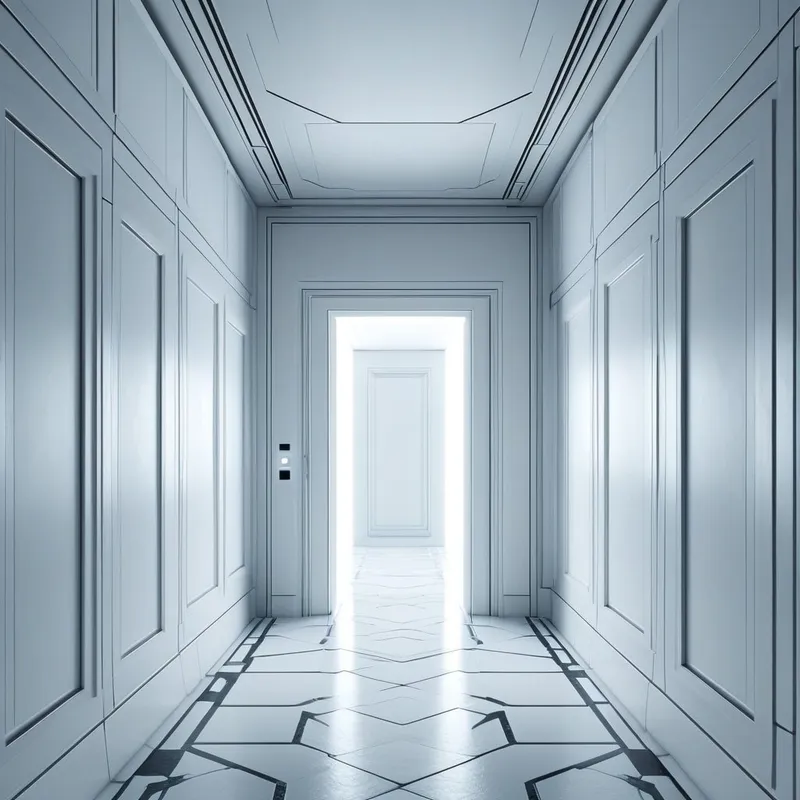
The Dream of Avoidance & Escape: A Somatic Call to Sovereignty
The Somatic Echo
Before the mind can name the fear, the body knows the geometry of escape. It is a low-frequency hum in the marrow, a tectonic pressure building beneath the sternum. The breath becomes shallow, a prisoner in its own cage of ribs, as the shoulders instinctively curve forward, preparing to make the body a smaller target. There is a peculiar, hollow ache in the palms—a phantom memory of pushing against a door that will not give, or of holding nothing when you should be holding your ground. This is not the adrenaline of fight, but the silent, slick mercury of flight. It is the visceral pre-language of a system preparing to dissociate, to make the self ghostly and untouchable. The dream of avoidance begins here, in this somatic whisper, long before it becomes a narrative of locked rooms and endless corridors.
The Dreamer's Log
The dream is always the same: I am in the control room of a vast, derelict station, tasked with maintaining a system I do not understand. Alarms blare—a cascade failure in Sector 7. My console is a sea of crimson glyphs. But instead of addressing it, I find myself meticulously, obsessively, polishing a single, dormant brass gauge on a far wall, my back to the screaming monitors, until the sound fades into a distant, acceptable hum.
This is the alchemy of neglect: the frantic polishing of the irrelevant to transmute the terror of the essential into background noise.

The False Lead
This theme is not a prophecy of external bad luck or a sign of inherent cowardice. To interpret it as such is to mistake the map for the territory. The locked door in the dream is rarely a literal obstacle in waking life; the pursuing shadow is not a specific person. These are the psyche’s brilliant, desperate metaphors for an internal confrontation that has been deemed unbearable. The dream is not showing you what you are running from in the world, but what you are refusing to meet within yourself—a grief, a truth, a power, or a responsibility that feels like it would annihilate the current configuration of “you.” Avoidance dreams are not failures of character; they are precise diagnostics of a boundary between who you have been and who you are being called to become.
Psychological Architecture
Beneath the dream of escape lies the Shadow work of the Unlived Life. Individuation—the process of becoming whole—requires the conscious assimilation of parts of ourselves we have exiled for being too messy, too powerful, too vulnerable, or too demanding. Avoidance is the defense mechanism of a fragile ego-structure, a castle built on sand that knows a tidal truth is coming. The psyche, in its infinite wisdom, will not allow this exile to continue indefinitely. It sends emissaries in the form of dreams.
These dreams stage the conflict. The part of you that wants to flee (the Orphan, the Child) is in a silent civil war with the part of you that knows you must stand and meet what comes (the Sovereign, the Adult). This is not a battle to be won, but a dialogue to be initiated. The “escape” is the ego’s attempt to preserve a familiar, if limiting, identity. The locked room is the very boundary of that identity. The work is to turn, in the dream and in the waking life, and to place your hand not on the fleeing foot, but on the locked door. To feel its texture. To ask it what it protects, and what it imprisons.
Mythic Resonance
We see this eternal dance in the myth of the Garden of Eden. The first human act after eating the fruit of knowledge is not celebration, but concealment. “I heard you in the garden, and I was afraid because I was naked; so I hid.” This is the primordial dream of avoidance: the sudden, searing awareness of a new reality (consciousness, vulnerability, responsibility) and the immediate, instinctive retreat into the underbrush of shame and denial. The expulsion from Eden is not merely a punishment, but the inevitable consequence of choosing hiding over facing—the world of toil and consequence becomes the inescapable “dreamscape” where the avoided reality must now be lived.
Similarly, the story of Lot’s wife fleeing Sodom is not about a punitive glance backward, but a catastrophic failure of the alchemical process. The instruction was “Escape for your life. Do not look back.” But the unintegrated past, the life left behind, holds a magnetic, paralyzing grief. To flee without integrating the loss is to become a pillar of salt—a monument to frozen avoidance, forever fixed in the moment of traumatic escape, unable to move into the new future.
Symbolic Nodes
- Locked Doors/Windows: The perceived boundary of the possible self.
- Endless Corridors/Spinning Rooms: The futile, looping logic of the avoidance mindset.
- Broken Vehicles/Missed Transport: The perceived failure of one's own agency or timing.
- Being Buried/Alive Entombment: The suffocating weight of deferred decisions or unexpressed truth.
- Fog/Blizzard/Visual Obstruction: The conscious mind's obscuration of a painful clarity.
- Forgotten Passcodes/Unrecognizable Maps: The disconnection from one's own inner guidance system.
Archetypal Resonance
The energy humming at the core of the Avoidance & Escape dream is that of The Shadow Orphan. This is not the resilient Orphan who learns to navigate a difficult world, but its shadow twin: the Victim, forever awaiting rescue, and the embodiment of Self-Pity, who believes the world is too harsh to face directly. Its somatic echo is that collapsed posture, the shallow breath of one who feels fundamentally unsupported. Its core belief is “I cannot handle this,” and so it orchestrates the entire dreamscape to prove itself right—creating labyrinths with no exit, authorities who cannot help, and tools that fail. Yet, within this archetype lies the alchemical potential: the raw, unmet need for safety and belonging. The transmutation begins when the dreamer stops running from the pursuing shadow and turns to ask the Orphan within, “What do you need so that we can face this together?”
The Alchemical Process
The transmutation of Avoidance into Sovereignty requires the heat of conscious containment. This is the opposite of escape. It is the voluntary act of staying present with the very somatic echo—the tight chest, the trembling—that screams for dissociation. Imagine the avoided truth not as a monster, but as a trapped, wild frequency within your own nervous system. The alchemical vessel is your mindful, embodied awareness.
The process is one of pressure and revelation. First, you must cease the frantic polishing of the brass gauge (the distractions). You must turn and face the crimson console (the avoided reality). The pressure is the sustained, compassionate gaze upon that which you have labeled “unbearable.” As you hold it in awareness, without fleeing into thought or action, a separation occurs. You are not the panic; you are the space holding the panic. You are not the grief; you are the witness to the grief. This is the solve—the dissolving of the identification with the avoided content. Then comes the coagula—the restructuring. The energy once used for fleeing is reclaimed. It becomes the solid ground under your feet, the steady breath in your lungs, the unwavering voice that can finally say, “I am here. I see you. We will not turn away.”

The Integration Protocol
Question 1: In the dream, what is the precise moment I choose flight? What is the quality of the silence, the texture of the fear, in the heartbeat before I run?
Question 2: If the thing I am avoiding (the pursuer, the alarm, the locked door) were not a threat, but a forgotten part of myself trying to deliver a message, what would that message be?
Question 3: Where in my waking life do I "polish the brass gauge"—engaging in meticulous, ultimately irrelevant activity to drown out a quieter, more important call for my attention?
Action 1 (Somatic Anchoring): When you feel the old, familiar urge to mentally flee a difficult feeling, stop. Place both feet flat on the floor. Press down. Feel the solidity. Breathe into the very center of the physical tension for three full cycles. You are not trying to change it, only to acknowledge its location in the vessel of your body.
Action 2 (Unsent Letter): Write a letter from the perspective of the thing you are avoiding—the locked door, the alarm, the pursuing shadow. Let it speak. What does it want? Why has it come? Do not censor. Use your non-dominant hand if it helps bypass the inner critic. Burn or bury the letter as a ritual of receipt.
Action 3 (Threshold Marking): Identify one small, tangible "avoided action" in your life (a difficult conversation, a neglected task, a creative project). Physically approach the space where it would happen. Stand at the threshold. Do not do the thing. Simply stand there for five minutes, feeling the entire somatic response—the desire to flee, the anxiety, the stories. You are retraining your system that presence at the threshold is an option stronger than escape.
Final Validation
It is human to want to flee the furnace. To see the alchemical fire and call it only destruction. The dreams of escape are testaments to how deeply you have felt, how much you have carried, and how intelligent your protections have been. They were necessary for a time. Honor that. And then, know this: the very awareness that feels like a trap is the beginning of your freedom. The door is not locked to keep you in; it is waiting for you to recognize that you, and only you, hold the architecture of the key within your own turned gaze. The escape ends the moment you stop running from the shadow and realize you are running from the source of your own light. Stand. Breathe. Turn. The corridor ends where you choose to build your altar.