
The Dream of the Artistic Filter: Re-Visioning the Self
The Somatic Echo
It begins not as an image, but as a pressure behind the eyes. A subtle, persistent strain, as if the world is being viewed through a pane of warped glass you forgot was there. The body registers a dissonance—a faint nausea in the gut, a tightness across the shoulders—long before the mind can articulate the problem. You feel the weight of an unseen lens, a pre-installed aperture that dictates what light is allowed in and what shape it must take. This is the somatic echo of the Artistic Filter: the visceral sensation of perception itself being curated, of your native sight being gently, insistently, overridden. It is the ache of an authentic impulse meeting an internal censor, a grief for a color you can sense but not see, a melody you can feel but not hear. Your nervous system knows the truth before you do: you are experiencing reality through a borrowed, ill-fitting frame.
The Dreamer's Log (Case Vignette)
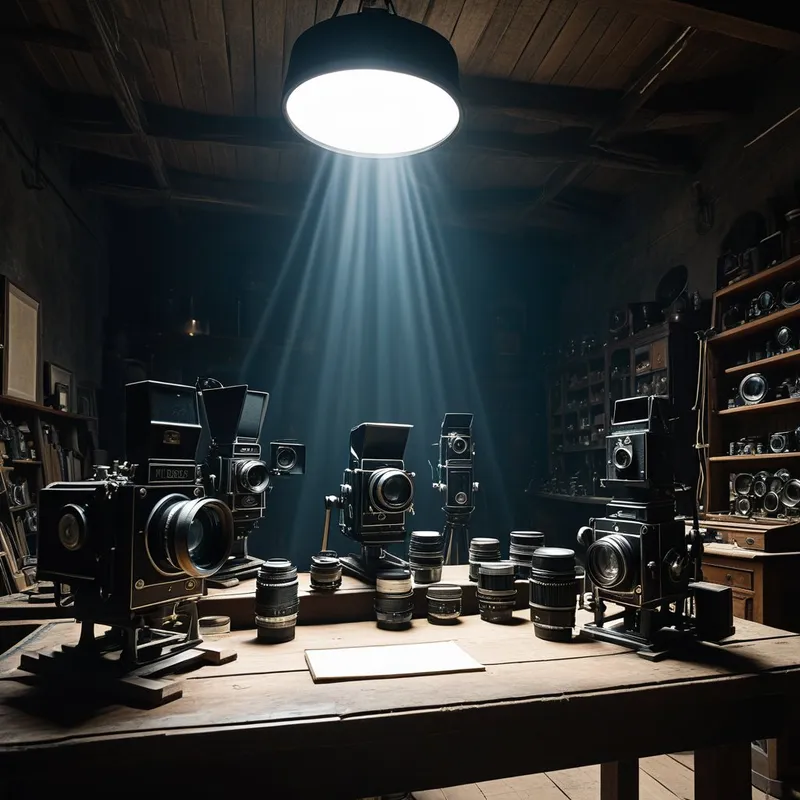
In the dream, I am in a vast, silent darkroom. My hands work under a dim red safelight, developing photographs from a roll of film I don’t remember shooting. As each image swims into being in the chemical bath, I see they are all of the same simple, beautiful seashell. But each print is ruined—smeared with garish Instagram filters, overlaid with tacky digital stickers, or crudely cropped into meaningless squares. I feel a profound, sinking despair. I just want to see the shell as it is.
Here, the soul’s raw, captured experience (the film) is automatically processed through layers of contemporary, mass-market distortion, obscuring the innate, organic beauty of the subject. The alchemical interpretation: The psyche is mourning the corruption of its primal, unfiltered impressions by the internalized expectations of a performative culture.
The False Lead
This is not a dream about creative block, nor is it merely a commentary on social media fatigue. To mistake it for such is to stay on the surface. The Artistic Filter is not the absence of inspiration, but the presence of a foreign inspiration—a borrowed aesthetic, an adopted voice, a inherited standard of what is "beautiful," "profound," or "acceptable." It is not about having nothing to say; it is about hearing your own true voice drowned out by a chorus of shoulds and coulds. The terror here is not of emptiness, but of inauthenticity so complete it feels like identity. The grief is for a self you intuit but have never been permitted to fully witness.
Psychological Architecture
The work here is Shadow work of the most intimate kind: the reclamation of personal perception from the collective gaze. We are born into a world already furnished with interpretations. Family systems, cultural norms, educational paradigms, and social algorithms all contribute to the construction of this internal filter—a complex, often unconscious, lens through which we not only view the world, but more crucially, through which we view our own interiority. The Individuation process activated by this dream is a deliberate, often painful, dismantling of this apparatus. It asks: Which parts of my taste, my judgment, my aesthetic longing, are authentically mine? Which are the internalized voices of a parent, a critic, a trend, a tribe? To confront the Artistic Filter is to enter the darkroom of the soul and develop the negatives of your conditioning, to see the ghostly imprints of other people’s visions on the photographic paper of your own psyche.
Mythic Resonance
We see this eternal struggle in the tale of Psyche and her tasks. Aphrodite, jealous of Psyche's mortal beauty, sets her impossible labors. One is to sort a massive, chaotic pile of mixed grains—wheat, barley, millet, poppy—into separate, perfect mounds before nightfall. It is a task designed for failure, a demand for inhuman, meticulous filtering. Psyche’s authentic despair is met not by her own force of will, but by an act of grace: a colony of ants takes pity and performs the sorting for her. The myth tells us that the initial, overwhelming work of distinguishing the true seeds of the self from the chaff of external expectation can feel impossible to the conscious ego alone. It requires the intervention of the instinctual, collective, and deeply patient life of the soul (the ants) to begin the sorting. The filter imposed by the goddess (the cultural ideal of beauty and worth) must be circumvented by a more ancient, earthy intelligence.
Symbolic Nodes
- Damaged or distorted lenses (cracked glasses, smeared camera filters, warped mirrors).
- Pre-processed or adulterated materials (pre-sliced bread, canned food, auto-tuned music, AI-generated art).
- Uniformity imposed on organic diversity (a garden where all flowers are forced to be the same color, a choir singing in perfect, soulless unison).
- Being forced to use a specific, clumsy tool to perform a delicate task.
- Trying to paint with mud, or write with a fading, borrowed pen.
Archetypal Resonance
The energy at the core of the Artistic Filter dream is that of The Shadow Creator.
The Shadow Creator is not inactive; it is hyper-active, but in service to a false or external blueprint. It is the part of us that builds elaborate facades, that expertly mimics trends, that produces work designed for applause rather than authenticity. Its core energy is a profound disorientation of source. Where the integrated Creator draws from the deep well of the Self, the Shadow Creator is a brilliant forger, adept at applying the filters, styles, and techniques that have been deemed valuable by others. The somatic echo of strain and dissonance is the body’s rebellion against this forgery. The alchemical potential lies in the moment the forger grows weary of its own impeccable copies, and in that exhaustion, begins to listen for the faint, unfamiliar pulse of its own original rhythm. The crisis of the Artistic Filter is the Shadow Creator’s necessary burnout, the precursor to discovering a true, and perhaps quieter, voice.
The Alchemical Process
The transmutation here is from Mimicry to Signature. The prima materia is the accumulated sludge of adopted styles, borrowed convictions, and performed emotions. The alchemical vessel is the conscious, grieving self who recognizes the filter as a filter. The required heat is the intense, uncomfortable pressure of creative abstinence—the voluntary cessation of producing anything for an external eye. This is the nigredo, the blackening. It is a descent into the seeming void where the old filters no longer function and the new vision has not yet formed. The pressure is the anxiety of silence, the fear of being "unproductive," the grief for a lost, if false, identity as a "creator" in the world's eyes.
Within this heat, dissolution occurs. The composite elements of the borrowed aesthetic—the color palettes, the narrative tropes, the philosophical poses—begin to separate. This is the albedo, the whitening, the washing. You see the components of your perception laid bare, recognizing them as distinct from the core of your sensing. The coagulation, the rubedo, is the slow, patient gathering of the few, simple, undeniable impulses that remain when all else is stripped away: the attraction to a certain quality of shadow, the resonance with a specific rhythm of words, the love for a shape that has no name. This becomes your signature—not a style applied, but a perception lived.
The Integration Protocol
Question 1: When you feel the impulse to create or express something, what is the very first, fleeting image or sensation that arises before you mentally "edit" it to make it more interesting, acceptable, or impressive?
Question 2: Can you identify a specific "filter" you inherited? (e.g., "All real art must be difficult and obscure," "Beauty must be pretty and calming," "To be taken seriously, I must sound like X authority").
Question 3: Where in your body do you feel a "yes" of authentic resonance, and where do you feel a "no" of imposed obligation when you consider your own creative work or taste?
Action 1 (The Unseen Collection): For one week, carry a small notebook. Do not write opinions, stories, or poems. Only record raw, unfiltered sensory impressions: "The rust stain on the wall looks like a continent." "The sound of the fridge motor is a B-flat." Do not share these. This rebuilds the connection between perception and record, bypassing the internal editor.
Action 2 (The Ritual of Erasure): Find an old piece of your own writing, a drawing, or even a social media post. Print it or redraw it. Then, with a pen or paint, deliberately and slowly obscure 70% of it. Black it out, smear it, tear it. Your task is not to create a new piece, but to actively, physically destroy the old form. Witness the fragments that remain and feel which, if any, still hold essential truth.
Action 3 (The Medium of Incompetence): Choose an artistic medium you have no skill in and believe you have "no talent" for (e.g., if you're a writer, try clay; if you're a painter, try dance). Spend 30 minutes engaging with it with the explicit goal of producing something "bad" or "childish." The goal is to re-inhabit the primal, pre-filtered state of expression where the judgment of quality is irrelevant, and only the gesture of making exists.
Final Validation
To dream of the Artistic Filter is to confront a profound and sophisticated suffering: the agony of being exiled from your own senses. It is a lonely and disorienting grief. Honor that difficulty. This dream does not come to the shallow seeker; it arrives when the soul has matured enough to detect the forgery within its own palace. The very pain of the distortion is the proof of your innate capacity for the pure signal. Your despair is the footprint of your authenticity, left in the mud of conditioning. The filter, once seen, can no longer function as truth. It becomes simply material—another lens available for your use, not your master. You are not being asked to destroy your creativity, but to finally, after a long apprenticeship to ghosts, become its sole and sovereign source.