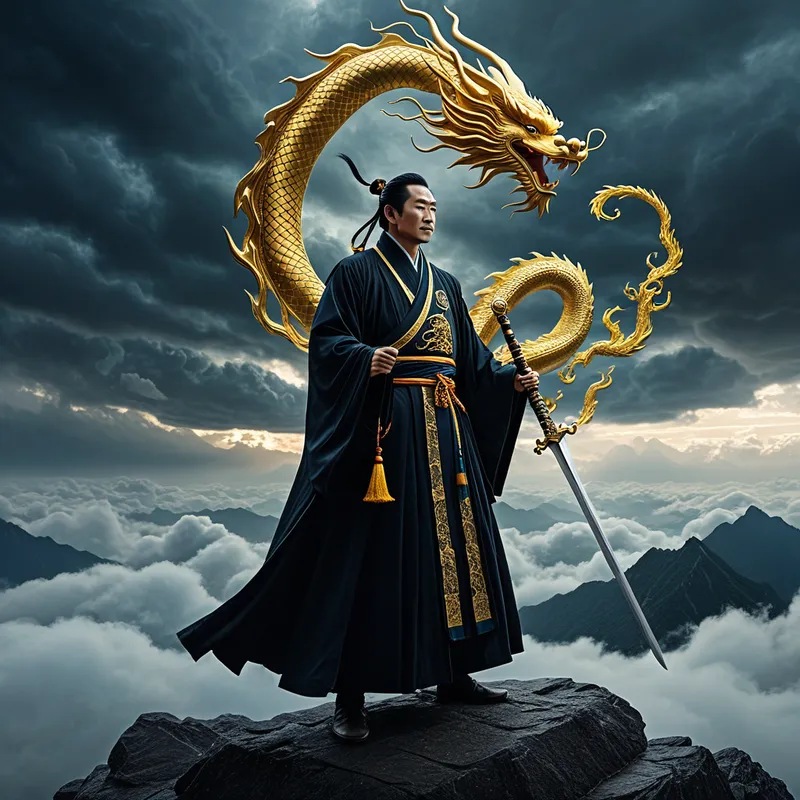
Zhang Daoling Myth Meaning & Symbolism
A scholar's quest for immortality leads to a celestial pact, founding a religious order to battle primordial chaos and establish a sacred covenant with the divine.
The Tale of Zhang Daoling
In the twilight of the Han Dynasty, when the empire frayed at its edges and the world seemed to slip into shadow, there was a scholar named Zhang Daoling. He was a man of letters, yet the words of the sages felt like dry leaves in his hands, offering no sustenance for the soul’s deep hunger. He turned his back on a promising career, his heart a hollow vessel echoing with a single question: where is the Way that grants life beyond decay?
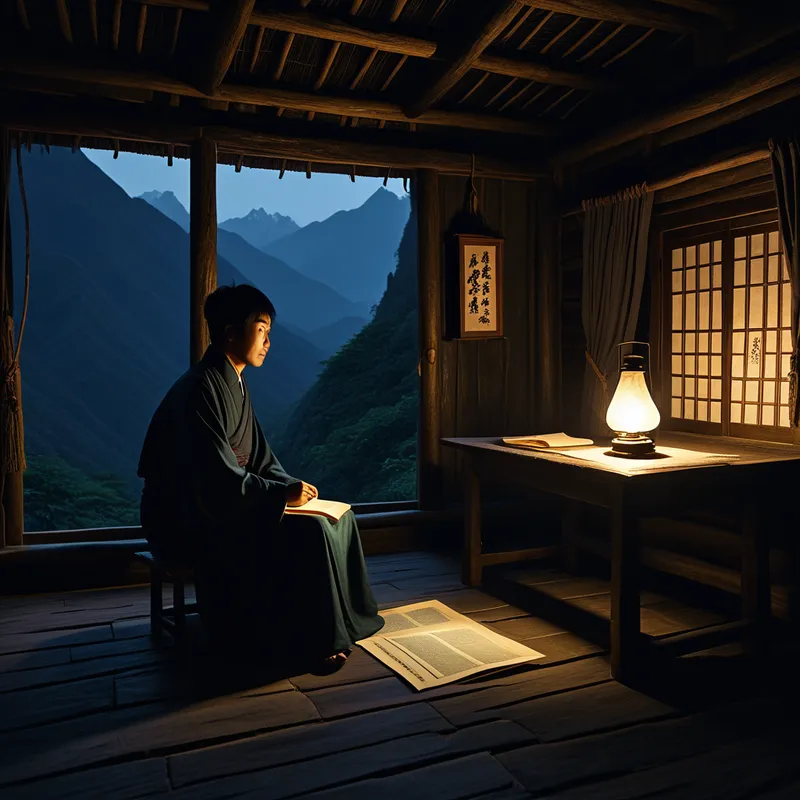
His feet carried him to the wilds of Mount Heming. Here, the air was thick with the scent of pine and possibility. He built a humble hut of earth and wood and entered a vigil of purification, fasting from grain, chanting the Daodejing, and refining his spirit through breath and stillness. For years, he was a silhouette against the mountain, a patient question mark posed to the silent heavens.
Then, the silence broke.
It was not with a gentle whisper, but a descent of thunderous light. The Most High Lord Lao appeared, not as an old man on an ox, but as a pillar of celestial fire and profound authority. The mountain itself seemed to bow. “The world drowns in the Six Heavens of Demonic Pneuma,” the voice intoned, a sound that vibrated in the marrow of Zhang’s bones. “The old covenants are broken. Chaos feeds on the people’s fear. You shall establish a new covenant.”
Into Zhang Daoling’s trembling hands, Lord Lao bestowed the instruments of this cosmic mandate: the Zheng Yi Jian, its blade inscribed with constellations; the San Tian Zheng Yi Zhi Yin, heavy with the weight of heaven’s promise; and a collection of talismans, diagrams, and registers—the very blueprints for a new celestial bureaucracy.
Armed with this divine commission, Zhang Daoling descended from the mountain, no longer just a scholar, but the first Tianshi. He confronted the world’s sickness directly. Where plagues festered, he drew talismans in cinnabar, burning them to purify the water. Where malevolent ghosts and shanziao tormented villages, he wielded his sword not of steel, but of pure yang energy, binding them with celestial law. He did not destroy them utterly; he subjugated them, enlisting them into the service of the new order. The people, seeing the chaos recede before this quiet, potent authority, came to him in multitudes. He organized them into the Zhengyi Mengwei, a community bound by moral precepts and a shared spiritual treasury. For the pledge of five pecks of rice, they entered a covenant, a mutual pact of healing and order between heaven, earth, and humanity.
His final act was one of sublime fulfillment. Having established the covenant on earth, having transmitted his texts and authority to his son, Zhang Heng, he ascended the mountain once more. At its peak, in a blaze of light witnessed by his disciples, he and his wife shed their mortal forms. Two cranes took wing from the summit, spiraling upwards until they vanished into the sun-drenched clouds, leaving behind only his robes, his sword, and his seal—the tangible anchors of a revolution that began not with an army, but with a single, resonant question in the heart of a seeker.
Cultural Origins & Context
The myth of Zhang Daoling is the foundational narrative of organized religious Taoism, emerging from the turbulent period between the 1st and 2nd centuries CE. It is not a folktale, but a sacred history, a myth of origins for the Tianshi Dao. It was propagated by the religious organization itself, a core part of its liturgical and teaching tradition, used to legitimize its authority, its rituals, and its hierarchical structure.
Societally, the myth functioned as a powerful response to crisis. The late Han Dynasty was a time of political corruption, natural disasters, and widespread social anxiety. The myth offered a potent solution: chaos is not fate, but a correctable imbalance. It positioned the Celestial Master not as a rebel against the empire, but as the founder of a parallel, spiritual governance that could restore harmony where earthly rule had failed. The “five pecks of rice” was both a practical economic foundation for the community and a symbolic token of entry into this new cosmic order, offering common people direct access to divine protection and a structured path to salvation.
Symbolic Architecture
At its core, the myth of Zhang Daoling is a profound drama of establishing cosmic and psychological order.
The scholar’s despair represents the ego’s realization that conventional knowledge and social structures are insufficient for the soul’s needs. The ascent to Mount Heming is the critical withdrawal from the collective, the journey into the inner wilderness of the unconscious.
The revelation on the mountain is not a gift, but a terrifying burden of consciousness. It is the moment the psyche recognizes its own responsibility to confront the inner chaos it has ignored.
Lord Lao represents the archetypal Self, the ultimate source of meaning and authority within. The bestowed instruments—sword, seal, talismans—are symbols of differentiated psychic functions: the sword is discriminative insight that cuts through confusion; the seal is the stamp of authentic, individual identity; the talismans are the specific, creative formulations (art, writing, rituals) that can reorganize psychic energy.
The Six Heavens symbolize the undifferentiated, autonomous, and often pathological complexes of the unconscious—our raw fears, compulsions, illnesses, and destructive patterns. Zhang Daoling’s work is not to exterminate them, but to subdue and integrate them into a personal system of order. He makes the demons take an oath; he turns chaotic energy into bound service.
The Dreamer’s Resonance
When this myth stirs in the modern unconscious, it often manifests in dreams of confronting overwhelming, formless anxiety or systemic “sickness” in one’s life. One might dream of a house infested with shadowy, decaying presences (the demonic pneuma), of being offered a corrupt bureaucratic contract (the old, broken covenants), or of finding a strange, powerful tool or book in a time of crisis (the celestial implements).
Somatically, this can coincide with a feeling of being “plagued” by unexplained fatigue, illness, or a sense of pervasive disorder. Psychologically, the dreamer is at the precipice of the “mountain ascent.” The ego is being called to cease being a passive victim of internal and external chaos and to seek, through disciplined introspection (the fast, the meditation), a foundational revelation. The dream is a nudge toward the terrifying, empowering realization: you must become the authority in your own inner realm.
Alchemical Translation
The myth models the alchemical process of individuation—the forging of a coherent, authentic Self from the raw materia of the psyche.
The Nigredo (Blackening): This is Zhang Daoling’s initial despair and withdrawal. It is the necessary dissolution of the old, outworn identity (the scholar-official) and confrontation with the shadowy, chaotic contents of the personal and collective unconscious.
The Albedo (Whitening) & Rubedo (Redening): The celestial revelation is the albedo, the illuminating insight from the Self. The receipt of the tools is the beginning of the rubedo, the long, arduous work of integration. Each act of “healing” or “binding a demon” in the myth corresponds to the modern task of confronting a complex—a pattern of anger, a core wound, a addictive behavior—not by denying it, but by understanding its origin, “naming” it, and consciously redirecting its energy.
The covenant of the five pecks of rice is the ultimate alchemical goal: the establishment of a lasting, reciprocal relationship between the conscious ego and the guiding Self. The “rice” is the ongoing sacrifice of egoistic will, the commitment of personal effort, paid in exchange for inner order and meaning.
Finally, the ascension as cranes signifies the transcendent function achieved. The mortal, ego-bound perspective is fully transcended. What is left behind—the robes, sword, and seal—are the enduring structures of the psyche: the mature personality, the discerning intellect, and the authentic symbol of Self, now fully operational in the world. The individual is no longer ruled by chaos, but is a vessel and administrator of a self-created, sacred order.
Associated Symbols
Explore related symbols from the CaleaDream lexicon: