Zeus transforming into a cuckoo Myth Meaning & Symbolism
The King of Gods transforms into a vulnerable cuckoo to win Hera's compassion, revealing the paradox of power and the necessity of disguise for true connection.
The Tale of Zeus transforming into a cuckoo
The air on Mount Thornax was thick with the scent of wild [thyme](/myths/thyme “Myth from Greek culture.”/) and impending storm. Here, far from the glittering chaos of Olympus, the Queen sat in solitary majesty. Hera’s gaze was turned inward, a fortress of resolve built from centuries of witnessing her lord’s infidelities. She had withdrawn, a tectonic silence more powerful than any [thunderclap](/myths/thunderclap “Myth from Various culture.”/). The very landscape held its breath.
He who shakes [the earth](/myths/the-earth “Myth from Hindu culture.”/) with his step now approached not as a conqueror, but as a strategist of the heart. Zeus, the cloud-gatherer, beheld her from the veils of [the sky](/myths/the-sky “Myth from Persian culture.”/). He knew brute force, the flash of lightning, the boom of authority—these were keys that had long failed to turn the lock of her wounded sovereignty. A deeper, more cunning magic was required. To win the Queen, he must cease to be the King.
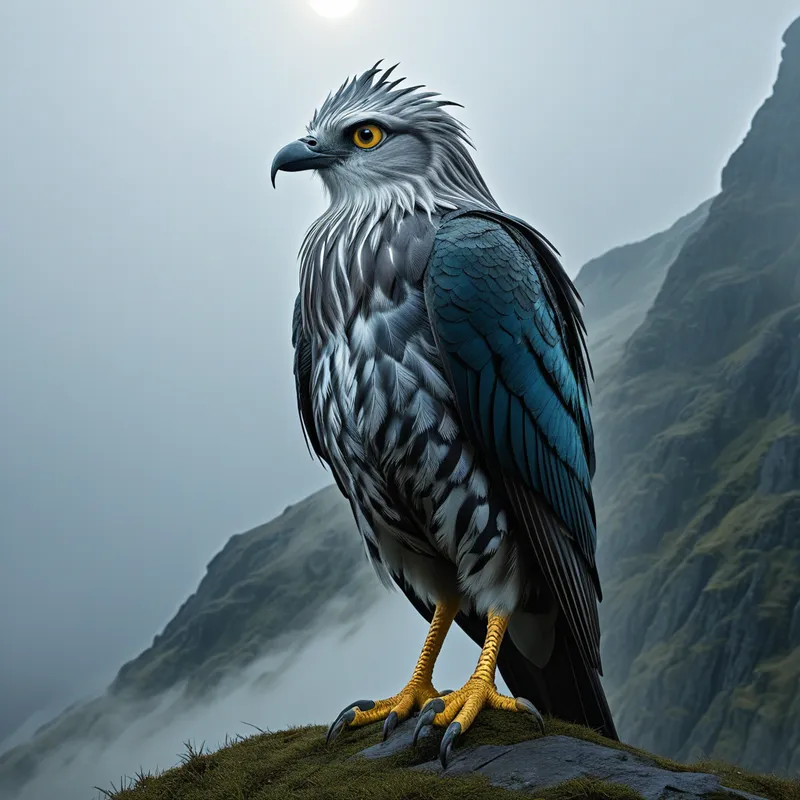
And so, the most powerful force in the cosmos performed an act of supreme vulnerability. The air crackled, not with fury, but with a strange, soft compression. The towering form of the god dissolved, not into nothingness, but into a lesser, fragile something. His boundless sky-blue essence condensed into damp, grey feathers. His thunderous voice softened to a plaintive, repeating call. Where the Father of Gods and men had stood, now huddled a small, storm-coloured cuckoo, its wings bedraggled by a sudden, manufactured squall. It was a perfect portrait of pitiable distress.
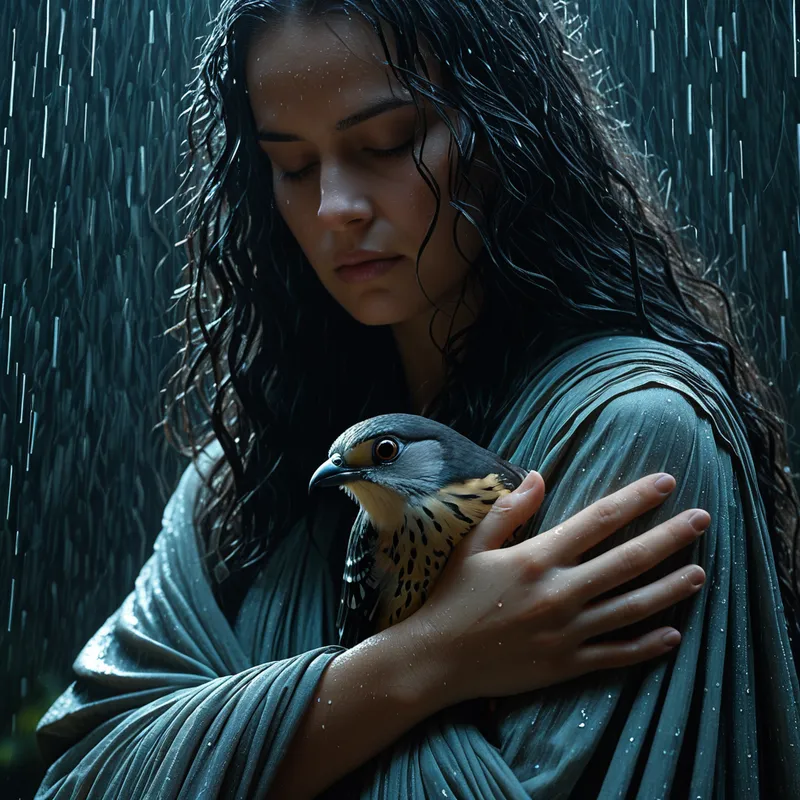
Driven by the tempest it seemingly fled, the bird fluttered weakly toward Hera’s secluded perch. It collapsed at her feet, a tiny bundle of trembling life, rainwater beading on its feathers. The goddess looked down. Her stern expression, carved from betrayal, did not soften, but it did deepen. Here was a paradox: a creature of the air, mastered by the sky’s own violence. A spark of compassion, that divine maternal fire that was core to her nature, was ignited. She did not smile, but she leaned forward. With hands that could fashion the constellations of marriage, she gently gathered the shivering bird, lifting it to the warmth of her bosom, offering sanctuary against the cruel chill.
It was in that moment of compassionate shelter that the transformation reversed. The fragile form in her hands began to swell, the feathers melting into the familiar, formidable flesh of the god. Before she could cast him away, he had already encompassed her. The trap of pity had sprung. From her own act of mercy, he remade the situation entirely. He laughed, not with mockery, but with the [triumph](/myths/triumph “Myth from Roman culture.”/) of a gambler who has played the perfect hand. The storm cleared as quickly as it had come. His persuasion was now complete, not through dominance, but through a sacred deception that appealed to her deepest essence. There, on the mountain sacred to her, their union was reconsecrated, born from the strange, fertile soil of disguise and unexpected care.
Cultural Origins & Context
This myth, preserved for us most notably in the works of the geographer Pausanias, was not merely a folktale. It was a sacred narrative, an aition, intimately tied to the cult of Hera. At her great sanctuary at Argos, and particularly at her shrine on Mount Thornax (later known as Cuckoo Mountain), cult statues depicted Hera holding a scepter topped with a cuckoo. The myth explained this ritual symbol.
Told and retold in ritual contexts, likely by priests and poet-priests, its function was multifaceted. For a patriarchal society, it humorously validated Zeus’s ultimate authority and cunning. Yet, for the female devotees of Hera, it carried a profound and complex message. It did not shy from depicting the tensions of divine (and by reflection, human) marriage—the strife, the withdrawal, the negotiations for power. It showed Hera not as a passive victim, but as a powerful entity whose compassion is a force so potent that even the King of Gods must disguise himself as vulnerable to access it. The myth sanctioned her worship as a goddess of marriage by dramatizing its foundational, often paradoxical, compromises: the interplay of strength and vulnerability, strategy and surrender.
Symbolic Architecture
At its core, this myth is a masterclass in the [symbolism](/symbols/symbolism “Symbol: The use of symbols to represent ideas or qualities, often conveying deeper meanings beyond literal interpretation. In dreams, it’s the language of the unconscious.”/) of necessary deception and the [alchemy](/symbols/alchemy “Symbol: A transformative process of purification and creation, often symbolizing personal or spiritual evolution through difficult stages.”/) of opposites. Zeus, the archetypal principle of sky, [consciousness](/symbols/consciousness “Symbol: Consciousness represents the state of awareness and perception, encompassing thoughts, feelings, and experiences.”/), order, and raw power, must descend. He must incarnate as his apparent opposite: a small, vulnerable, [earth](/symbols/earth “Symbol: The symbol of Earth often represents grounding, stability, and the physical realm, embodying a connection to nature and the innate support it provides.”/)-bound [creature](/symbols/creature “Symbol: Creatures in dreams often symbolize instincts, primal urges, and the unknown aspects of the psyche.”/) dependent on mercy. The [cuckoo](/symbols/cuckoo “Symbol: A bird symbolizing deception, time, and unexpected change, often representing intrusion or displacement.”/) is the perfect [vessel](/symbols/vessel “Symbol: A container or structure that holds, transports, or protects something essential, representing the self, emotions, or life journey.”/) for this ruse.
The supreme power achieves its aim not by assertion, but by apparent abdication. The ruler must become the supplicant.
The cuckoo itself is a potent [symbol](/symbols/symbol “Symbol: A symbol can represent an idea, concept, or belief, serving as a powerful tool for communication and understanding.”/) of displacement and borrowed nurture. Its well-known habit of laying eggs in other birds’ nests mirrors Zeus’s “laying” his true [identity](/symbols/identity “Symbol: Identity represents the sense of self, encompassing personal beliefs, cultural background, and social roles.”/) into the “[nest](/symbols/nest “Symbol: A ‘nest’ symbolizes safety, home, and the nurturing aspects of personal and familial connections.”/)” of Hera’s [compassion](/symbols/compassion “Symbol: A deep feeling of empathy and concern for others’ suffering, often involving a desire to help or alleviate their pain.”/). It represents the outsider, the [trickster](/symbols/trickster “Symbol: A boundary-crossing archetype representing chaos, transformation, and the subversion of norms through cunning and humor.”/) element that insinuates itself into a closed [system](/symbols/system “Symbol: A system represents structure, organization, and interrelated components functioning together, often reflecting personal or social order.”/) to ensure its own survival and [legacy](/symbols/legacy “Symbol: What one leaves behind for future generations, encompassing values, achievements, possessions, and memory.”/). Psychologically, this represents the often-uncomfortable [truth](/symbols/truth “Symbol: Truth represents authenticity, honesty, and the quest for knowledge beyond mere appearances.”/) that our conscious, ruling ego cannot integrate new wholeness by force alone. It must temporarily dissolve, adopting the guise of a wounded, needy, or shadowy part of the [psyche](/myths/psyche “Myth from Greek culture.”/) (the vulnerable cuckoo) to gain the [attention](/symbols/attention “Symbol: Attention in dreams signifies focus, awareness, and the priorities in one’s life, often indicating where the dreamer’s energy is invested.”/) and care of the inner other—the [anima](/symbols/anima “Symbol: The feminine archetype within the male unconscious, representing soul, creativity, and connection to the inner world.”/), the [soul](/symbols/soul “Symbol: The soul represents the essence of a person, encompassing their spirit, identity, and connection to the universe.”/), or in Hera’s [case](/symbols/case “Symbol: A case often signifies containment, protection of personal matters, and the need for organization in one’s life.”/), the powerful inner feminine principle of relatedness, commitment, and containment.
Hera’s act of sheltering the [bird](/symbols/bird “Symbol: Birds symbolize freedom, perspective, and the connection between the earthly and spiritual realms, often representing the soul’s aspirations or personal growth.”/) is equally symbolic. It represents the [moment](/symbols/moment “Symbol: The symbol of a ‘moment’ embodies the significance of transient experiences that encapsulate emotional depth or pivotal transformations in life.”/) when [the principle](/symbols/the-principle “Symbol: A fundamental truth, law, or doctrine that serves as a foundation for a system of belief, behavior, or reasoning, often representing moral or ethical standards.”/) of [structure](/symbols/structure “Symbol: Structure in dreams often symbolizes stability, organization, and the framework of one’s life, reflecting how one perceives their environment and personal life.”/), law, and wounded dignity (Hera) opens to the disguised, vulnerable [aspect](/symbols/aspect “Symbol: A distinct feature, quality, or perspective of something, often representing a partial view of a larger whole.”/) of the dynamic principle (Zeus). Her compassion is the catalyst that allows the transformation back into union. The embrace is not of the tyrannical [king](/symbols/king “Symbol: A symbol of ultimate authority, leadership, and societal order, often representing the dreamer’s inner power or external control figures.”/), but of the pitiful creature, yet it results in the return of the king in a new context—one of intimacy rather than [distance](/symbols/distance “Symbol: Distance in dreams often symbolizes emotional separation, unattainable goals, or the need for personal space and reflection.”/).
The Dreamer’s Resonance
When this mythic pattern stirs in the modern dreamer, it signals a critical juncture in relationship—to another person, or more commonly, to an inner dynamic. To dream of being a powerful figure who turns into a small, overlooked animal indicates a psyche instructing [the ego](/myths/the-ego “Myth from Jungian culture.”/) to relinquish control. The ego’s direct, forceful approaches have failed. The dream advises a strategy of vulnerable appeal, of showing need rather than strength.
Conversely, to dream of nurturing a seemingly helpless creature that then transforms into something formidable—a partner, a long-repressed emotion, a sudden responsibility—speaks to the Hera process. It is the somatic and psychological experience of having one’s compassion, boundaries, or care “invaded” or fundamentally altered by what one has taken in. There is a feeling of surprise, of a pact made under false pretenses that nevertheless leads to a new and binding union. The dreamer may feel a sense of psychic marriage, where two previously warring or separate parts of [the self](/myths/the-self “Myth from Jungian culture.”/) (perhaps the drive for sovereignty and the drive for connection) are forced into a new, intimate negotiation.
Alchemical Translation
The alchemical journey mirrored here is the conjunctio oppositorum—[the sacred marriage](/myths/the-sacred-marriage “Myth from Various culture.”/) of opposites. For the individual seeking individuation, the myth models the non-linear path to inner union.
The gold of the Self is not forged in the furnace of unwavering will, but in the hidden crucible of strategic vulnerability.
The conscious mind (Zeus) cannot simply command the soul (Hera) into integration. The soul, like Hera, is often righteously alienated by the ego’s past transgressions—its neglect, its infidelities with fleeting passions and distractions. To win the soul back, the ego must undergo a voluntary humiliation. It must transmute its leaden pride into the guileful gold of the cuckoo’s disguise. It must present itself to the soul not in its armor of achievements and rationality, but in its naked need, its storm-tossed fragility.
This is the alchemical dissolutio—the dissolving of the hardened, kingly form. When the soul, moved by its innate nature to care and relate, gathers this vulnerable aspect, the final transmutation occurs. The embraced vulnerability expands back into consciousness, but now it is a consciousness informed by and bonded to the soul. The result is not Zeus alone on his throne, nor Hera alone on her mountain, but a reconsecrated union. For the modern individual, this translates to those moments when we stop trying to fix or force an inner change and instead, with cunning honesty, expose our helplessness in the face of it. In that exposure, often disguised as failure or need, the compassionate, structuring power of the deeper psyche is engaged, and a new, more complete personality is born from the embrace.
Associated Symbols
Explore related symbols from the CaleaDream lexicon: