Zarathustra the Prophet Myth Meaning & Symbolism
A prophet's lonely quest to bring the divine law of cosmic order against chaos, forging a path of ethical choice and spiritual awakening.
The Tale of Zarathustra the Prophet
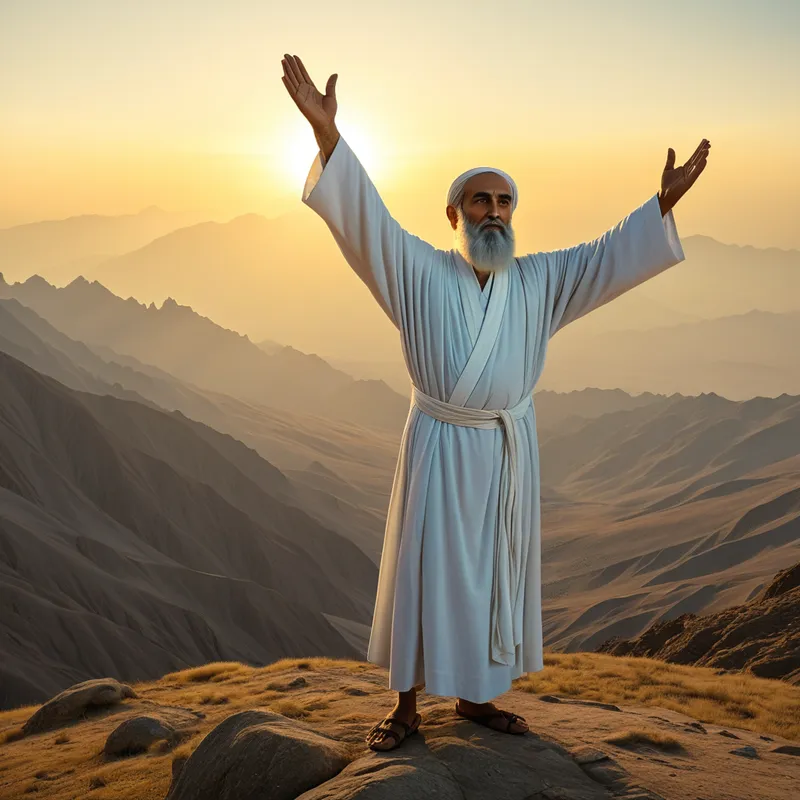
Listen, and hear the tale of the one who walked between worlds. In the age when the earth was younger and the sky spoke in thunder, there lived a man named Zarathustra. He was born not into royalty, but into the line of the Spitama, a people who knew the breath of cattle and the silence of the high plains. From his first cry, it is said, he did not wail but laughed, a sound so pure it scattered the shadows in the room.
For thirty years, he walked the world with a question burning in his chest like a cold ember. He saw the cruelty of the Karpans and Kavis, who performed empty rituals, who brought chaos instead of order, who worshipped gods of raid and pillage. The world was out of joint. The sacred fire of the hearth was dimmed by falsehood. In his soul, a great loneliness grew, a desert vaster than the Dāityā river plains.
Driven by this divine discontent, he turned away. He sought the voice that whispered on the wind. He went into the mountains, into the deep clefts of stone where only eagles dared. For ten years, he purified himself through thought, word, and deed. He drank from icy streams and ate the simplest fare, his body becoming a vessel waiting to be filled.
Then, on a dawn that split the world like a ripe fruit, it happened. He stood by a river, performing the ancient rite of purification. The waters swirled around his legs, cold and insistent. As he emerged, a being of unbearable brilliance appeared. It was Vohu Manah. The figure did not walk; it was composed of living light, and its presence was not sight but a knowing directly in the heart. Terror and ecstasy seized Zarathustra. His legs failed him.
The radiant being spoke, not with sound, but with meaning that blossomed in his mind. “Who are you?” it asked. “To whom do you belong? For what purpose do you exist?” And in that moment of ultimate question, Zarathustra’s soul found its answer. He was of Ahura Mazdā. His purpose was to bear the truth.
He was led, trembling, into the very presence of the Divine. He saw Ahura Mazdā not as a man, but as a principle of perfect order, Asha made manifest. Surrounding the Lord were the other Amesha Spentas, a radiant council: Vohu Manah, Asha Vahishta, Kshathra Vairya, Spenta Armaiti, Haurvatāt, and Ameretāt. Here was the architecture of a benevolent universe.
And he was shown the choice—the first and final choice. On one hand, the Spirit of Truth and Light, Spenta Mainyu. On the other, the opposing Spirit of the Lie and Darkness, Angra Mainyu. The cosmos itself was this battleground, and every human thought, word, and deed was a soldier for one side or the other. There was no neutrality, only choice.
Armed with this terrible and glorious knowledge, Zarathustra descended. For years, he was met with scorn, violence, and disbelief. He was driven from towns, his teachings mocked. The turning point came in the court of King Vishtāspa. Through divine miracles—healing the king’s favorite horse, withstanding molten metal poured upon his chest—and the irresistible power of his truth, he converted the king. The fire of his message, the Atar, was kindled in the heart of the kingdom. From there, it would spread, a slow, inexorable dawn across the land, a law against chaos, a song of order in the face of the Lie.
Cultural Origins & Context
This is the mythic core of Zoroastrianism, one of the world’s oldest continuously practiced prophetic religions. Its source is the Gathas, seventeen sublime hymns composed in an ancient Iranian dialect and preserved with meticulous care within the larger Avesta. These are not straightforward narratives but profound, often cryptic, poetic revelations. The biographical story of Zarathustra was woven later by the priestly tradition, the Magi, to provide a human vessel for the divine message.
The myth functioned as the foundational charter for Persian imperial identity, especially under the Achaemenids and Sassanians. It was not merely a personal salvation story but a cosmic and social blueprint. It provided a theology of cosmic war that justified the king’s role as defender of Asha against the Lie Druj, and it established an ethical framework where individual responsibility—“good thoughts, good words, good deeds”—directly impacted the balance of the universe. The prophet was the archetypal model for the righteous individual and the righteous king.
Symbolic Architecture
At its heart, the myth of Zarathustra is about the birth of conscious ethical choice in a universe of moral ambiguity. He is the archetype of the awakened mind that perceives the fundamental duality not as external gods to be appeased, but as an internal, existential condition.
The prophet is not one who predicts the future, but one who sees the eternal present in its stark, moral clarity.
The Ahura Mazdā revelation represents the emergence of a unifying, transcendent principle from a polytheistic wilderness. The Amesha Spentas are not separate gods but aspects of the divine and, symbolically, psychological faculties to be cultivated: Good Mind, Truth, Power, Devotion, Wholeness, Immortality. The central conflict with Angra Mainyu externalizes the inner struggle between the integrative impulse of the Self and the fragmenting, destructive power of the shadow. The sacred Fire is the symbol of this conscious, transformative energy—not a blind element, but a purified tool of insight and focus.
The Dreamer’s Resonance
When this mythic pattern stirs in the modern unconscious, it often manifests as dreams of profound isolation followed by a shattering revelation. One may dream of being in a vast, empty landscape (the spiritual desert), feeling a crushing responsibility to “fix” a broken system or family dynamic (the perceived Druj). This can lead to somatic experiences of a “burden” on the chest or a pressure in the head—the weight of an unlived truth.
The pivotal dream encounter is often with a radiant, androgynous, or non-human figure (a Vohu Manah figure) who poses a fundamental question: “What are you for?” The dream ego may respond with its job title or relationships, only to have them dismissed as insufficient. The psychological process here is the ego’s confrontation with the Self, the central organizing principle of the psyche, which demands alignment with a purpose beyond personal comfort or social convention. The terror in the dream is the terror of this reorientation.

Alchemical Translation
The journey of Zarathustra is a precise map of the alchemical opus, the process of psychic individuation. His initial thirty years of questioning represent the nigredo, the blackening—a state of depression, confusion, and feeling out of sync with the world. The withdrawal to the mountain is the separatio, consciously isolating the developing Self from the collective values (the old, empty rituals).
The revelation on the riverbank is the albedo, the whitening—a direct, unmediated experience of the Self that washes away the projections and clarifies the inner conflict into a conscious choice.
The vision of Ahura Mazdā and the Amesha Spentas is the coniunctio, the integration of multiple psychic complexes (thought, truth, power, devotion) under a central, ordering principle. The subsequent struggle and final establishment of his doctrine in the world is the rubedo, the reddening—the embodied application of this integrated consciousness in the rough-and-tumble of life, turning insight into ethical action. For the modern individual, this myth does not call for founding a religion, but for the courage to confront the internal Angra Mainyu of one’s own laziness, fear, and falsehood, and to consciously choose to build a personal Asha through one’s thoughts, words, and deeds.
Associated Symbols
Explore related symbols from the CaleaDream lexicon:
- Prophet — The awakened consciousness that serves as a bridge between the divine order and the human world, bearing a transformative truth that demands ethical choice.
- Fire — The sacred, purifying element of Ahura Mazdā, representing divine truth, conscious energy, and the transformative power of focused insight.
- Light — The fundamental principle of Ahura Mazdā and Asha, symbolizing consciousness, revelation, clarity, and the victory over ignorance and the Lie.
- Mountain — The place of solitude, purification, and revelation where the prophet withdraws to confront the divine and receive the foundational law.
- Order — The cosmic principle of Asha, the divine law and harmony that the prophet perceives and strives to establish against chaos.
- Vision — The direct, unmediated encounter with the divine reality, which shatters old paradigms and grants a new framework for understanding existence.
- Choice — The central, existential act defined by the myth; the eternal selection between the creative spirit of truth and the destructive spirit of the lie.
- River — The site of purification and the threshold where the mundane world meets the divine, where the prophet’s transformative vision occurs.
- Shadow — Psychologically represented by Angra Mainyu, the force of chaos, destruction, and the lie that must be consciously recognized and opposed.
- Journey — The prophet’s long, lonely quest for truth, encompassing both his physical wanderings and his inward, spiritual ascent.
- Sun — A symbol of Ahura Mazdā’s enduring, illuminating presence and the ultimate victory of light, often associated with the prophet’s dawn-time revelations.
- Horse — Symbolic of both vitality and royalty; the healing of King Vishtāspa’s horse represents the restoration of divine order and power within the kingdom.