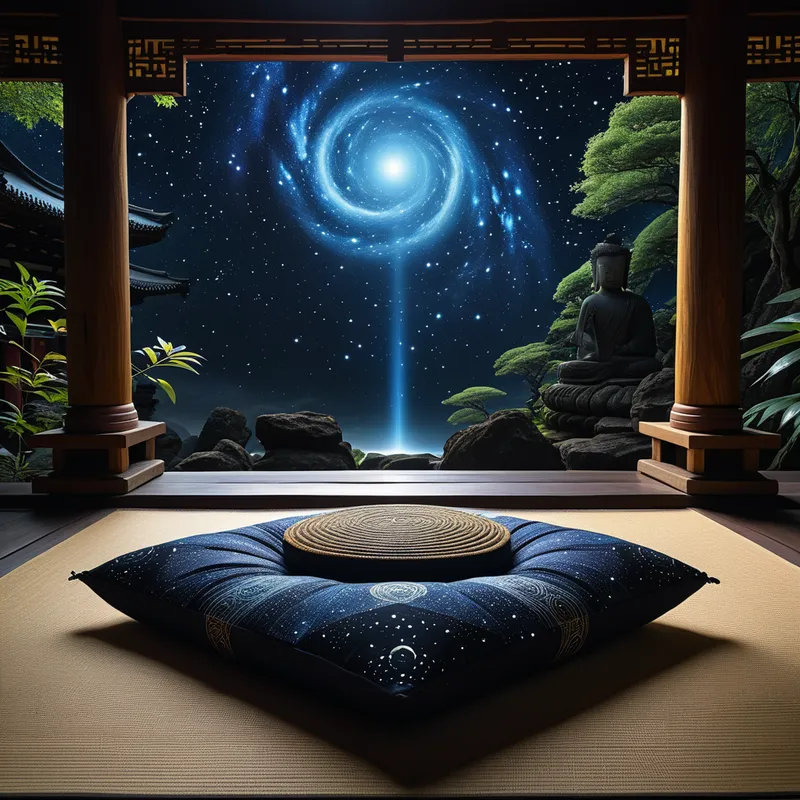
Zabuton Myth Meaning & Symbolism
A mythic tale of a humble meditation cushion that, through absolute stillness, becomes the vessel for the entire cosmos, teaching the unity of form and emptiness.
The Tale of Zabuton
Listen. In the time before time was counted, in a mountain monastery where the mist clung to the pines like a forgotten prayer, there was a cushion. It was not a throne, nor a bed of roses. It was a simple square, stuffed with the husks of rice, clad in humble, dark-dyed cotton. They called it Zabuton.
For generations, it knew only the weight of seekers. It bore the restless shifting of novice knees, the profound, aching stillness of the elder masters. It drank the salt of striving and the cool dew of surrendered breath. It was a patient, silent witness, absorbing the turmoil of the human heart into its quiet fibers.
One winter, a monk named Unsui came to the cushion. His mind was a stormy sea, his past a heavy chain. He sat, vowing not to rise until he saw his true nature. Days bled into nights. The cold bit his bones; his legs screamed in protest. He wrestled with phantoms of memory and towers of abstract thought. The Zabuton held him, a steadfast island in the tempest of his self.
On the seventh night, as the temple bell tolled a hollow note into the frozen dark, Unsui’s struggle ceased. Not in victory, but in utter exhaustion. The last thought—the “I” who was seeking—dissolved like a sugar cube in tea. In that vast, empty cessation, something shifted. Not in him, but in the cushion.
The humble square of fabric began to hum, a sub-audible frequency that vibrated in the marrow of the world. The rice husks within were no longer chaff, but became swirling nebulae. The dark dye of the cotton deepened into the void between stars. The impression of his seated form, worn into the fabric by years of practice, became a gravitational well, a still point.
Unsui did not see this. He was it. The Zabuton expanded, its corners dissolving into the four directions of the cosmos. The mountain was seated upon it. The river flowed across its weave. The cry of the hawk and the whisper of the pine were the sound of its threads tightening. The cushion did not contain the universe; the universe had always been the cushion’s true form, now remembered. The seeker and the seat, the form and the emptiness, were one single, seamless reality. When dawn came, washing the room in pale gold, there was only a monk, a cushion, and the undisturbed dust motes dancing in a sunbeam. The great event left no trace but everything.
Cultural Origins & Context
This is not a myth inscribed on ancient scrolls or chiseled into temple stones. The “Tale of Zabuton” is an koan of the body, a story transmitted not through words, but through posture and practice. It originates in the embodied, austere culture of Zen zazen.
Historically, the Zabuton is a practical tool, evolving from earlier meditation mats to provide a stable, insulated base for the zafu. Its mythic dimension arises spontaneously in the teaching halls and private interviews (dokusan) of Zen. A master, seeing a student striving for some lofty, disembodied enlightenment, might gesture to the cushion and say, “This is your Buddha-land. When will you bow to it?” The story is a lived metaphor, passed down to correct the spiritual error of seeking elsewhere. Its societal function is foundational: to sacralize the immediate, the mundane, and the physical ground of one’s own being as the very field of awakening.
Symbolic Architecture
The Zabuton is the ultimate symbol of the Samsara-Nirvana non-duality. It represents the ground of being itself—not as a philosophical concept, but as the literal, tactile ground upon which one meets oneself.
The universe has no center and no circumference. It finds both in the seat of the one who stops.
The rice husk stuffing symbolizes the discarded, the empty, the “useless” parts of the self and the world that, when gathered and held without judgment, become the supportive core. The worn impression is the archetypal seal of practice, the shape left by the continuous return to the present moment. It is the negative space that defines the positive form, showing that identity is not a solid thing, but a relationship with emptiness. The cushion’s expansion into the cosmos is not magic, but a revelation of its true nature, mirroring the Zen understanding that the absolute is not separate from the relative world of form.
Psychologically, the Zabuton represents the container—the holding environment of the psyche. It is the therapeutic frame, the ritual space, the reliable, non-judgmental presence that can bear the full weight of our human struggle. The hero of the myth is not the monk, but the relationship between the monk and the cushion. The conflict is the mind’s refusal to fully settle into its own ground. The resolution is the death of that refusal, allowing the ground to reveal its infinite depth.

The Dreamer’s Resonance
When this myth stirs in the modern unconscious, it often manifests in dreams of profound grounding or its terrifying absence. To dream of a Zabuton—or its symbolic equivalents: a familiar chair, a patch of earth, a trusted mat—is to dream of the psyche seeking its base of operations.
One might dream of finding an impossibly comfortable, supportive spot in a chaotic landscape, and upon sitting, feeling a wave of peace and rightness. This somatic signal in the dream-state indicates a nascent capacity in the waking ego to “sit with” previously unbearable emotions or situations. Conversely, one might dream of a Zabuton that is lumpy, unstable, or that crumbles to dust upon contact. This reflects a crisis of containment—a feeling that one’s foundational sense of self, one’s ability to hold one’s own experience, is failing. The dream-ego is then presented with the core task of the myth: to stop fleeing, to place its weight fully on the broken ground, and discover, through that very act of acceptance, what the ground is truly made of.
Alchemical Translation
The alchemy modeled here is the transmutation of the burden into the base. Our psychological pains, our history, our repetitive thoughts—these are the “rice husks” we consider worthless. The spiritual bypasser tries to discard them. The neurotic identifies with them. The alchemist of the Zabuton does neither. They gather this chaff and place it beneath them, making it the support for the crucible of seated awareness.
Individuation is not a journey to a distant peak, but the gradual recognition that you have always been sitting on the diamond.
The process begins with the willingness to sit—to commit to the practice of self-observation without immediate flight. This is the hero’s vow. The “rising action” is the inevitable confrontation with the shadow contents that arise when one stops moving: boredom, anxiety, memory, fantasy. The Zabuton, as the container, holds this psychic heat. The climax is the moment of exhaustion, the “giving up” of the ego’s project of managing reality. This is not defeat, but the necessary dissolution of the boundary between the alchemist and the alembic.
In that dissolution, the transmutation occurs. The personal history (the husks) reveals its cosmic dimension. The individual seat becomes the universal locus. For the modern individual, this translates to the profound shift where one’s wound is no longer just a personal flaw, but the very point of access to a transpersonal, archetypal layer of experience. Your anxiety becomes the hum of the universe. Your grief becomes the fertile void. You do not transcend your life; your life deepens into its mythic ground. You realize you are not on the path; you are the path, and the ground it rests upon. The practice is simply to stop, and know the seat.
Associated Symbols
Explore related symbols from the CaleaDream lexicon: