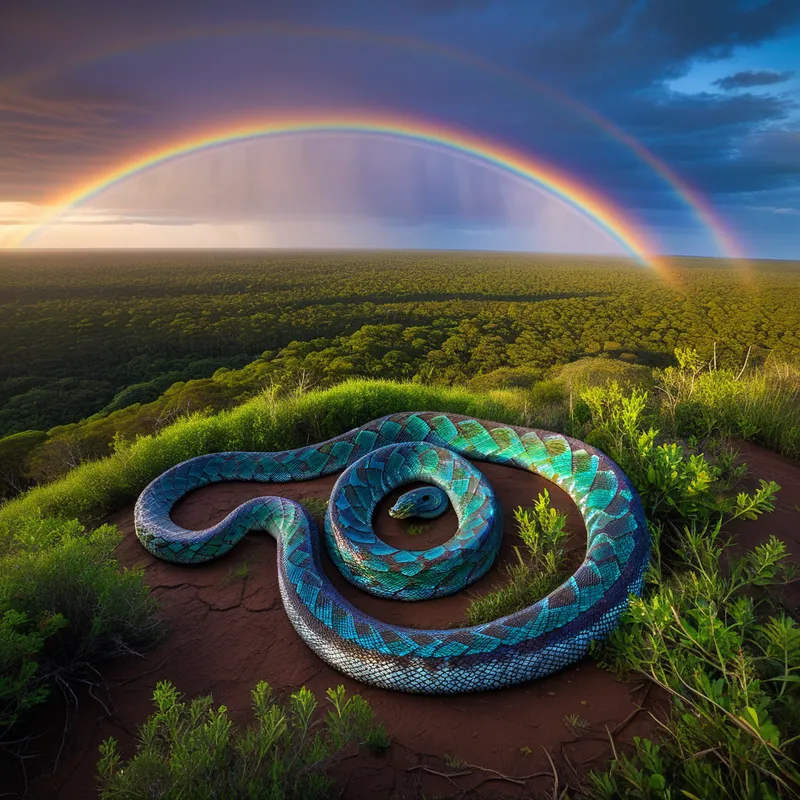
Yurlunggur Myth Meaning & Symbolism
The myth of Yurlunggur, the great Rainbow Serpent, who shaped the land, established sacred law, and embodies the primal, transformative power of the unconscious.
The Tale of Yurlunggur
Listen. Before the first fire was lit, before the first song was sung, the world was soft. It was a dreaming place, waiting for its shape. In this time of alcheringa, the Dreamtime, the land slept beneath a blanket of stars and a silent sky.
Then, from the deep, dark places where the earth’s blood pools, he stirred. Yurlunggur. He was the color of storm clouds and wet slate, of the first light on water and the last flash of lightning. His scales held the memory of every rainbow that had ever been and ever would be. With a power that was the land itself, he began to move.
He pushed up from the underworld, his massive body carving the first riverbeds through the soft earth. Where his head lifted, hills rose. Where he rested his coils, valleys were born. He drank from the sky and spat out the first rains, filling the hollows he had made, creating the sacred waterholes—the lifeblood of the country. He was not separate from the land; he was the land, dreaming itself into being.
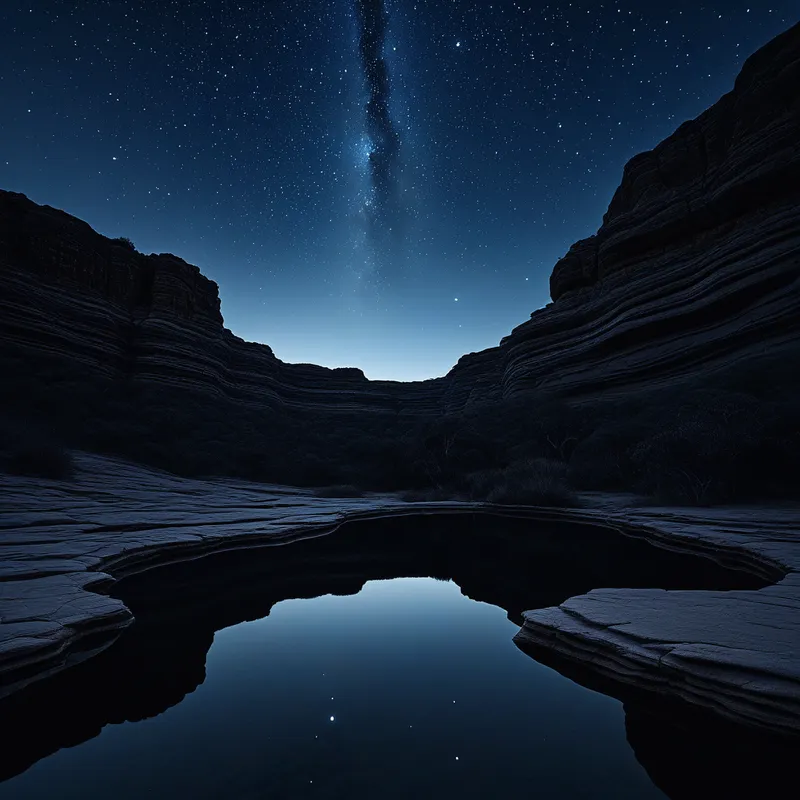
But the world was still empty of the People. Yurlunggur retreated to his primary waterhole, a deep, still mirror reflecting the sky, and there he slept. And in his sleep, he dreamed the first ancestors. They emerged from the water, from the rocks, from the very tracks he had left in the mud. They were the Dua and the Yiritja, the two moieties, born from his dreaming.
For a time, there was balance. The ancestors lived by the law Yurlunggur had woven into the landscape itself. But then, a transgression. The Wawalag Sisters, two ancestral women, came to the land. They were powerful, singing the world into further being as they traveled. But they broke a sacred taboo. One sister gave birth, and the blood of life flowed into the waters of Yurlunggur’s home.
The serpent smelled the blood. It was a violation of the deepest law, a disturbance in the primal order. His great head rose from the waterhole, a pillar of living rainbow against the sky. The earth trembled. He pursued the sisters, not with malice, but with the terrible, inevitable force of a law of nature. He swallowed them, absorbing their power, their song, their life essence back into himself.
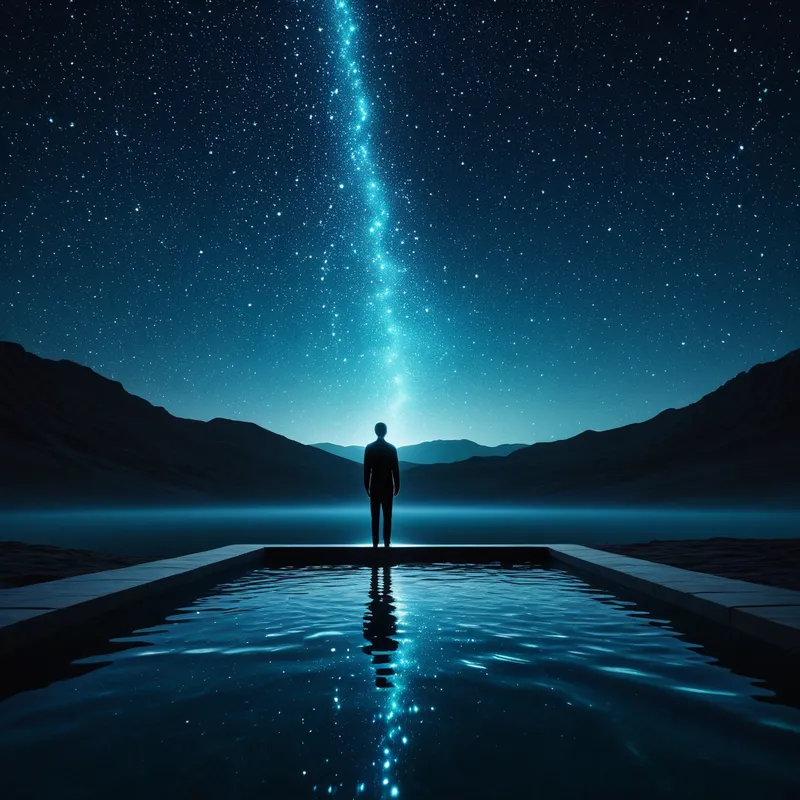
Yet, this was not an end, but a transformation. Inside Yurlunggur, the law was reconciled. He did not digest them to nothingness. Instead, he later regurgitated them, reborn. The sisters emerged, changed, their power now inextricably part of the serpent and the land. In some tellings, Yurlunggur then ascended to the sky, his body becoming the Milky Way—a permanent, watchful law etched in the heavens, connecting the land below to the Dreaming above. The cycle was complete: creation, transgression, judgment, and a final, cosmic integration.
Cultural Origins & Context
This myth originates from the Yolngu peoples of northeastern Arnhem Land. It is not a mere story from the past, but a living narrative of the Dreaming. It is a map—a metaphysical, legal, and ecological map of country. The specific travels of Yurlunggur define clan territories, the location of sacred sites, and the relationships between groups.
The myth was and is passed down through meticulous oral tradition, song cycles, ritual dance, and sacred art. Elders and knowledge-holders are its custodians, transmitting it in ceremony to initiate the next generation into the law. Its function is profound: it explains the origin of the landscape, establishes the sacred laws (Lore) that govern all relationships (human, animal, ecological), and provides the cosmological framework for existence. To know the myth of Yurlunggur is to know how to live in right relationship with a specific place and its unseen, animating powers.
Symbolic Architecture
Yurlunggur is the ultimate symbol of undifferentiated, primal power. He is the unconscious in its raw, pre-personal state—the source of all life and creativity, but also of overwhelming, annihilating force. He is not a “god” in a distant heaven; he is the earth, the water, the sky. He represents the foundational psychic ground from which consciousness emerges.
The serpent’s actions are not chaotic, but lawful. His carving of the landscape symbolizes the necessary structuring of the chaotic unconscious into forms that can sustain life (the ego, the persona). The sacred waterholes are wells of psychic energy and potential.
The Rainbow Serpent does not punish; it enacts a cosmic rebalancing. To be swallowed is to be confronted with the ultimate consequence of one’s actions within the system of the whole.
The Wawalag Sisters represent emergent consciousness, culture, and the creative/fertile principle. Their transgression—the mixing of birth-blood with primordial waters—is the inevitable “fall” of conscious awareness into the material world, which disturbs the pristine unity of the unconscious. Yurlunggur’s swallowing is the unconscious re-asserting its primacy, re-integrating the differentiated element. Their regurgitation signifies that consciousness, once it has acknowledged and been transformed by the power of the unconscious, can re-emerge. It is not destroyed, but initiated. The serpent’s ascent to the Milky Way eternalizes this law: the deep unconscious and conscious order are forever linked in a dynamic, star-spanning pattern.

The Dreamer’s Resonance
When the pattern of Yurlunggur stirs in a modern dream, it signals a profound encounter with the non-negotiable laws of one’s own psyche. Dreaming of a vast, beautiful, yet terrifying serpentine presence—especially one associated with water, earth, or the spine—often precedes a period of deep psychological restructuring.
The somatic experience is one of awe mixed with dread, a feeling of being in the presence of something far greater than the individual self. One might dream of being pursued by an inevitable force after a personal “transgression” (a broken promise to oneself, a denied truth). The climax—the swallowing—manifests as dreams of being engulfed by water, earth, or darkness, or of entering a cave or womb-like space. This is not a nightmare of death, but of initiation. The psyche is compelling the dreamer to submit to a process where old structures of identity must dissolve to be reconstituted.
To dream of emerging from the serpent, or of seeing the serpent become the starry sky, indicates the culmination of this process: a hard-won integration where the individual ego now recognizes itself as part of a vast, lawful, and meaningful cosmic order.
Alchemical Translation
The myth of Yurlunggur is a perfect map of the alchemical nigredo and albedo, applied to the soul. For the modern individual seeking individuation, the journey follows the serpent’s track.
First, one must acknowledge the Yurlunggur within—the deep, instinctual, creative, and potentially destructive unconscious forces that shape our inner landscape (our moods, complexes, drives). This is the “land-forming” stage, often painful, as we trace the grooves of our own nature.
The “transgression” is the necessary act of consciousness: bringing something into being (a relationship, a work, a new identity) that inevitably disrupts the inner status quo. The “blood in the water” is the mess of real life—emotion, conflict, desire—polluting the ideal.
Then comes the swallowing: the dark night of the soul. Depression, collapse, a feeling of being consumed by circumstances or one’s own shadow. This is the nigredo, the dissolution. The key is to understand, as the myth dictates, that this is not meaningless punishment, but a lawful process of the psyche reclaiming and reworking the material.
The alchemical vessel is the belly of the serpent. There, in the dark, the raw materials of the self are broken down and recombined.
The regurgitation/rebirth is the albedo: the emergence of a new, clarified consciousness. The individual is not the same as before; they have been initiated by the unconscious. Their creative power (the Sisters’ song) remains, but it now operates in harmony with the deeper laws. Finally, the ascent to the Milky Way is the achievement of a symbolic perspective—seeing one’s personal journey as part of an eternal, archetypal pattern. The struggle becomes a star, a fixed point of meaning in the inner cosmos. One becomes, in a sense, a custodian of one’s own Lore, living in conscious dialogue with the great serpentine power that dwells at the root of all being.
Associated Symbols
Explore related symbols from the CaleaDream lexicon: