Yoga Sutras of Patanjali Myth Meaning & Symbolism
The descent of a divine serpent-king to codify the human path from suffering to enlightenment, offering a map for the soul's journey home.
The Tale of the Yoga Sutras of Patanjali
Listen. In the time before time was counted, when [the world](/myths/the-world “Myth from Tarot culture.”/) was a tapestry of raw sensation and thought a storm-tossed sea, humanity wandered in a fog of its own making. They were tossed by the waves of desire, frozen by the cliffs of fear, lost in the thick forests of mistaken identity. Their inner world was Prakriti unchanneled—a magnificent, chaotic potential with no guide to its depths.
From the silent abode of the eternal, the [Vishnu](/myths/vishnu “Myth from Hindu culture.”/) reclined upon the cosmic serpent Ananta [Shesha](/myths/shesha “Myth from Hindu culture.”/). He witnessed the great suffering, the duhkha—the grinding of the soul against the wheel of its own nature. A great compassion stirred. The serpent-king, the embodiment of infinite support and remnant of all past universes, felt this divine concern ripple through his endless coils. He asked of the Lord, “How may I serve?”
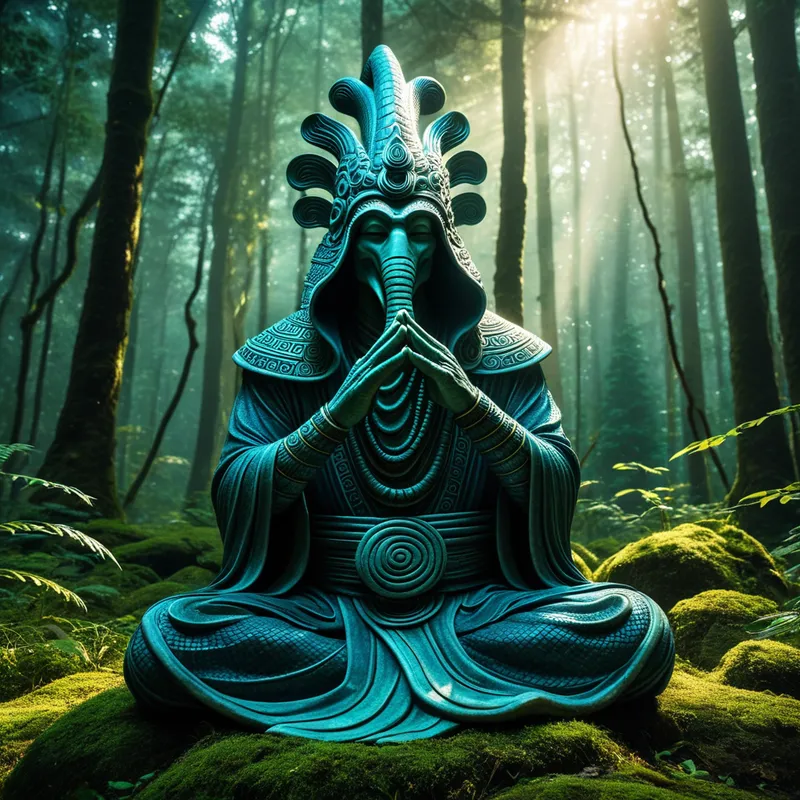
And it was decreed that he would descend. Not as a destroyer, not as a boon-giver of fleeting pleasures, but as a grammarian of the soul. He would take a form both wondrous and humble: the upper body of a man, poised for teaching, the lower body a mighty serpent’s coil, grounded in the wisdom of [the earth](/myths/the-earth “Myth from Hindu culture.”/). He would be known as Patanjali.
He descended not to a battlefield, but to the quiet field of human consciousness. His stage was the silent space between two thoughts. His weapons were not sword and shield, but observation and restraint. He sat, his serpent-body a foundation of immense stability, his human hands poised in the gesture of teaching. And he began to speak, or rather, the universe spoke through him. Each utterance was a [sutra](/myths/sutra “Myth from Hindu culture.”/)—a thread. Not a grand, flowing narrative, but a precise, diamond-cut seed of truth, so condensed that a single line could unfold into a universe of practice.
He spoke of the Kleshas, the poisonous roots of suffering that tangle the mind. He named the Ashtanga, the eight-limbed path that is a ladder from the mud of distraction to [the summit](/myths/the-summit “Myth from Taoist culture.”/) of clear seeing. He described the Samyama, the fierce, gentle process of binding the mind’s light to a single point until it burns through illusion.
His voice was the sound of order emerging from chaos. He did not tell a story of gods and demons clashing in [the sky](/myths/the-sky “Myth from Persian culture.”/), but of the silent, epic battle within the human heart: the struggle of [Purusha](/myths/purusha “Myth from Hindu culture.”/) to recognize itself amidst the dazzling dance of Prakriti. His tale had no violent climax, but a resolution of profound stillness: Yogas chitta vritti nirodhah. “Yoga is the cessation of the fluctuations of the mind-stuff.” In that stillness, the seeker realizes the seer, abiding in its own nature. The serpent, having offered its body as the path, rests. The journey is complete.
Cultural Origins & Context
The figure of Patanjali is shrouded in the mists of antiquity, with scholars placing the composition of the Yoga Sutras between the 2nd century BCE and the 4th century CE. This was a period of immense philosophical fermentation in India, following the foundational Vedas and Upanishads. Various darshanas or “viewpoints” were being systematized—Nyaya, Vaisheshika, Mimamsa, and others.
Patanjali’s work is considered a darshana in itself, often paired with the Samkhya philosophy, providing its practical methodology. The text is not a loose collection of folklore but a tightly woven manual, likely compiled for ascetics and serious practitioners (sadhakas) engaged in intensive spiritual discipline. It was transmitted orally from teacher to disciple for centuries, its memorization aided by the concise, aphoristic sutra style. This was not a myth for the masses in [the way](/myths/the-way “Myth from Taoist culture.”/) of the Puranas, but a technical and psychological map for those who had already heard the call to look inward. Its societal function was to provide an authoritative, systematic path (marga) out of existential suffering, legitimizing and structuring the ancient, diverse practices of yoga into a coherent science of consciousness.
Symbolic Architecture
Patanjali’s form as the [serpent](/symbols/serpent “Symbol: A powerful symbol of transformation, wisdom, and primal energy, often representing hidden knowledge, healing, or temptation.”/)-man is the myth’s central [symbol](/symbols/symbol “Symbol: A symbol can represent an idea, concept, or belief, serving as a powerful tool for communication and understanding.”/). The serpent represents the untamed, primal [energy](/symbols/energy “Symbol: Energy symbolizes vitality, motivation, and the drive that fuels actions and ambitions.”/) of the [universe](/symbols/universe “Symbol: The universe symbolizes vastness, interconnectedness, and the mysteries of existence beyond the individual self.”/)—[kundalini](/symbols/kundalini “Symbol: A dormant spiritual energy coiled at the base of the spine, representing untapped potential and awakening consciousness through ascension.”/)—as well as [eternity](/symbols/eternity “Symbol: The infinite, timeless state beyond human life and measurement, often representing the ultimate or divine.”/) (Ananta). The [human](/symbols/human “Symbol: The symbol of a human represents individuality, complexity of emotions, and social relationships.”/) torso represents order, intellect, and the [capacity](/symbols/capacity “Symbol: A measure of one’s potential, limits, or ability to contain, process, or achieve something, often reflecting self-assessment or external demands.”/) for articulate teaching. The [fusion](/symbols/fusion “Symbol: The merging of separate elements into a unified whole, often representing integration of self, relationships, or conflicting aspects of identity.”/) signifies the tantric and yogic ideal: not the [rejection](/symbols/rejection “Symbol: The experience of being refused, excluded, or dismissed by others, often representing fears of inadequacy or social belonging.”/) of our instinctual, earthly [nature](/symbols/nature “Symbol: Nature symbolizes growth, connectivity, and the primal forces of existence.”/), but its [integration](/symbols/integration “Symbol: The process of unifying disparate parts of the self or experience into a cohesive whole, often representing psychological wholeness or resolution of internal conflict.”/) and elevation as the very [foundation](/symbols/foundation “Symbol: A foundation symbolizes the underlying support systems, values, and beliefs that shape one’s life, serving as the bedrock for growth and development.”/) for transcendence. The [serpent](/symbols/serpent “Symbol: A powerful symbol of transformation, wisdom, and primal energy, often representing hidden knowledge, healing, or temptation.”/)’s coils are the foundational disciplines; the [human](/symbols/human “Symbol: The symbol of a human represents individuality, complexity of emotions, and social relationships.”/) hands offer the liberating [knowledge](/symbols/knowledge “Symbol: Knowledge symbolizes learning, understanding, and wisdom, embodying the acquisition of information and enlightenment.”/).
The Sutras themselves are not mere instructions; they are symbolic artifacts of [consciousness](/symbols/consciousness “Symbol: Consciousness represents the state of awareness and perception, encompassing thoughts, feelings, and experiences.”/). Each one is a bija [mantra](/symbols/mantra “Symbol: A sacred utterance, sound, or phrase repeated in meditation to focus the mind and connect with spiritual energy.”/) for the [psyche](/myths/psyche “Myth from Greek culture.”/), designed to dismantle a specific illusion.
The path of the eight limbs is an archetypal map of ascent, moving from the external and social (Yama, Niyama) to the internal and physical (Asana, Pranayama), and finally to the subtlest realms of the mind (Pratyahara, Dharana, Dhyana, Samadhi). It is the hero’s journey turned entirely inward.
The ultimate goal, Kaivalya ([isolation](/symbols/isolation “Symbol: A state of physical or emotional separation from others, often representing a need for introspection or signaling distress.”/) or liberation), is symbolically the Purusha seeing itself clearly, separate from the [tangled web](/symbols/tangled-web “Symbol: A tangled web represents complexity, entrapment, and the convoluted nature of one’s vices, particularly the deceptive and intricate ways they can ensnare individuals.”/) of Prakriti. This is not an annihilation of [the self](/myths/the-self “Myth from Jungian culture.”/), but the profound realization of the Self that was never truly bound.
The Dreamer’s Resonance
When this myth stirs in the modern unconscious, it rarely appears as a literal half-serpent sage. Instead, one may dream of trying to follow an intricate, ancient map through a chaotic, overgrown interior landscape. The dreamer might be painstakingly untangling a vast, knotted net that constricts their chest, or assembling a complex, precise machine from scattered parts while under a quiet, pressing urgency.
Somatically, this points to a process of psychic integration and structuralization. The dream ego is undergoing the labor of Patanjali: bringing order to inner chaos. The “knots” are the kleshas—perhaps a gnawing anxiety (aversion, dvesha) or an obsessive craving (attachment, raga). The dream is the psyche’s innate intelligence beginning the work of nirodhah, the cessation of these turbulent fluctuations. It is a call to discipline, not as repression, but as the necessary containment that allows a deeper energy to coalesce and rise. The dreamer is, in essence, building the ashtanga, the eight-limbed support structure for a consciousness that feels too fluid, too reactive, or too dispersed.
Alchemical Translation
For the modern individual, Patanjali’s myth models the alchemy of transforming suffering into conscious freedom. [The prima materia](/myths/the-prima-materia “Myth from Alchemical culture.”/) is the raw, suffering mind identified with its thoughts and emotions. The Opus is the application of the sutras.
[The first stage](/myths/the-first-stage “Myth from Alchemical culture.”/), Yama and Niyama, is the Negredo—the confronting and limiting of our base, reactive behaviors (harmfulness, deceit, greed) and the conscious cultivation of their opposites (cleanliness, contentment, self-study). It is the blackening, the humbling confrontation with our shadow.
The practice of asana (posture) and pranayama (breath control) is the Albedo. The body, often the seat of tension and unconscious history, is purified and made a stable vessel (sthira-sukham). The breath, the link between body and mind, is whitened, refined, and brought under conscious direction.
Pratyahara (withdrawal of the senses) begins the Citrinitas, the yellowing or solarizing, as attention is withdrawn from the outer world and turned inward like a golden light. Dharana (concentration) and Dhyana (meditation) are the intensification of this inner sun, focusing its rays until they penetrate.
Finally, [Samadhi](/myths/samadhi “Myth from Buddhist culture.”/) is the [Rubedo](/myths/rubedo “Myth from Alchemical culture.”/), the reddening or completion. It is not a passive bliss, but the full-bodied, radiant realization of the true Self, the Purusha, in its glorious, isolated perfection. The serpent-power, once latent and potentially destructive, has been fully integrated and now supports the throne of a calm, unshakeable awareness. The individual has performed the ultimate alchemy: turning the lead of distracted suffering into the gold of abiding witness-consciousness. The myth of Patanjali thus remains an eternal blueprint for the soul’s own masterpiece.
Associated Symbols
Explore related symbols from the CaleaDream lexicon: