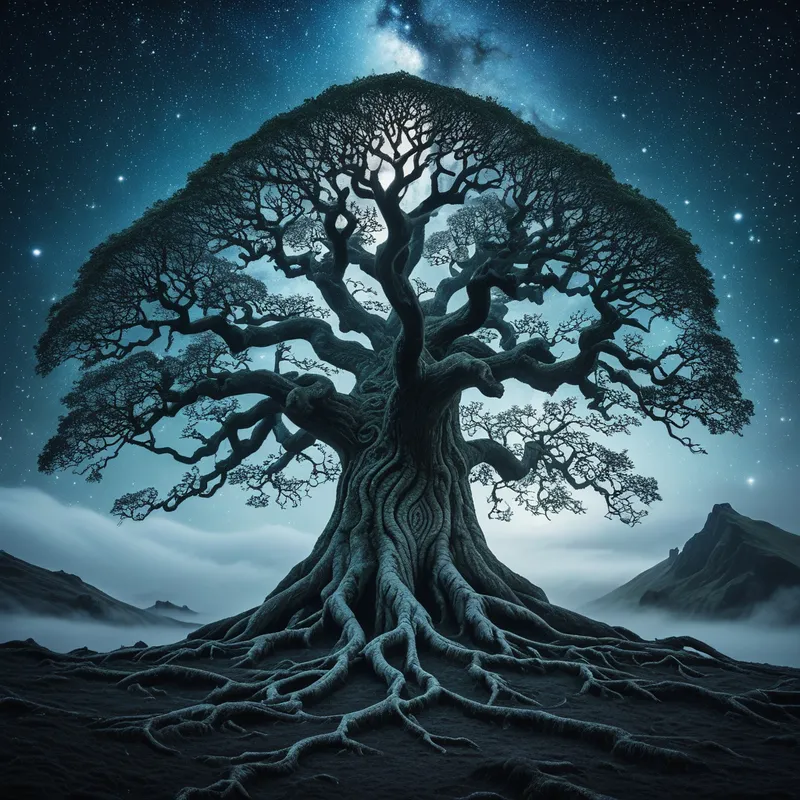
Yggdrasil's Roots Myth Meaning & Symbolism
The myth of the world tree Yggdrasil, whose three roots drink from wells of fate, wisdom, and primal chaos, binding all realms in a living, suffering unity.
The Tale of Yggdrasil’s Roots
Hear now of the great Ash, the Axis of All. It stands not in a forest, but in the void itself, its branches scratching the skull of the sky, holding the nine worlds in its grip. This is Yggdrasil, the Steed of the Terrible One, and its story is written in its roots.
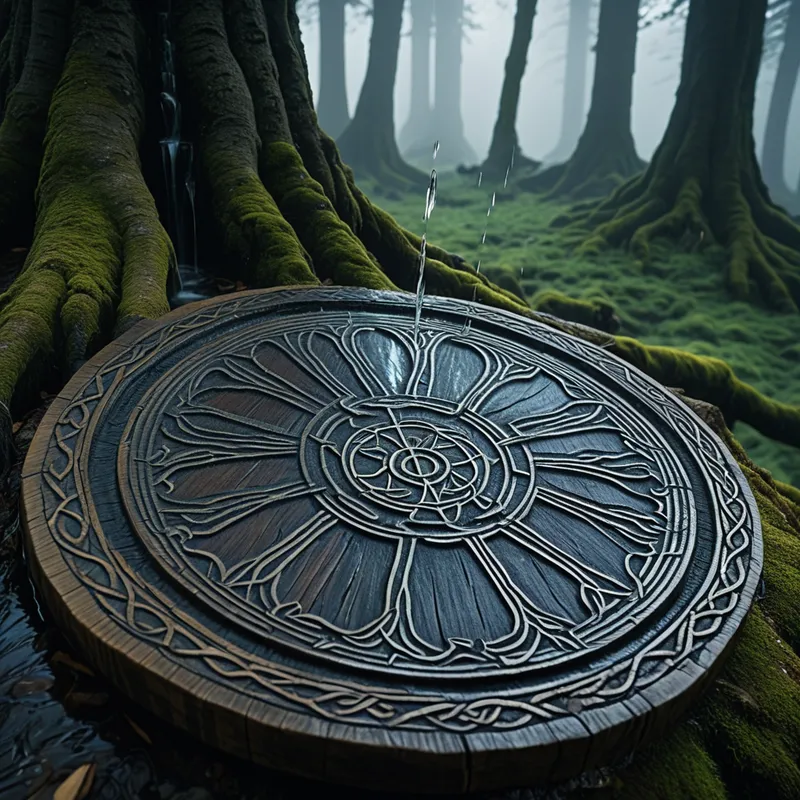
The first root drives deep into a place of mist and memory. Here, in Asgard, lies the Well of Urd. The water is so still it is a dark mirror. Around it sit the three Norns—Urd, Verdandi, Skuld—Past, Present, and Future. They are weavers and carvers. They draw water from the well, mix it with white clay, and pour it over Yggdrasil’s root to keep it from rotting. But they also carve runes into its wood, etching the laws of being, the orlog—the primal layer of fate—into the very flesh of the tree. The root drinks, and the tree shudders with the weight of what is written.
The second root tunnels into a land of frost and ancient power: Jotunheim. Here, the well is called Mimir’s Well. Its waters are knowledge itself, dark and cold. It is guarded by Mimir, a being of vast and silent thought, whose head is later severed and preserved. The god Odin once came here, drawn by a thirst no mead could quench. He stood before Mimir and asked for a drink. The price was his eye. Without a word, Odin plucked it out and dropped it into the well’s depths. It sank, a bloody jewel, and the well’s surface shimmered. Then Odin drank, and the root drank with him, and the agony of sight and the ecstasy of knowing became one. The tree groaned, gaining wisdom through divine sacrifice.
The third root descends into the darkest, most primal place: Niflheim. Here, the well is Hvergelmir, a seething, roaring cauldron. This is the wellspring of all rivers, and from it, venom and ice-water flow. And here, coiled eternally around this root, is the great dragon Nidhogg. Scale by scale, tooth by tooth, it gnaws. It is a sound like grinding bones, a perpetual erosion. Above, in the high branches, an eagle sits in watchful hatred, and between them runs the squirrel Ratatoskr, a messenger of malice, ensuring the animosity never ceases. This root drinks from chaos and decay, sustaining the tree even as it is consumed.
And so Yggdrasil lives: watered by fate, wisdom, and chaos; nourished and wounded; binding all things in a silent, suffering unity until the day the roots finally tremble and let go.
Cultural Origins & Context
This cosmology was not scripture, but a living map of a world perceived as profoundly interconnected and hostile. The primary sources, the Poetic Edda and the later Prose Edda, were written down in 13th-century Iceland, centuries after the conversion to Christianity. They preserve fragments of a much older, oral tradition. These stories were the province of skalds (poets) and, likely, seers. They were not mere entertainment but a framework for understanding one’s place in a cosmos where order (örlög) was constantly besieged by chaos.
The myth of Yggdrasil’s roots functioned as a grand organizing principle. It explained the structure of reality—the vertical axis connecting the divine, the earthly, and the chthonic—and the dynamic, often painful, forces that sustained it. It taught that wisdom requires unbearable sacrifice (Odin’s eye), that order is maintained through constant vigilance and ritual (the Norns’ watering), and that destruction (Nidhogg’s gnawing) is a fundamental, integrated part of existence, not an external enemy. In a culture facing harsh winters and existential threats, this was not pessimism, but a stark, courageous realism.
Symbolic Architecture
Yggdrasil is the ultimate symbol of the axis mundi, the world pillar present in countless traditions. Its three roots map the tripartite structure of the psyche and the cosmos.
The tree does not grow despite the serpent at its root; it grows because of it. The tension between ascent and decay is the very pulse of its life.
The first root, at the Well of Urd, symbolizes the Past and the Superego. It is the domain of law, fate, and inherited pattern. The Norns represent the inescapable conditioning of our beginnings—family, culture, DNA—the “what has been poured forth.” The second root, at Mimir’s Well, is the Present and the Ego’s Aspiration. It is consciousness seeking illumination, the painful sacrifice of a limited perspective (the eye) for a deeper, more unifying understanding. This is the quest for meaning. The third root, in Niflheim, is the Future and the Id. It is the churning, unconscious wellspring of primal energy, instinct, and inevitable decay. Nidhogg is not mere evil; it is the entropy inherent in all systems, the shadow that gnaws at the foundations of our identity, ensuring nothing remains static.
The squirrel Ratatoskr is a crucial psychological operator: it is rumination, the internal narrative that amplifies conflict between our highest self (the eagle) and our deepest, most destructive impulses (the dragon). The entire system is a closed loop of dynamic, necessary tension.
The Dreamer’s Resonance
When this myth stirs in modern dreams, it often manifests as dreams of immense, foundational trees; of discovering hidden rooms or tunnels beneath one’s house; of encountering wise or ominous figures at wells or springs; or of a persistent, gnawing anxiety at the base of things.
Dreaming of Yggdrasil’s roots signals a process of psychic re-grounding. The dreamer is being called to examine what nourishes and what corrodes their sense of self. The root in Asgard may appear as a confrontation with family legacy or societal expectations—the “fate” one feels bound to. The root in Jotunheim could manifest as a dream of making a painful but necessary sacrifice for insight, perhaps losing a familiar job or relationship to gain a new vision. The root in Niflheim is often the most visceral: dreams of teeth, of being consumed, of dark, watery cellars. This is the somatic recognition of the shadow’s work, the necessary dissolution of an outworn psychic structure. The dreamer isn’t being attacked; they are being shown the foundational work of transformation, where old identities must be broken down by inner forces that seem monstrous.
Alchemical Translation
The individuation process, the journey toward psychic wholeness, is perfectly modeled by Odin’s journey to the roots. One does not ascend to heaven by ignoring the underworld; one must descend to the roots.
Individuation is the act of drinking from all three wells, of holding fate, wisdom, and chaos in a single consciousness without splintering.
The first alchemical stage is acknowledging the Norns (Nigredo). We must confront our örlög—our personal and collective past—and accept its water, the mixed clay of our origins. This is the darkening, the recognition of limitation. The second stage is the Sacrifice for Wisdom (Albedo). This is the purifying white heat of Odin’s choice. We must willingly surrender a one-eyed, ego-centric view (a cherished belief, a comfortable identity) to gain the reflective, moon-cool wisdom of Mimir’s well. The “I” that knows is different from the “I” that began the quest.
The final, ongoing stage is integration with the Dragon (Rubedo). This is the red work, the enduring condition of wholeness. It is not slaying Nidhogg, but recognizing it as part of the tree’s life-support system. Psychologically, this means integrating the shadow—the repressed anger, the creative chaos, the awareness of mortality—not as an enemy, but as a source of fierce, transformative energy. The fully realized Self is not a static, perfect tree, but Yggdrasil itself: a living, suffering, majestic system, sustained by the eternal dialogue between its highest branches and its deepest, darkest roots.
Associated Symbols
Explore related symbols from the CaleaDream lexicon: