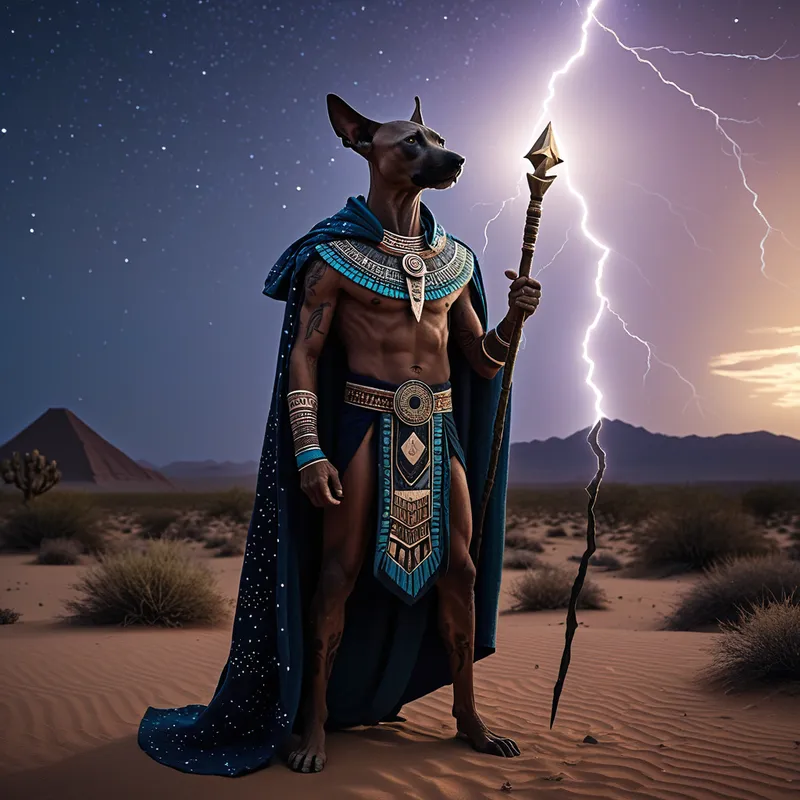
Xolotl Myth Meaning & Symbolism
The story of the twin god Xolotl, who refused sacrifice, fled through endless transformations, and became the guide for the sun through the underworld.
The Tale of Xolotl
In the age of [the Fifth Sun](/myths/the-fifth-sun “Myth from Aztec culture.”/), [the world](/myths/the-world “Myth from Tarot culture.”/) hung in a fragile balance. The gods had gathered at the sacred city of Teotihuacan, their purpose grave and terrible. The sun, [Tonatiuh](/myths/tonatiuh “Myth from Aztec culture.”/), refused to move across [the sky](/myths/the-sky “Myth from Persian culture.”/). It sat, a blazing, hungry eye on [the horizon](/myths/the-horizon “Myth from Various culture.”/), demanding a price for its journey. The price was divine blood, a sacrifice of the gods themselves.
Among them stood [Quetzalcoatl](/myths/quetzalcoatl “Myth from Aztec culture.”/), the Plumed Serpent, and his twin, Xolotl. Where [Quetzalcoatl](/myths/quetzalcoatl “Myth from Aztec culture.”/) was light and order, Xolotl was of the dusk, the deformed, the left-hand path. He had the head of a beast, a Xoloitzcuintli, and eyes that held the gleam of the evening star. The decree went forth: the gods must cast themselves into the divine hearth, a burning pyre, to set the sun in motion.
One by one, the proud deities stepped forward and were consumed. But Xolotl watched, and a cold terror, not of cowardice but of a profound refusal, coiled in his heart. He saw not glory in this annihilation, but an end to his own strange, twilight existence. When his name was called, a shudder passed through him. He did not step toward the flames.
Instead, he ran.
He fled from the sacred plaza, his form blurring with panic and innate power. He transformed himself, seeking to hide from the eyes of fate. First, he plunged into the maize fields and became a young maize stalk, standing double among its siblings. But the gods saw the one plant that trembled. He burst from [the earth](/myths/the-earth “Myth from Hindu culture.”/) and ran again, to the [water](/myths/water “Myth from Chinese culture.”/)‘s edge, twisting his body into that of an axolotl, hiding among the reeds. Yet his strange, wide-set eyes betrayed him. Finally, in a parched lakebed, he contorted himself into a monstrous creature, part-man, part-[salamander](/myths/salamander “Myth from Alchemical culture.”/), burrowing into the mud.
But [the hunter](/myths/the-hunter “Myth from African culture.”/), the god [Tezcatlipoca](/myths/tezcatlipoca “Myth from Mesoamerican culture.”/), was relentless. He found the hiding place. There was no grand battle, only a final, desperate capture. Xolotl, the refuser, [the shapeshifter](/myths/the-shapeshifter “Myth from Celtic culture.”/), was seized. His sacrifice was not a willing leap, but a necessary extraction. As his life-force was torn from him and cast into the fire, the sun, at last, lurched into motion, beginning its first perilous journey across the sky. And from that moment of compelled sacrifice, Xolotl’s true destiny was forged: not as a god among the shining host, but as the guide for that very sun through the terrors of the Mictlan each night.

Cultural Origins & Context
This myth, recorded primarily in the post-Conquest texts like the Florentine Codex, was not mere entertainment. It was a foundational narrative explaining the cosmic order of the Aztec world. The story was told by the tlamatinime (wise ones) and priests, often during ceremonies related to the sun, death, and the Xoloitzcuintli dogs that were sacrificed to accompany souls. Its function was multifaceted: it explained the origin of the sun’s daily cycle, it validated the absolute necessity of sacrifice (nextlahualli, the “debt payment”) for cosmic sustenance, and it provided a divine model for the soul’s journey after death.
Xolotl occupied a crucial, ambivalent space in the Aztec [pantheon](/myths/pantheon “Myth from Roman culture.”/). As the twin of Quetzalcoatl, he embodied the dark, monstrous, and inverted aspect of the benevolent culture hero. He was god of twins, monsters, lightning, and most significantly, of the west and the evening star ([Venus](/myths/venus “Myth from Alchemical culture.”/)). His role as [psychopomp](/myths/psychopomp “Myth from Greek culture.”/)—the guide of the sun through [the underworld](/myths/the-underworld “Myth from Greek culture.”/) and of human souls to Mictlan—made him a deity of profound importance. He was the essential companion for the most dangerous transition, a god who knew the path of refusal and transformation intimately, and was thus uniquely qualified to lead others through darkness.
Symbolic Architecture
Xolotl is the [archetype](/symbols/archetype “Symbol: A universal, primordial pattern or prototype in the collective unconscious that shapes human experience, behavior, and creative expression.”/) of the [shadow](/symbols/shadow “Symbol: The ‘shadow’ embodies the unconscious, repressed aspects of the self and often represents fears or hidden emotions.”/) made divine. He is not evil, but the necessary “other,” the part of [the self](/myths/the-self “Myth from Jungian culture.”/) that says “no” to collective mandates, even divine ones. His dog-head signifies loyalty and [guidance](/symbols/guidance “Symbol: The act of receiving or seeking direction, advice, or leadership in a dream, often representing a need for clarity, support, or a higher purpose on one’s life path.”/), but also an animalistic instinct for survival and a [connection](/symbols/connection “Symbol: Connection symbolizes relationships, communication, and bonds among individuals.”/) to the [underworld](/symbols/underworld “Symbol: A symbolic journey into the unconscious, representing exploration of hidden aspects of self, transformation, or confronting repressed material.”/) (dogs were seen as guides for the dead across many cultures).
The true guide is not the one who has never been lost, but the one who has fled to every dark corner and knows the map of despair.
His [flight](/symbols/flight “Symbol: Flight symbolizes freedom, escape, and the pursuit of one’s aspirations, reflecting a desire to transcend limitations.”/) and transformations are a masterclass in symbolic [resistance](/symbols/resistance “Symbol: An object or tool representing opposition, struggle, or the act of pushing back against external forces or internal changes.”/). He becomes maize (sustenance), the axolotl (a [creature](/symbols/creature “Symbol: Creatures in dreams often symbolize instincts, primal urges, and the unknown aspects of the psyche.”/) of regenerative waters), and a hybrid [monster](/symbols/monster “Symbol: Monsters in dreams often symbolize fears, anxieties, or challenges that feel overwhelming.”/). Each transformation is an attempt to preserve his unique [consciousness](/symbols/consciousness “Symbol: Consciousness represents the state of awareness and perception, encompassing thoughts, feelings, and experiences.”/) by merging with the natural world, a refusal to be assimilated into a singular, sacrificial narrative. His ultimate capture and forced sacrifice represent the brutal [truth](/symbols/truth “Symbol: Truth represents authenticity, honesty, and the quest for knowledge beyond mere appearances.”/) that the individual’s rebellion is often subsumed by the needs of the larger [system](/symbols/system “Symbol: A system represents structure, organization, and interrelated components functioning together, often reflecting personal or social order.”/) (cosmic or psychic). Yet, from this defeat comes his ultimate [purpose](/symbols/purpose “Symbol: Purpose signifies direction, meaning, and intention in life, often reflecting personal ambitions and core values.”/): his [knowledge](/symbols/knowledge “Symbol: Knowledge symbolizes learning, understanding, and wisdom, embodying the acquisition of information and enlightenment.”/) of evasion becomes knowledge of the [path](/symbols/path “Symbol: The ‘path’ symbolizes a journey, choices, and the direction one’s life is taking, often representing individual growth and exploration.”/). His rebellion is alchemized into a sacred function.
The Dreamer’s Resonance
When the pattern of Xolotl stirs in the modern dreamer, it often manifests as dreams of frantic hiding, of being chased by an impersonal, authoritative force. One might dream of transforming—growing gills, sinking into mud, becoming a plant among many—in a desperate bid to avoid a looming duty, a prescribed role, or a demanded sacrifice of authenticity. The somatic feeling is one of tightness in the chest, a racing heart, the instinct to make oneself small or invisible.
Psychologically, this is the process of confronting the shadow of non-compliance. It is the part of the [psyche](/myths/psyche “Myth from Greek culture.”/) that rejects [the ego](/myths/the-ego “Myth from Jungian culture.”/)’s ambitions or the [persona](/myths/persona “Myth from Greek culture.”/)’s performances. It is the creative writer who flees the blank page, the leader who fears their own authority, the individual who feels a profound “no” rising within them against the life they are “supposed” to live. The dream signals that an aspect of the self is in active rebellion against a perceived mandate, and that this rebellion, while terrifying, holds the key to a deeper integration. The chase must happen; the refusal must be voiced, even if it ends in a form of capture, for it is the raw material of one’s unique destiny.
Alchemical Translation
The myth of Xolotl models the individuation process not as a heroic conquest, but as a necessary betrayal followed by a sacred re-purposing of that betrayal. [The first stage](/myths/the-first-stage “Myth from Alchemical culture.”/) is the Refusal. The conscious ego, faced with a demand for total sacrifice of its peculiarity (to family, culture, or outdated self-image), instinctively rebels. This is not pathology, but the soul’s immune response against annihilation.
The second stage is the Flight and Metamorphosis. The psyche, in its panic, tries on various identities (the transformations), attempting to hide its core self in roles, hobbies, or other lives. This is a chaotic but creative period of exploration in the [underworld](/myths/underworld “Myth from Greek culture.”/) of the unconscious.
The third stage is the Capture and Sacrifice. The rebellious complex cannot remain forever autonomous. It is eventually confronted by a greater psychic authority (the Self, or life itself). The old form of rebellion—the mere “no”—is sacrificed. This feels like a defeat, a forcing into a role.
The alchemy occurs in the fourth stage: the Guiding Function. The energy of the rebellion is not destroyed but transmuted. The knowledge gained from fleeing through every dark alley of the soul becomes a guide for the central, solar consciousness (the ego) through its own nightly journeys into the unconscious. The one who refused the collective fire becomes the essential companion for the individual journey. The rebel is alchemized into the psychopomp. What was once a deformity (the dog-head) becomes the very organ of perception needed to navigate the darkness, transforming personal misfortune into a universal service. The individual’s deepest refusal becomes, paradoxically, their most profound contribution to the whole.
Associated Symbols
Explore related symbols from the CaleaDream lexicon: