Xoanon Myth Meaning & Symbolism
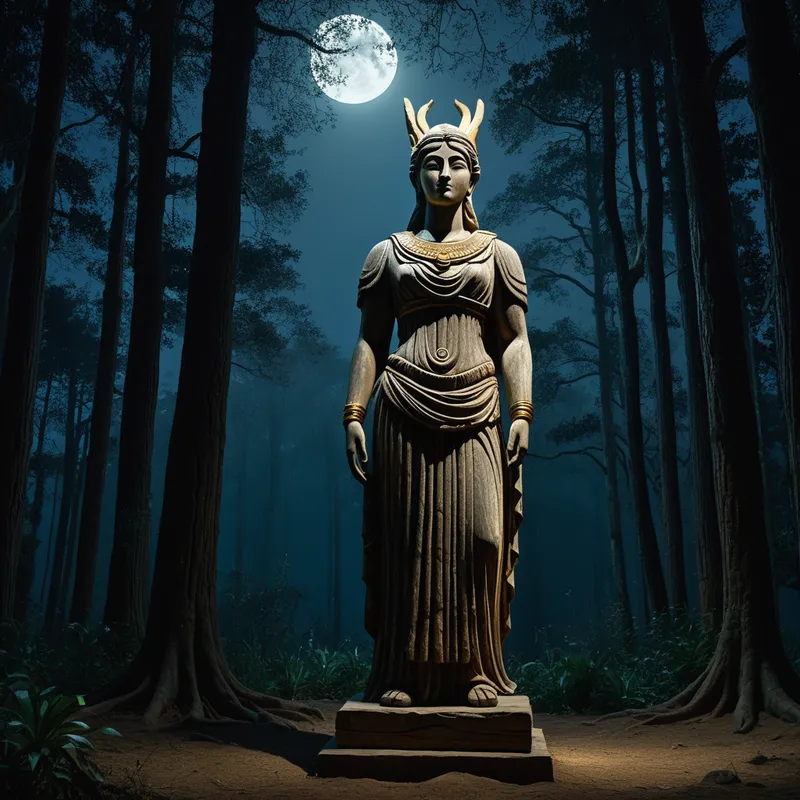
The myth of the Xoanon tells of the first, crude wooden idols of the gods, embodying the raw, terrifying, and authentic face of the divine before civilization.
The Tale of Xoanon
Listen. Before the marble gods, before the perfect proportions and serene smiles carved by mortal hands, there was the wood. There was the tree that fell in the sacred grove, struck by a sky-born fire or chosen by a trembling, awe-struck soul. They did not carve it so much as reveal it. With flint and reverence, they peeled back the bark, and in the grain, they saw a face—not a human face, but the face of the Artemis who dwells in the thicket, or the Dionysos who screams in the vine.
This was the Xoanon. A log, a plank, barely shaped. Its arms were stumps, its legs a single post. Its eyes were perhaps two discs of polished silver or simple painted circles, seeing everything and nothing. They dressed it in precious cloth, hung it with necklaces of amber and gold, anointed it with oil until the wood grew dark and glossy with centuries of devotion. It did not stand proudly in the open sun but resided in the innermost dark, the cella, where only the chosen could approach.
The people knew this was not a representation. It was. It was the god’s first dwelling, captured in a moment of epiphany. When the great temple was built around it, with columns reaching for the rational sky, the Xoanon remained at its heart—the dark, silent, primal core. It did not speak in oracles, but in a presence that thickened the air. To look upon it was not to admire artistry, but to stand before the origin of awe itself, raw and unmediated. It was the god before the god had a name you could call out comfortably in the marketplace. It was the divine as a shudder in the spine, a scent of damp earth and old smoke, the memory of the forest from which both the tree and the worshipper were born.
Cultural Origins & Context
The Xoanon belongs not to the age of Periclean Athens, but to the deep, mist-shrouded past of the Aegean world. Its roots are in the Neolithic and early Bronze Age, in the aniconic worship of spirits in stones, trees, and pillars. These objects were not idols in the later sense, but fetishes—vessels believed to hold intrinsic power. As Greek culture evolved from tribal to polis-based, these ancient cult objects were not discarded. They were sanctified, enveloped, and preserved.
Every major sanctuary had its story of a “fallen-from-heaven” or “not-made-by-mortal-hands” Xoanon. The most famous was the ancient statue of Athena Polias in the Erechtheion on the Athenian Acropolis, a crude wooden figure said to have fallen from the sky. These objects were the palladia of cities—their spiritual anchors. Their authenticity derived from their perceived antiquity and direct, miraculous origin. They provided a tangible link to the heroic age, a continuity of the numinous that transcended changes in artistic style or political power. The Xoanon was the cult’s heartbeat, around which the magnificent architecture, the elaborate festivals, and the philosophical discourses later pulsed.
Symbolic Architecture
The Xoanon is the ultimate symbol of the numinous in its raw, untranslated state. It represents the primordial encounter with the divine, which is inherently terrifying (mysterium tremendum) and fascinating (mysterium fascinans) all at once.
The Xoanon is the psychic fact before it is given acceptable form. It is the traumatic kernel, the ecstatic vision, the core complex, around which the entire structure of the ego and the persona must be built.
Psychologically, it symbolizes the authentic, often crude or shocking, content of the unconscious. It is the unprocessed emotion, the instinctual drive, the archetypal image in its most basic, potent form. The subsequent dressing of the Xoanon in rich garments and jewelry represents the human psyche’s necessary act of containment. We must cloak the raw, terrifying power of the unconscious (the rough wood) in the symbols, rituals, and narratives of our culture (the gold, the cloth) to be able to relate to it without being annihilated. The Xoanon is the Self in its most archaic manifestation—not the integrated, golden symbol of wholeness, but the central, non-negotiable, and often awkward truth of one’s being.
The Dreamer’s Resonance
To dream of a Xoanon is to encounter the bedrock of one’s own psyche. One might dream of a simple, dark wooden object in the basement of a modern house, or a faceless figure made of gnarled roots in a forgotten corner of a dream-library. The affect is key: it evokes a deep, primal reverence mixed with unease.
This dream signals a moment where the dreamer is confronting something fundamental and unadorned within themselves. It may feel alien, yet intimately familiar—an old, forgotten truth. The somatic sensation is often one of stillness, a dropping down into gravity, a feeling of confronting something that cannot be argued with or aestheticized. It is the dream equivalent of touching the “thing itself”—be it a core wound, a latent talent, a buried identity, or a spiritual calling in its most rudimentary, demanding form. The psyche is presenting its own foundational myth, its own non-negotiable sacred object, prior to all the stories the ego has told about it.
Alchemical Translation
The alchemical process mirrored in the myth of the Xoanon is the opus contra naturam: the work against nature, which here means the work of conscious engagement with the primordial. The rough, fallen tree (materia prima) is the unrefined substance of the soul. The first, crude shaping is the nigredo, the blackening—the confrontation with the shadowy, raw truth.
The individuation journey is not about creating the sacred from nothing, but about discovering the crude, innate Xoanon within and undertaking the lifelong ritual of clothing it in the gold of consciousness.
Dressing and anointing the statue represents the stages of albedo (whitening) and rubedo (reddening)—the processes of illumination, integration, and embodiment. We do not destroy or replace the primal core. We build a temple of understanding, discipline, and expression around it. The modern individual’s “temple” might be a creative practice, a psychological framework, a relationship, or a spiritual path. The goal is not to make the Xoanon look like a classical statue, but to honor its essential, archaic power while creating a conscious relationship with it. The triumph is the coexistence of the raw, numinous core and the elegant, lived structure—the dark, oil-scented wood eternally enshrined within the sunlit marble, each giving meaning and depth to the other.
Associated Symbols
Explore related symbols from the CaleaDream lexicon: