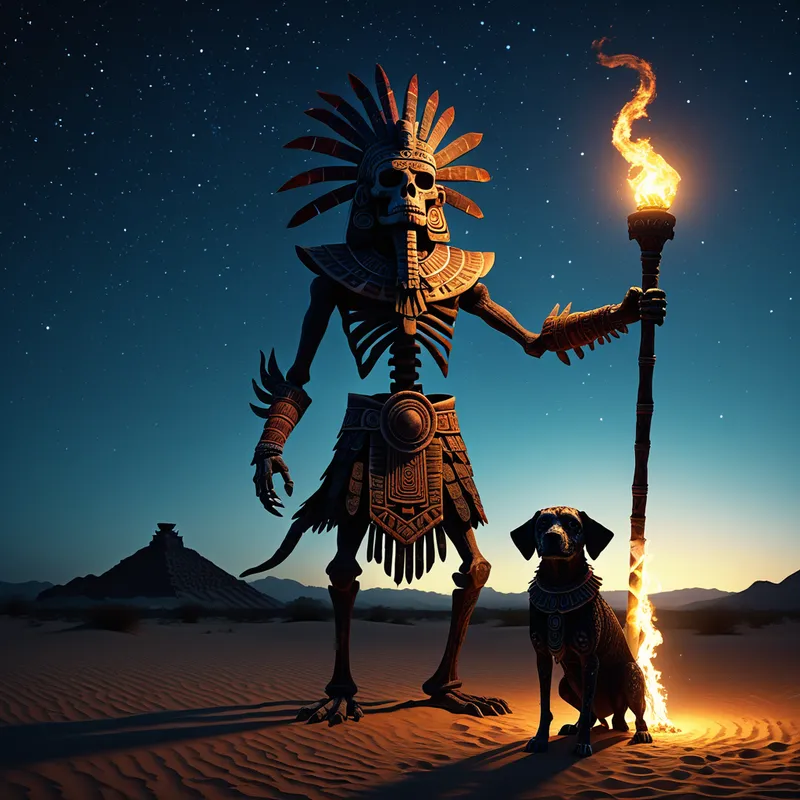
Xólotl Myth Meaning & Symbolism
The monstrous twin who refused death, transforming into all things to escape his fate, becoming the guide for souls through the underworld.
The Tale of Xólotl
[The world](/myths/the-world “Myth from Tarot culture.”/) was dark, and the gods were dying. In the sacred city of Teotihuacán, a terrible stillness had fallen. The Fourth Sun had perished, cast down into the black waters of the primordial sea. No light warmed [the earth](/myths/the-earth “Myth from Hindu culture.”/), no wind stirred the dust on the great pyramids. The divine assembly, the Teteoh, stood in a silent circle, their radiance dimmed to mere embers. A new sun was needed, a Fifth Sun, to set the cosmos in motion once more. But a sun requires a heart. A sun requires a sacrifice.
Two gods stepped forward. Tecciztecatl, proud and adorned in gold and quetzal feathers, offered himself first. And then, Nanahuatl, poor and covered in sores, covered only in paper garments, offered himself with trembling resolve. Two great pyres were built, burning for four nights. When the moment came, Tecciztecatl’s courage failed him; he could not leap into the divine furnace. Nanahuatl, without hesitation, closed his eyes and threw himself into the blaze. Shamed, Tecciztecatl followed.
From the ashes, two suns rose—blinding, magnificent, and immobile. The gods roared in dismay. A sun must move! It must journey across [the sky](/myths/the-sky “Myth from Persian culture.”/)! And so it was decreed: one of the gods must die, must give his life-force to push the sun on its course. The lot fell upon Xólotl, the twin, the double, the monstrous one with the head of a beast.
But Xólotl did not accept his fate. A great terror seized him, a terror deeper than the darkness. “I will not die!” he cried, and he fled. He did not run like a warrior, but like a creature possessed, his form shifting with his panic. He fled to the watery places and transformed himself into the axolotl, the “[water](/myths/water “Myth from Chinese culture.”/) monster,” hiding among the reeds. The gods found him. He fled to the cornfields and twisted his body into the twin stalks of the mexolotl, the “agave monster.” They found him again. Finally, in a field of young corn, he became the [xolotl](/myths/xolotl “Myth from Aztec culture.”/) itself, a deformed twin stalk. But the gods’ eyes were relentless.
Captured, Xólotl was slain. His life was taken, not in willing offering, but in desperate refusal. His essence, wrested from him, became [the force](/myths/the-force “Myth from Science Fiction culture.”/) that pushed the sun, that set the great celestial clockwork in motion. And from his final, failed transformation, a new role was born. The one who refused to die for the sun would now guide the dead. Xólotl, the evader, became the guide for the setting sun into the land of the dead, and the guide for human souls on the same perilous journey. The rebel became the companion. The coward became the essential guide.
Cultural Origins & Context
This myth is recorded in the Florentine Codex, compiled by the Franciscan friar Bernardino de Sahagún with the help of Nahua elders. It is a central narrative of the Legend of the Five Suns, explaining the origin of the current cosmic era. The story was not mere entertainment; it was a foundational truth, recited and performed to reinforce the most critical tenets of Aztec cosmology: that the world exists through periodic, catastrophic sacrifice, and that order is born from a debt paid in divine life.
Xólotl’s tale served a profound societal function. In a culture where ritual sacrifice was seen as a sacred duty to sustain the cosmos, the story of a god who refused that duty was a powerful didactic tool. It illustrated the ultimate futility of resisting cosmic necessity, while simultaneously acknowledging the raw, terrifying reality of that necessity. His final role as [psychopomp](/myths/psychopomp “Myth from Greek culture.”/) provided a comforting logic: even the being most opposed to death becomes its essential servant, ensuring that the journey, though inevitable, is not made alone.
Symbolic Architecture
Xólotl is the [archetype](/symbols/archetype “Symbol: A universal, primordial pattern or prototype in the collective unconscious that shapes human experience, behavior, and creative expression.”/) of the [shadow](/symbols/shadow “Symbol: The ‘shadow’ embodies the unconscious, repressed aspects of the self and often represents fears or hidden emotions.”/) twin. As the twin of the brilliant morning star, [Quetzalcoatl](/myths/quetzalcoatl “Myth from Aztec culture.”/), he represents the evening star—the same celestial [body](/symbols/body “Symbol: The body in dreams often symbolizes the dreamer’s self-identity, personal health, and the relationship they have with their physical existence.”/), but seen in descent, in darkness, in disappearance. He embodies [the principle](/symbols/the-principle “Symbol: A fundamental truth, law, or doctrine that serves as a foundation for a system of belief, behavior, or reasoning, often representing moral or ethical standards.”/) of duality made monstrous: the necessary counterpart that is ugly, fearful, and unwilling.
To refuse sacrifice is not to avoid transformation; it is to be transformed against your will, into something you never intended to become.
His three transformations are a masterclass in symbolic evasion. He becomes creatures and plants defined by their duality or liminal state: the axolotl (neither fully fish nor [lizard](/symbols/lizard “Symbol: A lizard symbolizes adaptability, survival instincts, and the ability to shed old skin to embrace new beginnings.”/), living in perpetual larval state), the doubled maguey stalk, the twin corn shoot. He tries to lose himself in the in-between, to become not-one-[thing](/myths/thing “Myth from Norse culture.”/)-nor-the-other, and thus escape categorization and [fate](/symbols/fate “Symbol: Fate represents the belief in predetermined outcomes, suggesting that some aspects of life are beyond human control.”/). Psychologically, Xólotl represents the part of the [psyche](/myths/psyche “Myth from Greek culture.”/) that screams “I will not!” in the face of a necessary, ego-shattering change—the part that would rather dissociate, hide, or deform itself than undergo a conscious [death](/symbols/death “Symbol: Symbolizes transformation, endings, and new beginnings; often associated with fear of the unknown.”/) and [rebirth](/symbols/rebirth “Symbol: A profound transformation where old aspects of self or life die, making way for new beginnings, growth, and renewal.”/).
The Dreamer’s Resonance
When the pattern of Xólotl stirs in the modern dreamscape, it often manifests as dreams of frantic hiding, of being chased, or of grotesque, involuntary bodily transformations. The dreamer may find themselves melting, growing gills in a boardroom, or turning into a potted plant while trying to give a speech. This is the somatic signature of a psyche confronting a non-negotiable demand for growth.
The feeling is one of profound, shame-filled resistance. [The ego](/myths/the-ego “Myth from Jungian culture.”/), facing an impending “sacrifice”—perhaps the end of a career, a relationship, a long-held identity, or the need to integrate a rejected part of [the self](/myths/the-self “Myth from Jungian culture.”/)—panics. It seeks every possible escape route, every psychological “transformation” that is not the true one: addiction, dissociation, a frantic shift into a new but inauthentic [persona](/myths/persona “Myth from Greek culture.”/) (the axolotl, the mexolotl). The dream is the unconscious stating clearly: you cannot hide from this death. Your attempts to do so are making you monstrous to yourself.

Alchemical Translation
The alchemical journey modeled by Xólotl is not one of heroic, willing surrender. It is the far more common path of the reluctant psyche, forced into its individuation. [The first stage](/myths/the-first-stage “Myth from Alchemical culture.”/) is [Nigredo](/myths/nigredo “Myth from Alchemical culture.”/)—the blackening, the confrontation with [the shadow](/myths/the-shadow “Myth from Jungian culture.”/). Xólotl is [the Nigredo](/myths/the-nigredo “Myth from Alchemical culture.”/): the monstrous, fearful twin we wish to disown.
The guide through the darkest passage is forged from our most stubborn refusal to enter it.
His flight and capture represent the inevitable failure of the ego’s evasion strategies. The psyche cannot sustain its deformations forever; reality, or the deeper Self, will “capture” it. His death is the Mortificatio—the killing of the old, rigid attitude of refusal. This is not a glorified death, but a messy, reluctant one. Yet, from this forced sacrifice arises his true function: [the psychopomp](/myths/the-psychopomp “Myth from Various culture.”/).
This is the alchemical gold. The energy that was spent on frantic evasion is transmuted into the capacity to guide. The part of us that most fears [the underworld](/myths/the-underworld “Myth from Greek culture.”/) of the unconscious becomes, once integrated, our most trusted companion for navigating it. We do not become fearless heroes. We become like Xólotl: scarred, reluctant, but intimately knowledgeable guides for our own souls through the necessary darknesses of transformation. The rebel, integrated, does not cease to question fate; instead, he learns to walk beside it, lighting [the way](/myths/the-way “Myth from Taoist culture.”/) with the torch born of his own consumed defiance.
Associated Symbols
Explore related symbols from the CaleaDream lexicon: