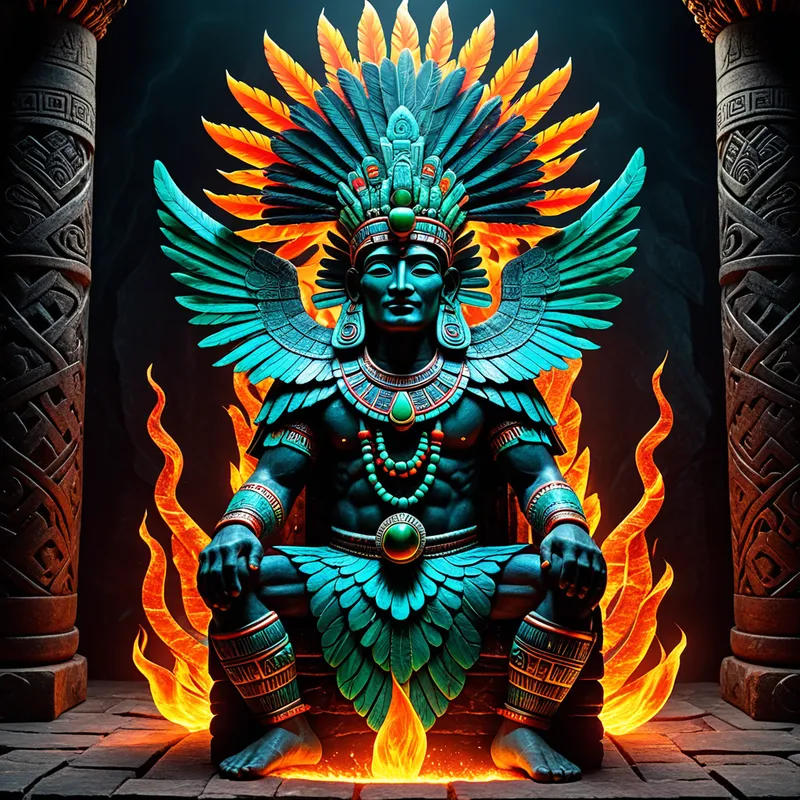
Xiuhtecuhtli Myth Meaning & Symbolism
The ancient, ever-present god of fire at the world's center, embodying the primal heat of life, the passage of time, and the soul's enduring spark.
The Tale of Xiuhtecuhtli
Listen. Before the first sun rose, before the gods drew blood to set the world in motion, there was a presence in the absolute dark. Not a shape, but a potential. A wanting. A cold so profound it yearned for its opposite. From this yearning, in the very center of the void, a spark kindled itself. It was not born; it declared itself. It was the first “I am.”
This was Xiuhtecuhtli. He was old when the other gods were young. While they schemed and sacrificed to move the sun, he was the unmoving center. His throne was the navel of the world, the axis of the four quarters. His body was not flesh, but the slow burn of obsidian and the sudden flash of lightning. His hair was smoke; his breath, the desert wind that fans the ember.
The other gods, the bright and hungry ones, would come to him in his temple of eternal twilight. They came not to command, but to petition. For without his foundational fire, their celestial lights were mere reflections. Quetzalcoatl needed his spark to breathe life into the bones of humanity. Huitzilopochtli needed his enduring heat to fuel his daily war across the sky. Even Tezcatlipoca, with his smoking mirror, saw his own schemes reflected in Xiuhtecuhtli’s unwavering flames.
His conflict was not with others, but with entropy itself. Each year, at the height of the dry season, the world grew brittle. The heat threatened to consume everything, to burn life back to ash. This was his moment of trial. The people would extinguish every fire in the land—in hearth, in temple, in palace. Total darkness would fall, a silence of light. In that terrifying stillness, they would enact the Binding of the Years. Priests would climb the hill of Citlaltépec, hearts drumming against their ribs, watching the stars. If the Tianquiztli crossed the zenith, it meant the world would continue.
Then, on the chest of a captive warrior, a priest would take a fire drill. With a prayer that was also a scream, he would twist the stick. Friction. Smoke. A gasp from the watching thousands in the black valley below. And then—a spark. A tiny, newborn tongue of flame, drawn directly from the ancient heart of Xiuhtecuhtli. This new fire would be carried, a rushing star of hope, to relight every hearth in the empire. The god had not been petitioned; he had been rekindled within the world. His triumph was not conquest, but continuance. The cycle was secured for another span. The center held.
Cultural Origins & Context
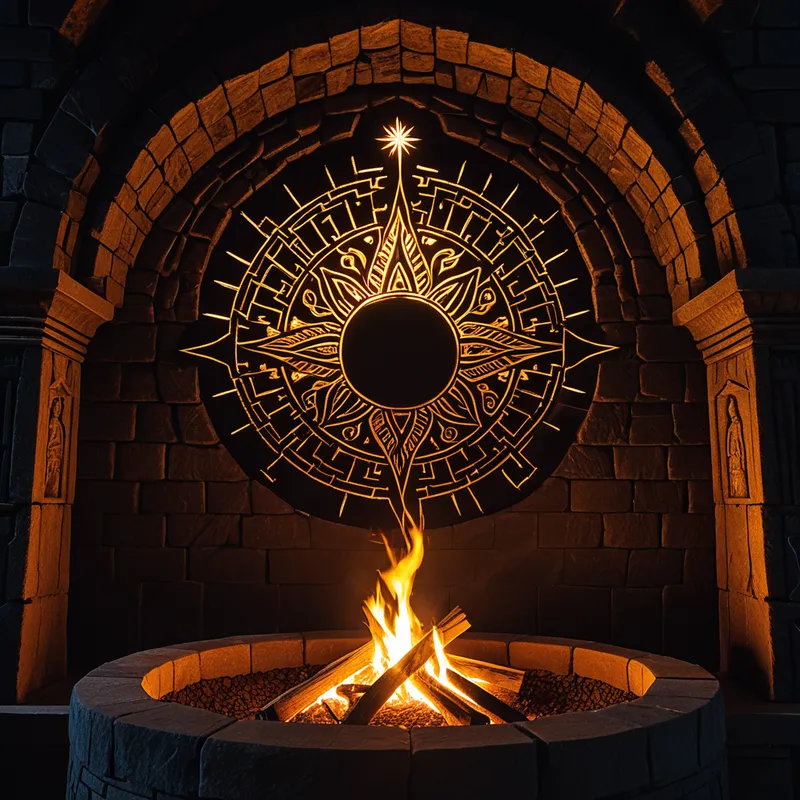
Xiuhtecuhtli was not merely an Aztec god; he was a deity of profound antiquity, inherited from the Toltecs and likely far older peoples. His name, “Turquoise Lord” or “Year Lord,” points to his dual dominion over precious, life-giving things (turquoise, fire) and over time itself. In the hyper-structured, cyclical world of the Aztec cosmovision, he was the still point. While other gods governed specific days or seasons, Xiuhtecuhtli was the foundational principle upon which all calendars, all rituals, all life depended.
His myth was not a single narrative told by bards, but a living reality enacted. It was passed down through the strict training of the priestly class and embodied in daily ritual. Every hearth was a miniature altar to him. Every 52-year cycle culminated in his grand, state-sponsored ceremony, the New Fire, which was less a story told and more a national psychodrama of renewal and existential dread. His societal function was absolute: he was the guarantor of cosmic order. Without his perpetual flame at the center, the four quarters would fly apart, time would stop, and the universe would end. He was the ultimate teotl—the sacred energy—of sustenance and continuity.
Symbolic Architecture
Xiuhtecuhtli is the archetype of the Axis Mundi, the World Pillar. He symbolizes the central, non-negotiable core of existence—both cosmically and psychologically.
The first fire is not the blaze that consumes, but the spark that insists. It is the primal “yes” at the heart of being, the will to exist against the void.
His turquoise adornment connects him to precious water and vibrant life, yet his element is fire. This is the alchemical union of opposites: the moist, life-giving blue-green stone married to the dry, transforming flame. He is the heat within the seed that prompts it to split and grow. Psychologically, he represents the libido not as sexual desire, but as fundamental life energy—the psychic fuel for all endeavors, the will to live and create. He is the ego’s foundational stability, the “I” that persists through all changes of mood, role, and age.
His manifestation as an old man signifies that this core energy is primordial, pre-existing the individual personality. The annual threat of his fire going out symbolizes the psychological truth that our central vitality is not guaranteed; it can be neglected, dissipated, or buried under ash. The New Fire ceremony is a profound symbol of deliberate, ritualized renewal—the conscious decision to reignite one’s central purpose.
The Dreamer’s Resonance
When Xiuhtecuhtli appears in the modern dreamscape, he rarely comes as a literal figure. He manifests as the experience of the center. One might dream of the foundation of their house being made of glowing coals. Or of a tiny, indestructible pilot light burning blue in a vast, cold engine. One might dream of being in a completely dark space and discovering, with immense relief, a single, warm ember in their own hand.
These dreams surface during times of existential fatigue, when life feels peripheral, scattered, or devoid of inner heat. The somatic sensation is often a hollow coldness in the chest or solar plexus, or conversely, a sudden, grounding warmth spreading from the core. Psychologically, this is the process of re-collection—of gathering the dispersed fragments of one’s energy and identity back to the center. The dream is pointing to a need for ritual, not in a religious sense, but in a psychological one: a deliberate, respectful act to tend the inner hearth. It signals that the dreamer’s “New Fire ceremony” is due.
Alchemical Translation
The individuation process, the journey toward psychic wholeness, requires a stable center from which to integrate the opposites of the personality. Xiuhtecuhtli models this as the first and most crucial alchemical operation: the discovery and maintenance of the inner athanor (the furnace).
The work is not to become the raging wildfire, but to become the hearth that contains it—the vessel that transforms raw, consuming heat into sustainable warmth and light.
The modern individual must first locate their own “navel of the world.” This is not the inflated ego, but the deeper, older Self—the timeless, enduring spark of consciousness that observes all personal transformations. The “Binding of the Years” translates to the necessary, often anxious, periods of self-assessment—the birthdays, the life transitions, the moments where we ask, “Is my fire still burning? Does my life have a center?”
The alchemical translation is the practice of sacred tending. It is the daily, often mundane, commitment to what fuels your core: the practices, relationships, and values that feed your inner flame. It is the courage, when life grows cold and scattered, to enact your own New Fire ceremony—to consciously extinguish the old, exhausted ways (the “fires” of burnt-out ambitions or identities), sit in the dark uncertainty, and through focused friction (effort, prayer, introspection), rekindle a new, purified flame from your own ancient center. In this myth, triumph is not a final victory, but the eternal, vigilant act of keeping the central fire alive. The ruler archetype is fulfilled not by controlling an external kingdom, but by stewarding the sovereign, fiery core of the self.
Associated Symbols
Explore related symbols from the CaleaDream lexicon: