Xiuhcoatl Myth Meaning & Symbolism
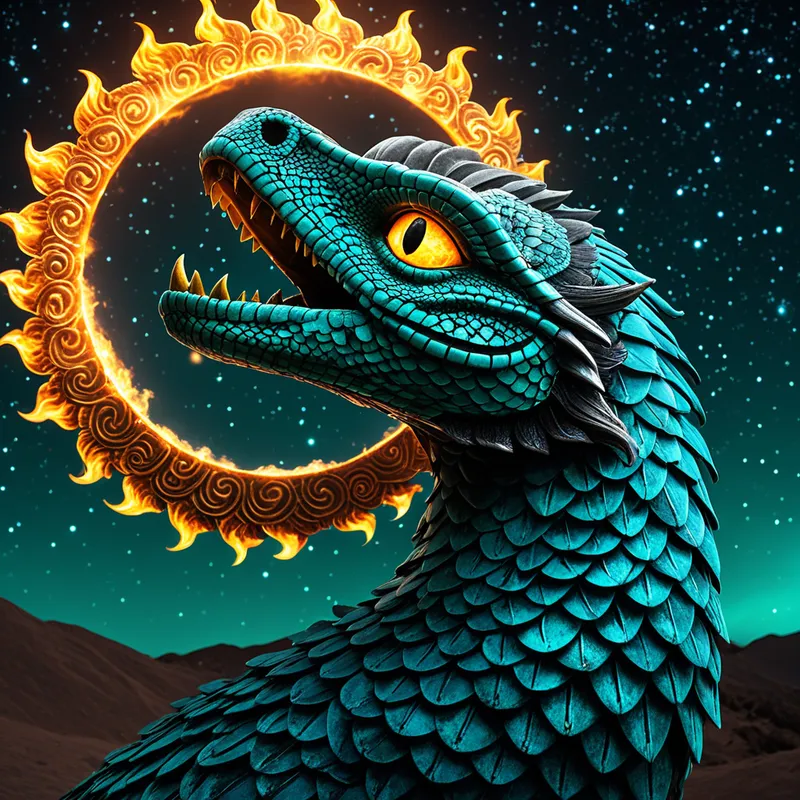
The celestial fire-serpent, weapon of the sun, whose cyclical destruction and renewal sustains the cosmic order through a pact of sacred sacrifice.
The Tale of Xiuhcoatl
Listen. The world is dark and cold, and the stars are hungry. They glitter like a million knife-points in the belly of the night, Coyolxauhqui, and her four hundred brothers, the Centzon Huitznahua. They have come to the sacred mountain, Coatepec, with murder in their hearts. Their target is their mother, Coatlicue, who has been mysteriously impregnated by a ball of feathers. They see her condition as a profound dishonor, a stain upon their celestial family. They sharpen their obsidian blades on the mountain’s stone ribs.
High on Coatepec, Coatlicue trembles, feeling the malice rising like a chill wind. But in her womb, the child hears the threat. He is Huitzilopochtli, and he is born not as a mewling infant, but as a fully formed warrior, painted for battle, his body humming with divine fury. He has no time for childhood. The crisis is now.
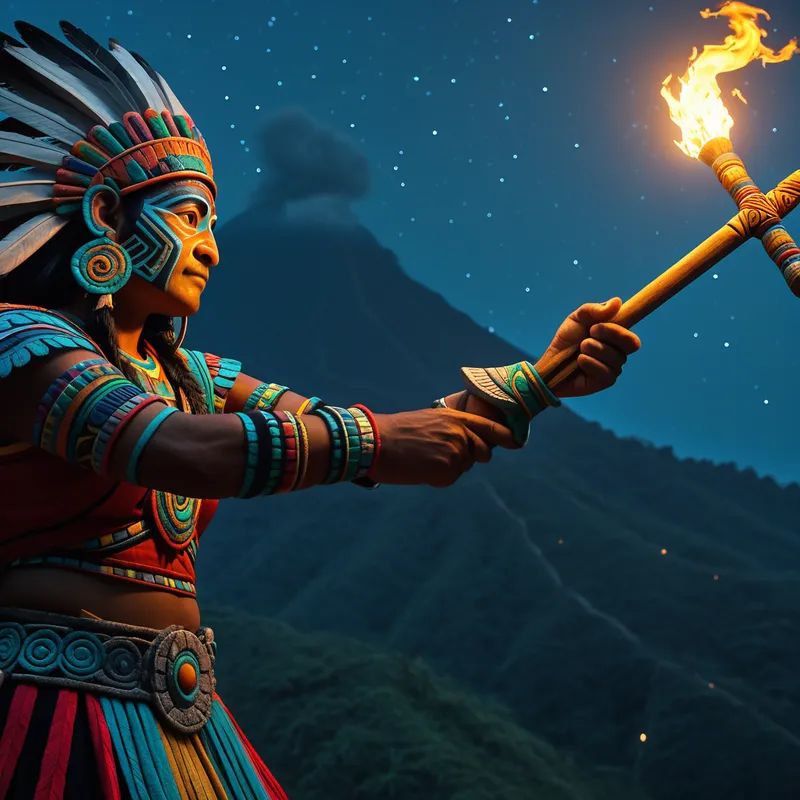
From the heavens, Coyolxauhqui leads the charge, her silver body cutting through the darkness, her brothers swarming behind her like a cascade of malevolent fireflies. Huitzilopochtli does not reach for a common spear. He extends his hand, and the mountain itself answers. From its volcanic heart, from the place where time itself is forged and unmade, he summons his weapon. It is not merely a tool; it is a force of nature given form. The Xiuhcoatl.
It manifests as a spear-thrower, an atlatl, but one wrought from living turquoise and obsidian, wreathed in a fire so pure it burns blue-white. It is the serpent of time, the serpent of drought and burning years, the embodiment of the sun’s scorching path. With a roar that shakes the foundations of the world, Huitzilopochtli hurls the Xiuhcoatl.
It flies not as a projectile, but as a blazing comet, a river of annihilating light. It strikes Coyolxauhqui with the force of a solar flare. The impact is catastrophic and precise. Her starry body is shattered, dismembered, her limbs scattering down the mountainside. The Xiuhcoatl does not stop. It becomes a whirlwind of fire, pursuing the four hundred star-brothers, cutting them down without mercy, until not a single hostile light remains in that quarter of the sky.
The battle is over in a moment that lasts an eternity. Huitzilopochtli stands victorious upon Coatepec. He picks up the head of his fallen sister and flings it into the sky, where it becomes the moon, a cold, broken reminder orbiting the world forever. And the Xiuhcoatl, its task complete, returns to its master—not as a weapon sheathed, but as a living covenant. For this act of destruction is not an end, but the first note in a song that must be sung every single day. The sun has been born through violence, and only through perpetual sacrifice will it ever rise again.
Cultural Origins & Context
This myth was the central, beating heart of the Mexica (Aztec) cosmic vision. It was not merely a story of the distant past but a living, breathing model of present reality, performed daily in the grandeur of the Templo Mayor. This pyramid was Coatepec itself, and at its summit, the shrines to Huitzilopochtli and Tlaloc re-enacted the primordial drama. The myth was passed down through generations of priestly custodians and tlamatinime (wise ones), recited during ceremonies and encoded in spectacular ritual re-enactments.
Its societal function was existential. The Aztecs lived in a cosmos perpetually on the brink of collapse, having survived four previous world ages, or “Suns.” The Fifth Sun, the era of movement, was born at Teotihuacan through the self-immolation of the gods. Huitzilopochtli’s battle on Coatepec was a parallel, sustaining event. It established the fundamental law of the universe: tonalli (solar life-force) must be fed with the most precious substance—chalchihuatl, the precious liquid of life, found in human blood. The Xiuhcoatl was the instrument of this divine logic. Every sunrise was Huitzilopochtli’s victory over the forces of night (the stars); every sunset was his journey through the underworld, requiring strength for the next day’s battle. The myth justified and sanctified the state’s most profound duty: the guerra florida (Flowery War) to capture sacrificial victims, whose hearts were offered to “feed” the sun-serpent and ensure the world’s continuation.
Symbolic Architecture
The Xiuhcoatl is not a monster but a principle. It is the archetypal force of necessary, purgative destruction that precedes all creation. It represents the inexorable, cyclical nature of time (xiuhpohualli, the year count), which both gives life through the seasons and takes it away through drought and fire.
The Fire Serpent is the moment when the old self, the stagnant constellation of habits and identities, must be shattered so that a new, more conscious order can ascend.
Psychologically, Coyolxauhqui and her star-brothers symbolize the fragmented, complex, and often hostile aspects of the unconscious psyche—the “family” of inherited patterns, sibling rivalries, and lunar emotions (reflective, cold, reactive) that rise up to attack any new, integrative consciousness (Huitzilopochtli) forming in the womb of the soul (Coatlicue, the embodied Self). The Xiuhcoatl is the focused, solar will of the emerging consciousness. It is the incisive insight, the fiery discipline, or the traumatic event that dismembers the old, complexified state of being. This dismemberment is not annihilation for its own sake, but a ruthless reorganization. The moon is not destroyed; it is transformed and placed in orbit, its reflective light now serving the new psychic totality.
The Dreamer’s Resonance
When the Xiuhcoatl appears in modern dreams, it rarely manifests as a literal Aztec serpent. It may be a sudden, purifying fire in a childhood home; a laser-like beam of light cutting through a tangled forest of thoughts; or a feeling of being gripped by a force of immense, transformative heat during a crisis. The somatic experience is often one of intense, focused energy—a burning in the chest or a sensation of being “forged.”
This dream signals that the dreamer is in a profound state of psychic alchemy. The “Coatepec moment” has arrived: an old, complexified structure of the personality (a long-held grievance, a career identity, a family role) has become a hostile constellation blocking new growth. The rising “Huitzilopochtli” consciousness—the Self seeking greater integration—is calling forth its ultimate weapon. The dreamer is undergoing the terrifying but necessary process of de-integration. The comforting, familiar, yet limiting patterns (the starry siblings) are being actively broken down. The dream is the psyche’s dramatic enactment of this inner civil war, assuring the dreamer that this destructive fire is sacred, not psychotic. It is the prelude to renewal.
Alchemical Translation
The individuation process modeled here is not one of gentle growth, but of revolutionary, solar triumph. The modern individual must become both Coatlicue (the vessel receiving the mysterious, fecund inspiration), Huitzilopochtli (the warrior of consciousness who defends and acts), and the wielder of the Xiuhcoatl.
The first step is to recognize the “Coyolxauhqui complex”: the beautiful, compelling, yet ultimately fragmenting narrative of victimhood, blame, or old familial loyalties that attacks any new, authentic life forming within us. We must then locate our personal Xiuhcoatl—that incisive faculty of discernment, truth, or will that can cut with surgical precision. This is not about uncontrolled rage, but about focused, sacred violence against inner oppression.
To wield the Fire Serpent is to accept the terrible responsibility of one’s own becoming, to sacrifice the beloved complexities of the past for the fierce simplicity of an authentic future.
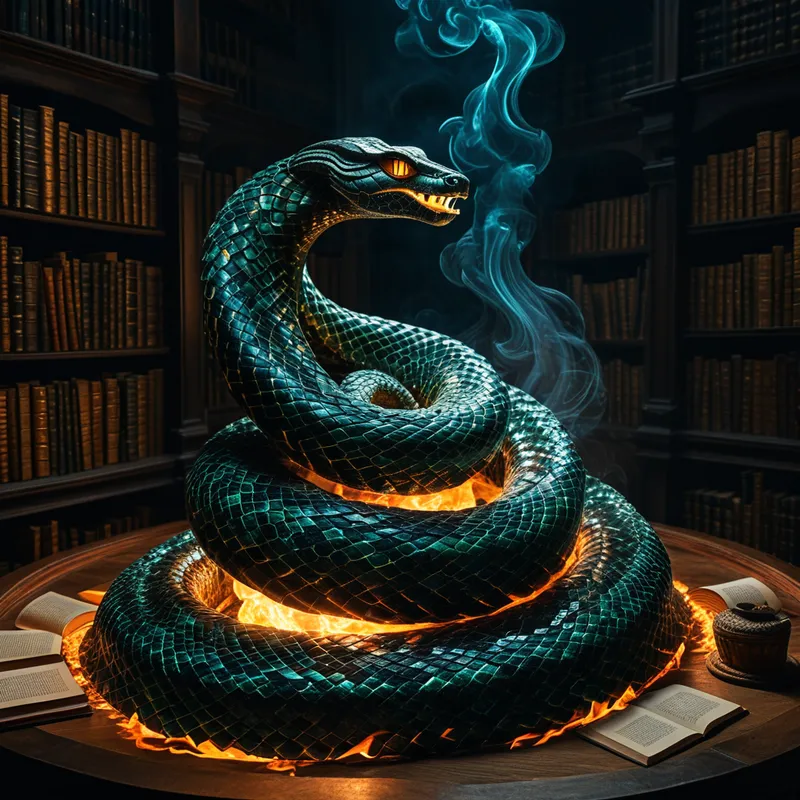
The final, alchemical translation is in the repetition. Huitzilopochtli must wield the Xiuhcoatl every day. For us, this means the work of consciousness is not a one-time battle but a daily practice. Each morning, we must choose to sacrifice the “star-stuff” of distraction, fear, and inertia to fuel our inner sun’s journey. We dismember the past not to banish it, but to place it in proper orbit—as memory, not as ruler. In doing so, we participate in the ancient, sacred pact: we feed the serpent of time with our attention and our courage, and in return, it grants us another day of conscious life, another cycle in the ongoing creation of our world.
Associated Symbols
Explore related symbols from the CaleaDream lexicon: