Xipe Totec Myth Meaning & Symbolism
The Flayed Lord whose golden skin, torn from a sacrificial victim, becomes the fertile earth, embodying the brutal, necessary cycle of death and rebirth.
The Tale of Xipe Totec
Listen. The world was hard and dry. The sun, Tonatiuh, hung like a great, hungry eye in the sky, and the earth, Cipactli, lay parched and cracked. The corn withered in the fields; the people’s bones showed through their skin. They cried out, but the gods were silent, for a balance had been broken. Life had consumed without giving back.
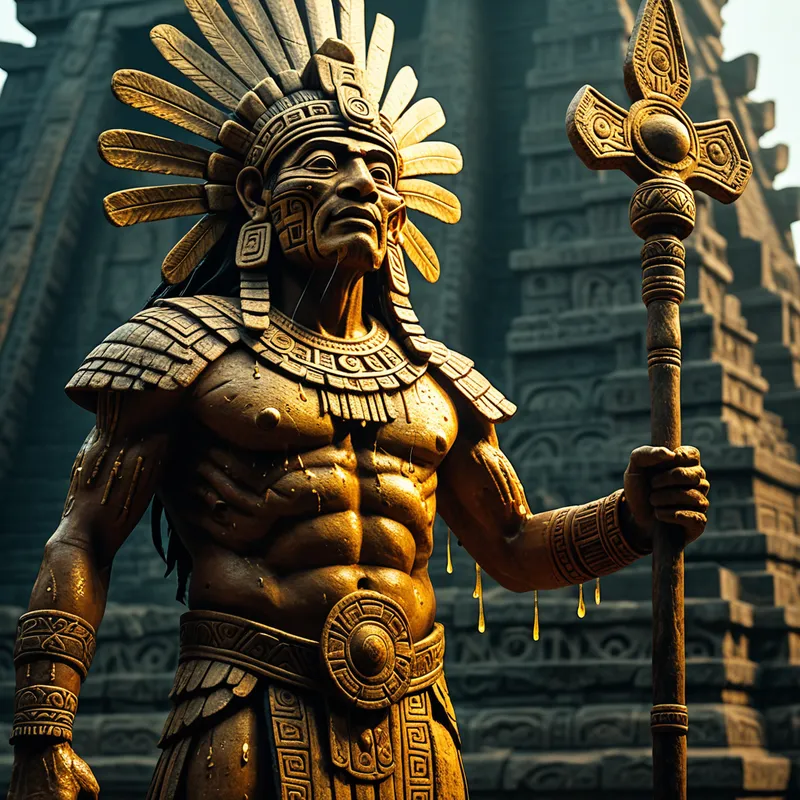
Then, from the eastern horizon, where the sun is born, a figure emerged. He was not beautiful. His name was Xipe Totec, and he wore a second skin. It was the skin of a warrior, taken in the Tlacaxipehualiztli, still glistening and raw. It hung from him like a loose garment, the hands dangling, the face a hollow mask over his own. He carried a staff, a chicahuaztli, that sounded not with music, but with the dry rustle of seeds in a gourd.
He walked into the heart of the city. The people recoiled in horror and awe. “Why do you wear this terrible cloak?” they whispered. Xipe Totec did not speak with words. He raised his rattle. The sound was the sound of bones shaking in the earth, of pods splitting open. He pointed to a barren field. Then, with a movement both tender and grotesque, he began to peel the golden, bloody skin from his own body.
It came away not as a corpse’s hide, but as a living membrane. As it fell upon the cracked earth, a miracle unfolded. The blood did not stain; it soaked in. The skin did not rot; it melted. Where it touched the soil, the hard ground softened. From beneath the dreadful offering, green shoots pushed forth—tender maize, vibrant squash, blooming beans. The flayed skin became the fertile earth itself. The god stood revealed beneath, his own body shining, not with gore, but with the luminous, polished gleam of spring rain on new growth. He was both the sacrificer and the sacrificed, the slayer and the seed. The horror of the skin was the promise of the harvest. The people understood. To receive life, life must be given. The old form must be torn away so the new form may emerge.
Cultural Origins & Context
The myth of Xipe Totec was central to the Aztec world view, a civilization deeply attuned to the precarious cycles of existence. His primary festival, the Tlacaxipehualiztli (“The Flaying of Men”), held in the spring equinox month of the same name, was not mere barbarism but a profound, communal ritual of agricultural and cosmic renewal. The myth was passed down through generations of priests, the tlamatinime (“knowers of things”), and enacted with terrifying literalism on temple platforms.
The captured warriors, dressed in the regalia of Xipe Totec, were not merely killed; they were transformed into living avatars of the god. Their sacrifice and subsequent flaying mirrored the mythic act. Their skins were then worn by priests for twenty days, dancing through the city, symbolizing the god walking among his people, the dead skin nurturing the living community. This practice embedded the myth into the very flesh and senses of the populace. It was a brutal, somatic theology: renewal is not a gentle metaphor, but a physical, often violent, stripping away. The myth served to explain the necessity of war (to obtain sacrificial “seed”), to ensure agricultural fertility, and to model the fundamental Aztec concept that life, energy (teotl), is constantly consumed and must be constantly replenished through sacred debt-payment.
Symbolic Architecture
At its core, Xipe Totec is the archetype of the necessary decay. He is the psychological truth that growth is predicated on loss. The flayed skin is the ultimate symbol of the persona—the outer identity we present to the world, forged from experience, trauma, and social expectation. This skin can become a prison, a dead, desiccated thing that no longer contains our burgeoning life.
To be reborn, one must first consent to be flayed. The ego, that which believes itself to be the self, must be sacrificed to make room for the Self.
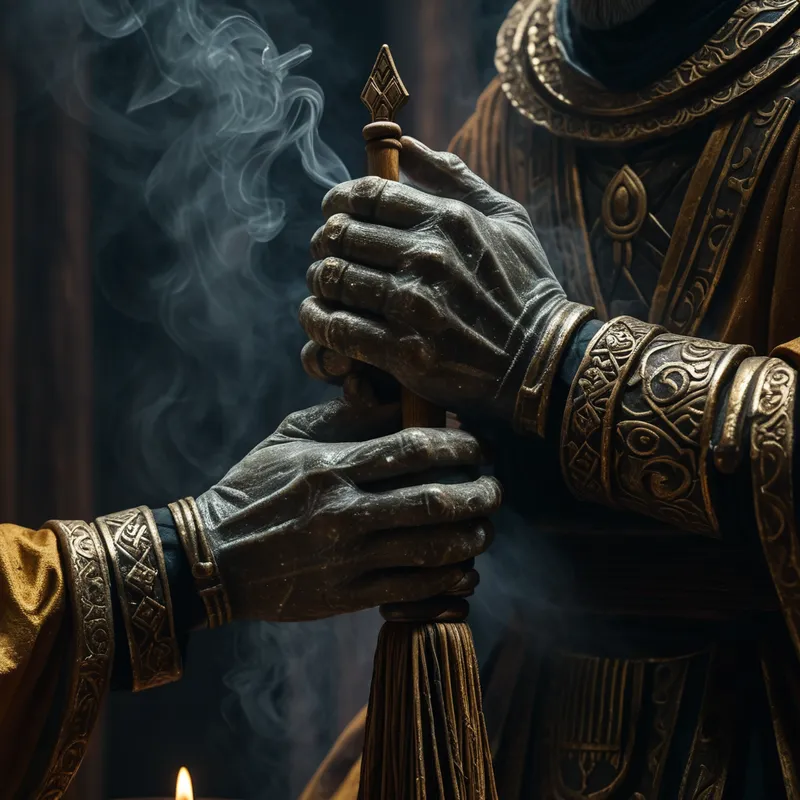
The golden hue of the worn skin connects him to the sun and to goldsmiths, revealing another layer: the alchemical process. Base metal (the old self, the captive identity) is subjected to fire and violence (the sacrifice) to reveal the precious metal within (the renewed, authentic self). Xipe Totec does not create from nothing; he transmutes through destruction. The chicahuaztli, his rattle staff, is the sound of this potential—the seeds of new life rattling in the hollow vessel of the old form, waiting for the shell to break.

The Dreamer's Resonance
When this myth stirs in the modern psyche, it manifests in dreams of profound, often unsettling, transformation. One does not dream of Xipe Totec directly, but of his process. You may dream of shedding your own skin like a snake, but it is painful and slow, tearing like cloth. You may dream of wearing a mask or a uniform that has fused to your face, and the struggle to remove it is agonizing. You may find yourself in a sterile room (the temple) being meticulously prepared for an unknown procedure.
Somatically, this can correlate to periods of intense life transition—the end of a career, a relationship, a long-held identity (as a caregiver, a high-achiever, a victim). The psychological process is the ego’s confrontation with its own limitation. The “skin” to be flayed is the outmoded adaptation: the people-pleaser, the perpetual hero, the cynic. The dream imagery signals that this structure, once protective, is now a dead weight suffocating the soul’s growth. The anxiety and horror in the dream are the ego’s rightful terror at its own dissolution.

Alchemical Translation
The individuation journey modeled by Xipe Totec is the via negativa—the path of removal. Where other myths involve quests and acquisition, his myth is about surrender and stripping bare. The modern individual engaged in this alchemy is not seeking to add more skills, more knowledge, or more accolades (more “skin”). They are engaged in the excruciating work of subtraction.
The first stage is Capture. This is the conscious recognition that you are bound by an identity that is not yours. You have been captured by family expectations, cultural narratives, or your own past successes. You wear their uniform.
The second is Sacrifice. This is the voluntary offering of that identity on the altar of truth. It feels like a death—of a role, a dream, a self-image. This is the moment of quitting the soul-killing job, ending the toxic relationship, or admitting a long-held belief is false.
The third is Flaying. This is the active, often painful, work of therapy, shadow-work, or deep introspection. It is peeling back the layers of habit, defense mechanism, and trauma to see what lies, raw and vulnerable, beneath.
The golden skin is not the goal; it is the discarded vehicle. The goal is the luminous, fertile being that stands revealed once the borrowed identity falls away.
The final stage is Germination. The energy once used to maintain the old persona is now freed. Like the seed nourished by the decaying skin, new life—authentic desires, creative impulses, genuine connection—sprouts from the compost of the old self. You become both the priest who performs the rite and the god who is reborn from it. You hold the rattle staff, and its sound is the rhythm of your own, newfound life.
Associated Symbols
Explore related symbols from the CaleaDream lexicon: