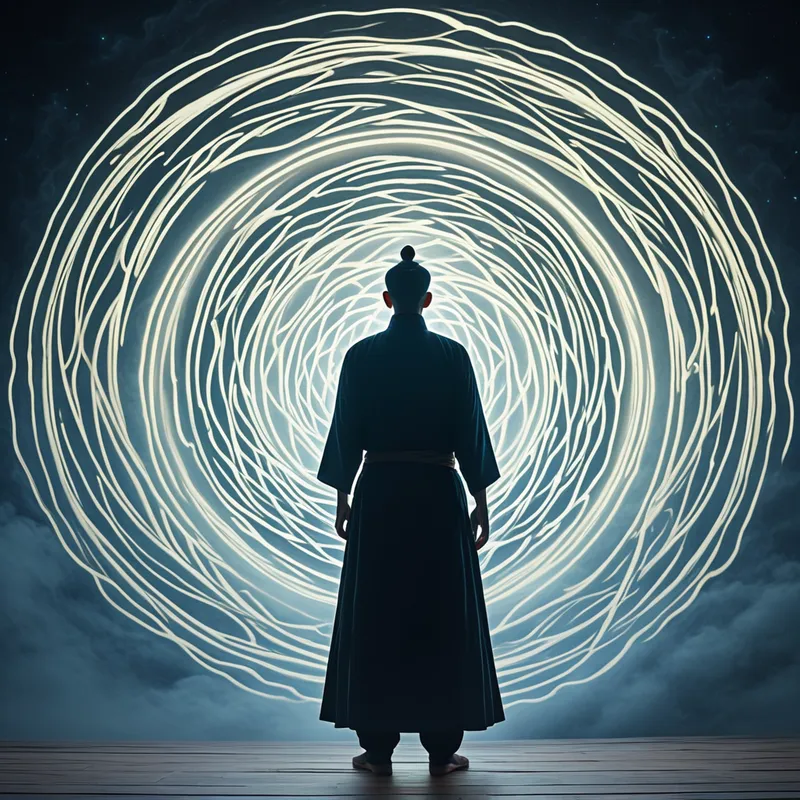
Wu Ji Myth Meaning & Symbolism
The story of Wu Ji, the boundless, undifferentiated state before existence, from which all polarity and the cosmos itself emerges.
The Tale of Wu Ji
Before the whisper of a name, before the concept of a beginning, there was a state without state. It was not darkness, for darkness implies the memory of light. It was not silence, for silence is the echo of sound that has ceased. It was not emptiness, for emptiness is a vessel waiting to be filled.
This was Wu Ji.
Imagine a shoreless ocean with no [water](/myths/water “Myth from Chinese culture.”/), a sky without height or depth, a mind before the first thought. It was perfect, complete, and utterly whole in its absence of distinction. There was no here or there, no this or that, no self or other. It was the ultimate, serene potential, dreaming a dream of nothing in particular.
Within this boundless non-state, a subtle inclination arose. It was not a will, not a desire, but a gentle, inevitable leaning—like a breath held for an eternity, preparing to be released. This inclination was the first hint of movement within absolute stillness, a soft focus within infinite diffusion. It was the seed of a question not yet asked.
From this inclination, a center manifested—not a place, but a point of [reference](/myths/reference “Myth from Global/Universal culture.”/) within the referenceless. This was the Tai Ji, the Supreme Pivot. It was the first stirring, the primordial axis around which the dance of existence would soon whirl. At this still point, the undifferentiated potential of Wu Ji began to turn in upon itself, not with violence, but with the natural, graceful inevitability of a flower deciding to bloom.
And from that turning, the first great breath was drawn. The one became two. From the Tai Ji emerged the luminous, active, ascending principle of Yang, and the receptive, dark, descending, and nurturing principle of Yin. They were not opposites, but complements, born from the same breath, forever chasing and containing one another in the great, slow dance of the cosmos. The ten thousand things—the mountains and rivers, the creatures and stars, joy and sorrow, life and death—all followed in their wake, cascading into being from that single, silent turn within [the Void](/myths/the-void “Myth from Buddhist culture.”/).
Thus, the story is not one of a creator god speaking a command, but of the formless finding its own rhythm. It is the myth of the universe awakening from a dream of pure being into the playful, paradoxical, and beautiful dream of becoming.
Cultural Origins & Context
The concept of Wu Ji is foundational to Taoist cosmology and philosophy, most systematically articulated in the neo-Confucian text Tai Ji Tu Shuo (Explanation of the Diagram of the Supreme Ultimate) by Zhou Dunyi in the 11th century. However, its roots sink deep into the primordial soil of Chinese thought, evident in the cryptic verses of the Dao De Jing: “[The Tao](/myths/the-tao “Myth from Taoist culture.”/) that can be told is not the eternal Tao. The name that can be named is not the eternal name. The nameless is the beginning of heaven and earth.”
This was not a myth told around fires with characters and plots, but a metaphysical narrative passed down through sage-kings, philosophers, and alchemists. It functioned as the ultimate cosmological map, explaining the origin and nature of reality not as an act of creation ex nihilo by a deity, but as a spontaneous, organic process of emanation from a state of primordial integrity. It provided a model for understanding change, conflict, and harmony in the natural world, in society, and within the human spirit. To know Wu Ji was to understand the source and to which all things ultimately return.
Symbolic Architecture
Psychologically, Wu Ji represents the unconscious in its purest, most undifferentiated state—the [pleroma](/symbols/pleroma “Symbol: In Gnostic cosmology, the Pleroma is the divine fullness or totality of spiritual powers, representing the realm of perfection beyond the material world.”/), the unformed ground of being from which [consciousness](/symbols/consciousness “Symbol: Consciousness represents the state of awareness and perception, encompassing thoughts, feelings, and experiences.”/) itself emerges. It is the psychic [condition](/symbols/condition “Symbol: Condition reflects the state of being, often focusing on physical, emotional, or situational aspects of life.”/) before [the ego](/myths/the-ego “Myth from Jungian culture.”/) is formed, before the complexes split the [psyche](/myths/psyche “Myth from Greek culture.”/) into warring factions, before we learn to name and categorize our experience.
The journey from Wu Ji to Tai Ji is the birth of consciousness from the unconscious, the necessary and painful fall into duality that makes self-awareness possible.
The Tai Ji symbolizes the emergent ego, the first point of self-reference that says “I am.” This is not a flaw, but the beginning of the [individuation process](/symbols/individuation-process “Symbol: The psychological journey toward self-realization and wholeness, integrating conscious and unconscious aspects of personality.”/). The subsequent generation of Yang and Yin represents the primary splitting of the psyche into fundamental opposites: conscious and unconscious, [persona](/symbols/persona “Symbol: The social mask or outward identity one presents to the world, often concealing the true self.”/) and [shadow](/symbols/shadow “Symbol: The ‘shadow’ embodies the unconscious, repressed aspects of the self and often represents fears or hidden emotions.”/), [logic](/symbols/logic “Symbol: The principle of reasoning and rational thought, often representing order, structure, and intellectual clarity in dreams.”/) and [intuition](/symbols/intuition “Symbol: The immediate, non-rational understanding of truth or insight, often described as a ‘gut feeling’ or inner knowing that bypasses conscious reasoning.”/), [activity](/symbols/activity “Symbol: Activity in dreams often represents the dynamic aspects of life and can indicate movement, progress, and engagement with personal or societal responsibilities.”/) and receptivity. The “ten thousand things” are all the myriad contents of our personal and collective psyche—our thoughts, emotions, memories, and drives.
The Dreamer’s Resonance
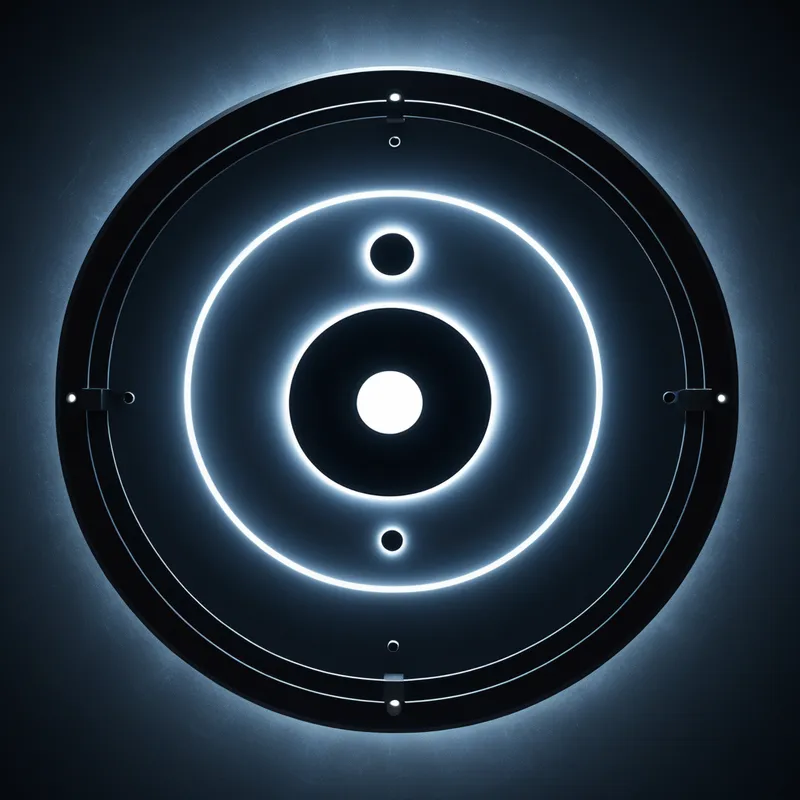
When this mythic pattern stirs in the modern dreamer, it often manifests in dreams of profound emptiness, vast spaces, or primordial landscapes. One might dream of floating in a silent, grey ocean under a uniformly grey sky, where direction and identity dissolve. Or of standing in an endless, featureless plain or a blank, white room. These are not dreams of terror, but of deep, unsettling peace—the ego momentarily touching the boundless ground of Wu Ji.
Such dreams frequently precede or follow periods of major life transition, breakdown, or breakthrough—a divorce, a career change, a spiritual awakening, or a deep depression. They signal a dissolution of old structures. The conscious personality, with its rigid categories and identities, is being called back to the source for reconstitution. The somatic experience can be one of weightlessness, disorientation, or a quiet, pervasive anxiety of non-being. It is the psyche’s winter, where all forms are reduced to their essence, preparing for a new, more authentic spring.
Alchemical Translation
The alchemical work modeled by this myth is the opus contra naturam—the work against nature. Here, “nature” is the habitual identification with the differentiated world of the “ten thousand things.” The alchemical goal is not to remain in unconscious Wu Ji, but to consciously return to it, carrying with us the hard-won diamonds of our differentiated experience.
Individuation is not the perfection of the ego, but the ego’s graceful surrender to the greater rhythm of the Self, re-integrating the polarized fragments back into a conscious wholeness.
The process begins with [Nigredo](/myths/nigredo “Myth from Alchemical culture.”/), the blackening. This is the conscious descent into one’s own inner Wu Ji—facing the chaos, the depression, the meaningless, and the formless aspects of the psyche we spend our lives avoiding. It is allowing the old, rigid ego-structures to dissolve.
From this fertile void, the Albedo, or whitening, occurs. This is the emergence of the Tai Ji point—a new, more flexible center of consciousness that can hold paradox. Finally, the [Rubedo](/myths/rubedo “Myth from Alchemical culture.”/), or reddening, is the conscious dance of Yang and Yin within us. We no longer fight our opposites but see them as essential partners in a dynamic, creative tension. We achieve not a bland neutrality, but a vibrant, conscious wholeness that contains and transcends duality. We become a living Tai Ji, forever rooted in the silent wisdom of Wu Ji.
Associated Symbols
Explore related symbols from the CaleaDream lexicon: