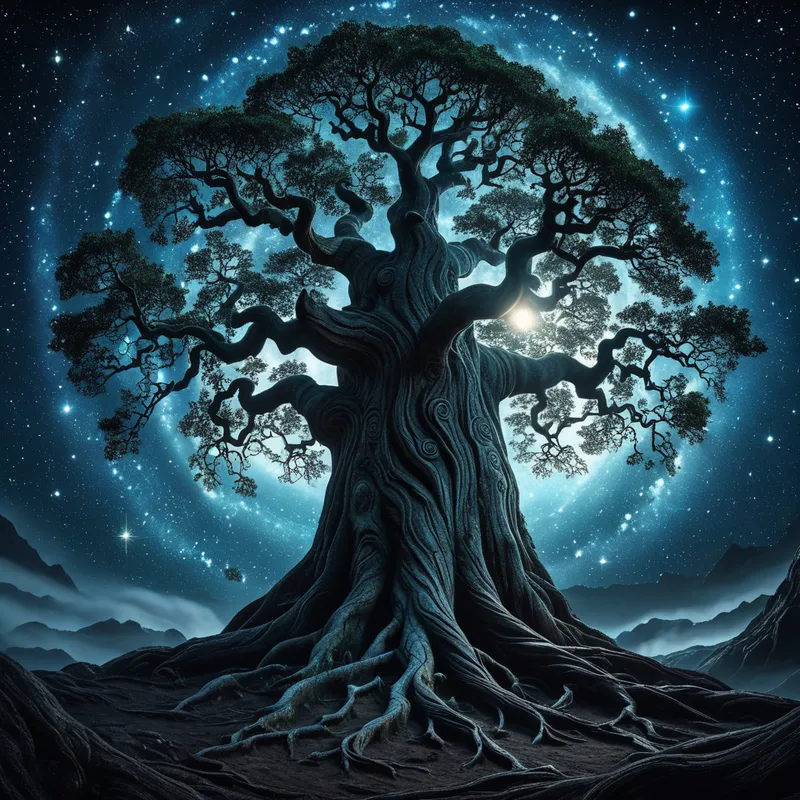
World Tree Myth Meaning & Symbolism
A cosmic axis connecting heaven, earth, and underworld, the World Tree is a universal symbol of life, order, and the soul's ascent through knowledge and sacrifice.
The Tale of the World Tree
Listen. Before the names of countries, before the borders of gods, there stood the First Pillar. It was not born of seed and soil, but of the great sigh that followed the first separation—when the One became the Many. Its roots are not of wood, but of longing, digging deep into the dark, moist soil of memory and forgotten things. There, in the Underworld, they drink from the well of Urd, where the Norns whisper and carve what was, what is, and what may be into the trunk’s living flesh.
Its trunk, vast beyond the grasp of any arms, rises through the Middle Realm—our world of solid stone and fleeting breath. Here, its bark is scored by the claws of eagles and the passage of centuries. The winds that ring its girth carry the songs of all peoples, the cries of birth, the silences of death. It is the axis around which the sun and moon dance their eternal chase.
And its branches… ah, its branches. They do not merely touch the heavens; they are the scaffold of the sky. They hold the sun, the moon, and the sharp, cold stars in their leafy grasp. In their highest boughs, an eagle of piercing sight keeps watch, while at the root, a serpent of boundless cunning coils, and between them, a squirrel of gossip runs, carrying tidings of strife from top to bottom. This is the great tension that sings through the wood.
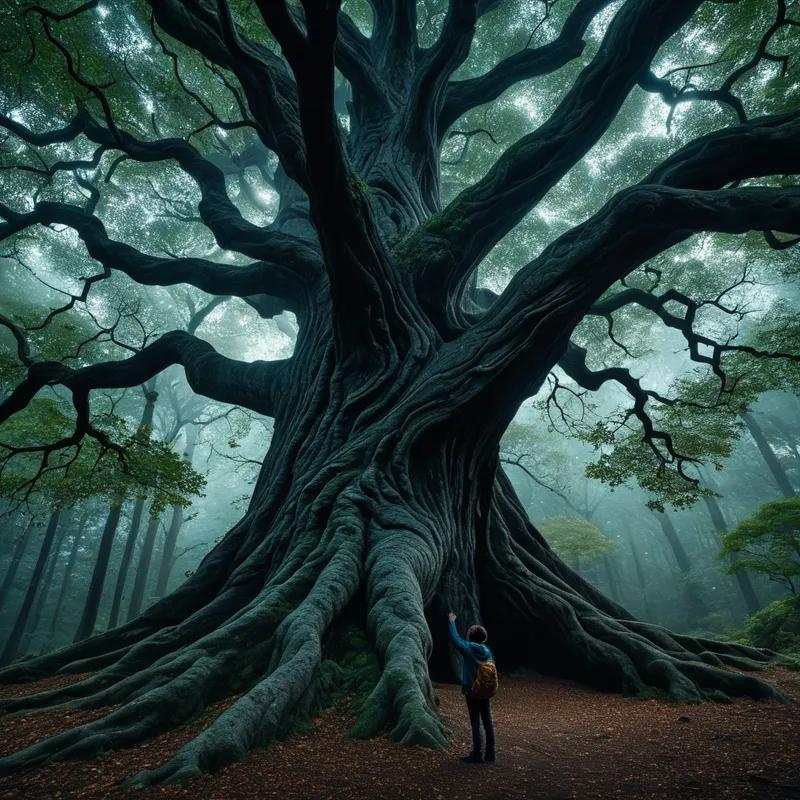
But the Tree is not merely a thing to be observed. It is a path to be walked. A daring one, a god or a mortal in a god’s skin, must climb. Not for conquest, but for knowing. The ascent is a stripping away. The bark scrapes the skin, the height steals the breath, the gaze of the eagle pierces the soul. The seeker hangs, suspended between realms, a sacrifice to oneself, for nine nights of the soul. In that agony of suspension, when the world below is shadow and the world above is a blinding fire, the final veil is torn. The seeker falls… but not downward. They fall into the Tree, into the secret of the runes, the law of things, the terrible, beautiful price of wisdom. They return not as they left, but as a bridge between the waters below and the lights above, having tasted the sap of the cosmos itself.
Cultural Origins & Context
The World Tree is not a myth owned by any one people; it is a pattern that emerged, independently and persistently, from the deep well of the human psyche. We find it as the Yggdrasil of the Norse, an ash tree trembling from the strife of its inhabitants. We find it as the Bodhi Tree in India, a silent witness to the end of suffering. It is the Etz Chaim with its ten spheres of divine emanation, the Tree of the Shaman in Siberia, and the Wacah Chan of the Maya.
This archetype was carried not by trade routes alone, but by the very structure of human experience. It was told by skalds in smoky mead halls, by shamans in trance, by priests in temples, and by grandmothers by the hearth. Its function was profound: to provide a cosmic model of order. In a vast, often terrifying universe, the World Tree placed the individual at the very center of a connected, meaningful cosmos. It explained the structure of reality (the three realms), the source of fate (the well at the roots), and the possibility of transcendence (the climb). It was the ultimate map, showing that the path to the divine, or to wisdom, wound directly through the core of the world—and by analogy, through the core of the self.
Symbolic Architecture
Psychologically, the World Tree is the ultimate symbol of the Self in its totality, as envisioned by Carl Jung. It represents the architecture of the psyche itself.
The roots are the unconscious—dark, tangled, foundational, drawing nourishment from the primal waters of instinct and ancestral memory. The trunk is the ego, the conscious self, standing in the daylight world, shaped by the winds of experience. The branches are the striving toward consciousness, the higher ideals, spiritual yearnings, and the connection to the transpersonal—what Jung called the archetypal realm.
The creatures that inhabit it are the dynamic, often conflicting, forces within us. The eagle is the soaring spirit and acute intellect; the serpent is the chthonic wisdom of the body and the unconscious; the squirrel is the restless, anxious mind that perpetuates inner conflict. The tree holds these opposites in a tense, living unity. Its perpetual state of being both “ever-green” and yet under constant threat—gnawed at by serpents, decaying at the root—mirrors the psyche’s simultaneous resilience and fragility. To know the tree is to know the full, interconnected system of one’s being.
The Dreamer’s Resonance
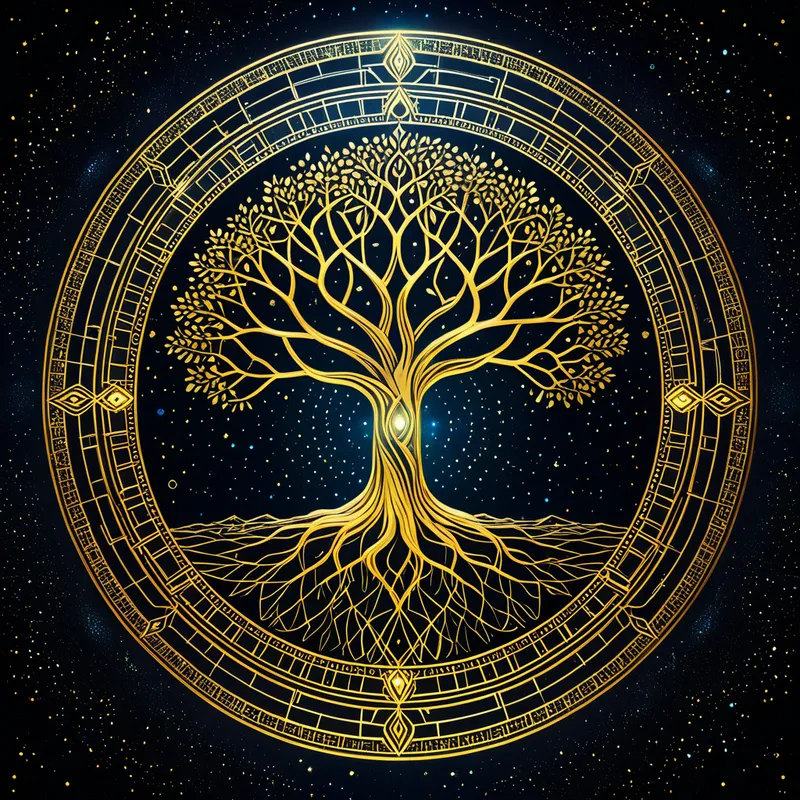
When the World Tree appears in a modern dream, it is rarely a peaceful pastoral image. It is a profound somatic signal. The dreamer may be undergoing a process of recentering or a crisis of connection. To dream of climbing the tree suggests an active, often arduous, engagement with integrating unconscious material (the roots) with conscious understanding (the branches). There is a quest for perspective, for a “view from above” on one’s life.
To dream of sitting beneath the tree, perhaps in its shade or roots, indicates a need for grounding, for drawing sustenance from one’s depths. The dreamer may feel spiritually or psychologically uprooted. A dream where the tree is dying or damaged often correlates with a feeling that one’s inner order is collapsing, that the connections between one’s instincts, daily life, and higher values are fraying. Conversely, dreaming of a sapling or a seed of this tree points to the nascent, fragile emergence of a new, more authentic psychic structure. The body may feel this as tension along the spine (the axis mundi of the physical form) or a deep, resonant calm—the somatic echo of finding one’s true center.
Alchemical Translation
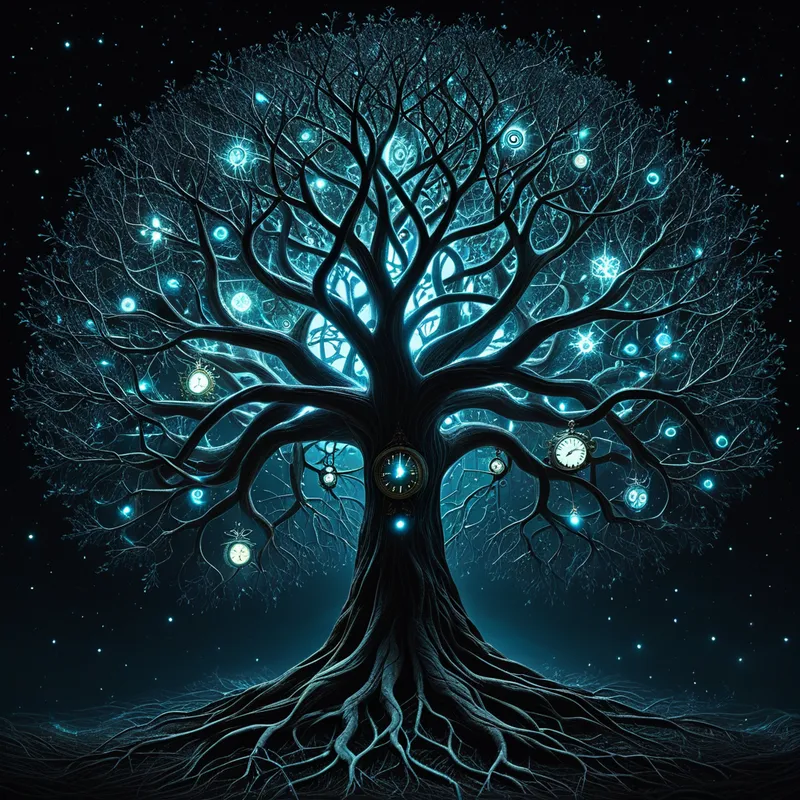
The myth of the World Tree is a perfect map for the alchemical process of individuation—the psychic transmutation of the lead of the fragmented personality into the gold of the integrated Self. The initial state is one of disconnection: we identify only with the trunk (the ego), ignoring the dark roots and feeling unworthy of the high branches.
The alchemical work begins in the nigredo, the blackening, represented by the descent to the roots. This is the confrontation with the shadow, the personal underworld. One must “drink from the well of Urd,” facing one’s past, one’s wounds, and the serpent of one’s own instinctual nature.
The climb, the sacrifice, is the albedo, the whitening. It is the purification, the suffering of holding the tension of opposites (eagle and serpent) without being torn apart. The ego is crucified on the tree of the larger Self. This suspension is not punishment, but a necessary condition for revelation. The gaining of wisdom—the runes, enlightenment, the vision of connection—is the citrinitas, the yellowing, the dawning of a new consciousness.
Finally, the return, not as a mere ego but as a living bridge, signifies the rubedo, the reddening. This is the fully realized Self, embodied and grounded, yet transparent to the transcendent. The individual becomes a living axis mundi. Their very presence orders their world, not through force, but through authentic being. They have internalized the Tree. Their roots are in the earth of reality, their branches in the sky of spirit, and they stand, whole at last, as a testament to the unity of all things.
Associated Symbols
Explore related symbols from the CaleaDream lexicon: