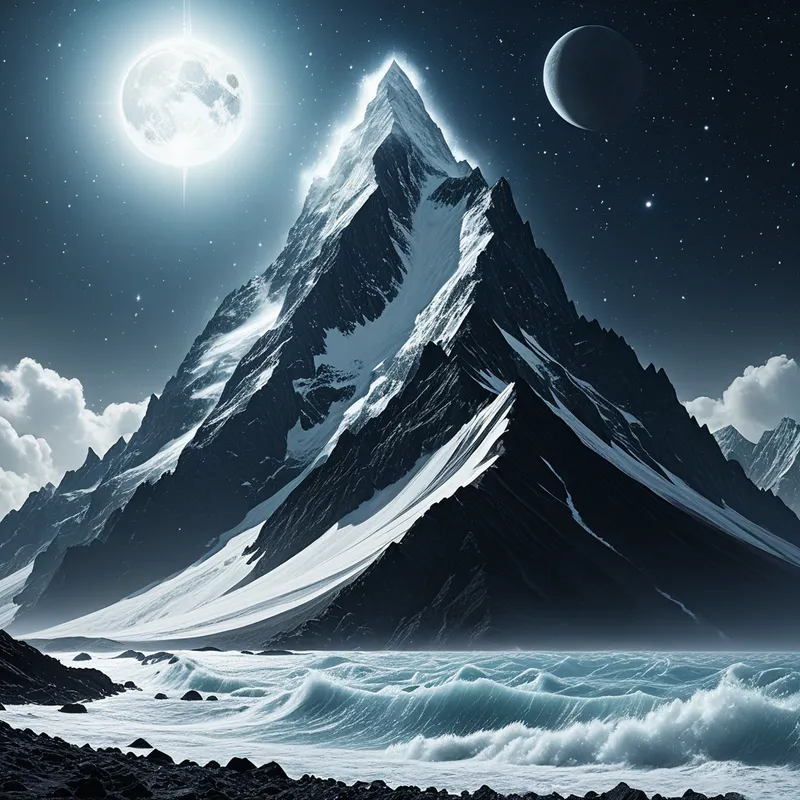
World Mountain Myth Meaning & Symbolism
A primordial mountain anchors the cosmos, connecting heaven, earth, and underworld, embodying the axis of existence and the soul's ascent.
The Tale of World Mountain
In the time before time, when [the world](/myths/the-world “Myth from Tarot culture.”/) was a churning, formless soup of potential, there was only chaos. The waters of the deep knew no shore, the winds had no direction, and the spirits of [the sky](/myths/the-sky “Myth from Persian culture.”/) and the dark below were locked in a ceaseless, roaring tumult. From this primal storm, a longing for stillness was born. And from that longing, a single point of absolute resolve emerged.
It began as a vibration in the deep, a hum that stilled the waves. Then, a rumble that silenced the winds. From the very heart of [the abyss](/myths/the-abyss “Myth from Kabbalistic culture.”/), a great mass pushed upward—not with violence, but with the slow, inevitable certainty of a breath being drawn. Stone piled upon stone, earth compacted into unshakeable foundation. It climbed, a pillar of living rock, pushing back the chaos. It did not stop when it pierced the clouds. It climbed until its peak became a needle, a point of perfect stillness that touched the vault of the highest heaven itself.
This was the World Mountain. Its roots plunged deep into [the underworld](/myths/the-underworld “Myth from Greek culture.”/) realms of ancestors and forgotten things. Its broad middle was the world of humans, beasts, and forests—the realm of life and struggle. And its shining summit was the dwelling place of the celestial powers, the source of order, law, and pure light.
From [the summit](/myths/the-summit “Myth from Taoist culture.”/), a great river of life, clear as crystal and bright as moonlight, sprang forth. It did not flow in one course, but split into four sacred streams at the very peak, cascading down the four faces of the mountain to the four cardinal directions. Where these waters touched the formless lands below, the world solidified. The first forests grew. The first animals drank. The first humans, molded from the mountain’s clay and animated by the celestial river’s breath, opened their eyes at its foothills.
The mountain was not just a place, but a promise. It was the axis around which the stars turned, the post that held up the sky, the ladder between all realms. To be in its shadow was to be under the gaze of heaven and above the memory of the deep. It stood, eternal and unmoving, the silent sovereign of a cosmos now held in perfect, sacred balance.
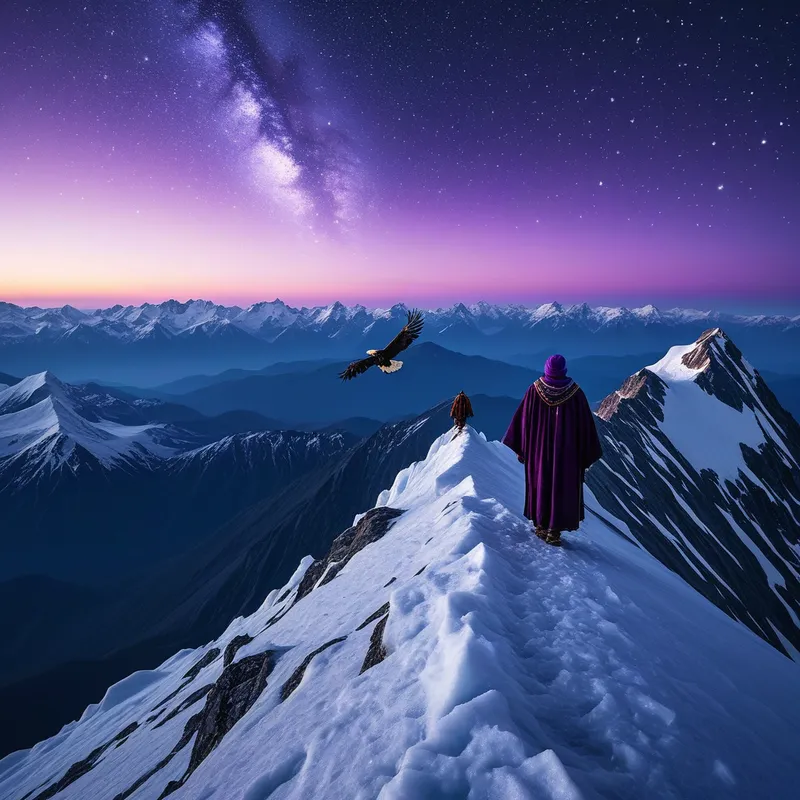
Cultural Origins & Context
The World Mountain is not a myth belonging to any one people, but a primordial image that has risen independently in the sacred geographies of cultures across the globe. It is known as [Mount Meru](/myths/mount-meru “Myth from Hindu culture.”/) in Hindu, Buddhist, and Jain cosmology, the axis of countless universes. The ancient Greeks knew it as [Mount Olympus](/myths/mount-olympus “Myth from Global/Universal culture.”/), a physical and divine peak shrouded in cloud. For the Norse, it was the unseen height upon which Asgard was built. In Mesopotamia, it was the [Ziggurat](/myths/ziggurat “Myth from Mesopotamian culture.”/), a man-made mountain connecting earth to heaven. For the indigenous peoples of the Americas, peaks like Blanca Peak or Bear Butte served this cosmic function.
This myth was not merely a story told for entertainment; it was the foundational map of reality. It was recited by priests during rituals of kingship, where the ruler was seen as the human counterpart to the mountain, the stabilizing center of the social world. It was visualized by shamans as the pathway for their ecstatic journeys between worlds. For the everyday person, the myth provided an ontological anchor: it explained why the world had structure, why the sun rose in the east, and where one stood in the grand, vertical order of existence. It transformed random geography into a sacred, meaningful cosmos.
Symbolic Architecture
Psychologically, the World [Mountain](/symbols/mountain “Symbol: Mountains often symbolize challenges, aspirations, and the journey toward self-discovery and enlightenment.”/) is the [archetype](/symbols/archetype “Symbol: A universal, primordial pattern or prototype in the collective unconscious that shapes human experience, behavior, and creative expression.”/) of the Self. It represents the central, integrating [structure](/symbols/structure “Symbol: Structure in dreams often symbolizes stability, organization, and the framework of one’s life, reflecting how one perceives their environment and personal life.”/) of the [psyche](/myths/psyche “Myth from Greek culture.”/) that emerges from the [chaos](/symbols/chaos “Symbol: In Arts & Music, chaos represents raw creative potential, uncontrolled expression, and the breakdown of order to forge new artistic forms.”/) of the unconscious.
The mountain is the psyche’s spine: the axis that connects the depths of instinct (the underworld) with the heights of spirit (the summit) and grounds them in the reality of lived experience (the middle world).
Its four rivers flowing to the cardinal directions symbolize the [differentiation](/symbols/differentiation “Symbol: The process of distinguishing or separating parts of the self, emotions, or identity from a whole, often marking a developmental or psychological milestone.”/) of the unified Self into the four functions of [consciousness](/symbols/consciousness “Symbol: Consciousness represents the state of awareness and perception, encompassing thoughts, feelings, and experiences.”/)—thinking, feeling, [sensation](/symbols/sensation “Symbol: Sensation in dreams often represents the emotional and physical feelings experienced in waking life, highlighting one’s intuition or awareness.”/), and [intuition](/symbols/intuition “Symbol: The immediate, non-rational understanding of truth or insight, often described as a ‘gut feeling’ or inner knowing that bypasses conscious reasoning.”/)—that orient us in the world. The [ascent](/symbols/ascent “Symbol: Symbolizes upward movement, progress, spiritual elevation, or striving toward higher goals, often representing personal growth or transcendence.”/) of the mountain is the [journey](/symbols/journey “Symbol: A journey in dreams typically signifies adventure, growth, or a significant life transition.”/) of individuation, the difficult climb toward self-[knowledge](/symbols/knowledge “Symbol: Knowledge symbolizes learning, understanding, and wisdom, embodying the acquisition of information and enlightenment.”/) and wholeness. The [summit](/symbols/summit “Symbol: The highest point of a mountain, representing achievement, perspective, and the culmination of effort.”/) represents a state of consciousness where opposites are reconciled: one sees the entirety of one’s being, from the deepest [shadow](/symbols/shadow “Symbol: The ‘shadow’ embodies the unconscious, repressed aspects of the self and often represents fears or hidden emotions.”/) to the highest aspiration, as part of a single, coherent whole. It is the point of transcendence, yet it is firmly rooted in the [earth](/symbols/earth “Symbol: The symbol of Earth often represents grounding, stability, and the physical realm, embodying a connection to nature and the innate support it provides.”/) of embodied [life](/symbols/life “Symbol: The symbol of ‘Life’ represents a journey of growth, interconnectedness, and existential meaning, encompassing both the joys and challenges that define human experience.”/).
The Dreamer’s Resonance
When the World Mountain appears in modern dreams, it often signals a critical phase of psychological integration. The dreamer may find themselves at the base of an immense, daunting peak, feeling both called and terrified. The somatic experience is one of weight, gravity, and a profound pull upward—a literal feeling of “ascent” in the soul.
This dream motif emerges when the conscious ego is being compelled to acknowledge a larger psychic structure. The chaos of a life crisis, a period of depression, or creative block is the “formless soup” from which the mountain begins to rise. The dream is an image of the psyche attempting to re-establish order from within. Climbing the mountain in a dream, with its trials of thin air, treacherous paths, and sheer cliffs, mirrors the arduous work of confronting repressed material (the shadows in the crags) and striving for a new perspective. To reach a vantage point on the mountain, even if not the summit, often correlates with gaining crucial insight or achieving a hard-won stability in waking life.
Alchemical Translation
The alchemical process mirrored in the World Mountain myth is that of Coagulatio—the making solid. It is the stage where the insights and dissolved elements from earlier phases of the work (the [prima materia](/myths/prima-materia “Myth from Alchemical culture.”/) of chaos) are given lasting, coherent form.
The individual is both the alchemist and the vessel. The climb is the slow, persistent fire that transforms the leaden confusion of a fragmented life into the golden, mountain-like integrity of the Self.
For the modern individual, this translates to the commitment to build a durable, centered identity. It is the work of taking the fleeting insights from therapy, meditation, or crisis and “building a mountain” with them—establishing daily practices, ethical stances, and personal boundaries that are rooted and unshakeable. The “four rivers” are the ways we channel this newfound integrity into the world: through our work (action), our relationships (feeling), our understanding (thought), and our intuition (vision). The myth teaches that transcendence is not an escape from the world, but the act of becoming the stable axis around which one’s world can meaningfully revolve. The goal is not to live at the summit, removed from life, but to have the summit within, providing orientation and meaning for every step taken in the valleys below.
Associated Symbols
Explore related symbols from the CaleaDream lexicon: