Wisanggeni Myth Meaning & Symbolism
A divine child born of fire, destined to overthrow the old celestial order, embodies the archetypal struggle for authentic selfhood against paternal authority.
The Tale of Wisanggeni
Listen, and hear the tale that echoes in the smoke of the sacred hearth and the silent spaces between the stars.
In the beginning, there was order. Batara Guru sat upon his throne in Suralaya, his will the law of the cosmos. His court was majestic, his power absolute, his rule maintained by the unwavering loyalty of his sons and the divine assembly. Yet, in the heart of absolute power, a seed of disruption was sown. It began not with a shout, but with a request. Batara Brama, the god of fire, desired a companion, a wife. From this union, a destiny was set aflame.
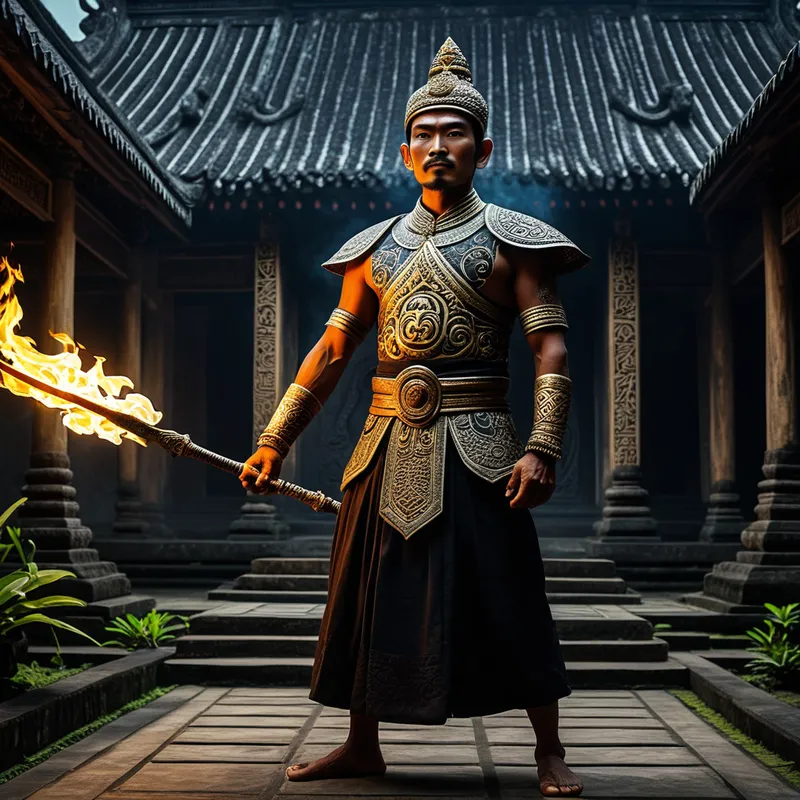
But the child was not born of flesh and blood. When the time came, from the divine womb emerged not an infant, but a towering, perfect column of pure, smokeless fire. The celestial palace trembled. This was no ordinary birth; it was an eruption, an incarnation of elemental will. From the heart of this conflagration stepped a youth, already in the fullness of his power. He was named Wisanggeni. His eyes held the calm, terrifying focus of a flame that consumes everything yet leaves no ash. His very presence was a challenge, a living question to the established order of his grandfather, Batara Guru.
Fear gripped Suralaya. Here was a being whose origin defied nature, whose power was untamed and unaligned. Batara Guru, seeing not a grandson but a threat, a spark that could ignite the heavens, commanded that the child be destroyed. Thus began the great persecution. The gods, bound by oath and fear, unleashed their might upon Wisanggeni. Storms were summoned, mountains hurled, oceans turned to spears. Yet, Wisanggeni stood. The fire that birthed him was also his armor and his soul. Every attack refined him; every assault only proved the impotence of the old powers against this new, self-defined force.
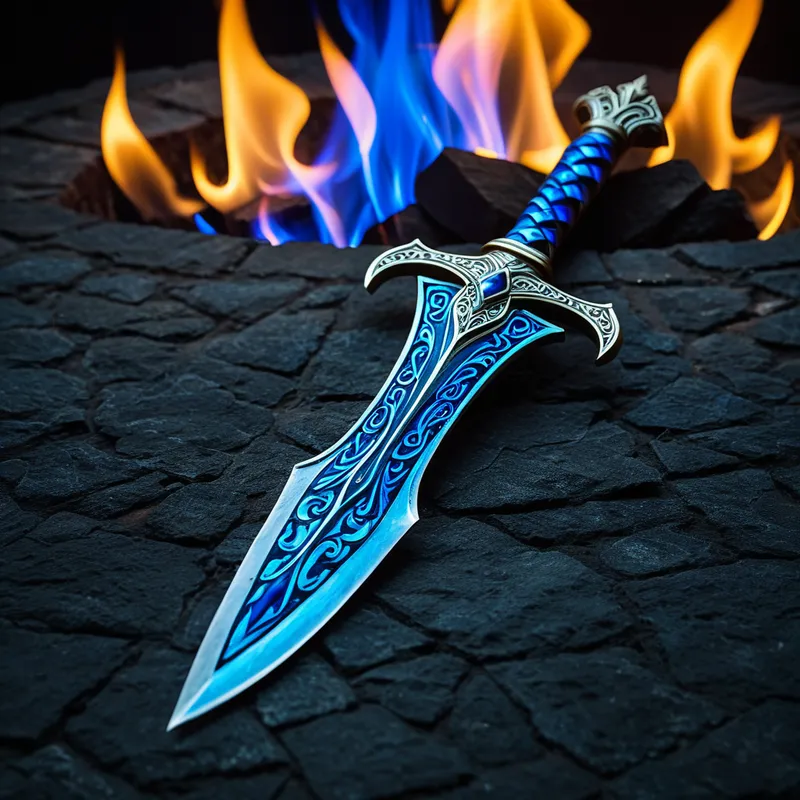
His exile was not a retreat but a forging. He wandered the margins of creation, a solitary, blazing truth. His final refuge was the one place that could match his essence: the workshop of the supreme blacksmith god, Empu Ramadi. In the heart of the cosmic forge, amidst primordial fires, Wisanggeni found not a master, but a kindred spirit. He did not submit to apprenticeship; he merged with the process itself. Here, his fiery nature was not contained but directed. He plunged his own spirit into the crucible, and from it, he drew his own sacred kris, a weapon that was not merely a tool, but an extension of his sovereign self.
Armed with this self-forged destiny, Wisanggeni returned. His march to Suralaya was not an invasion, but an inevitable reckoning. The celestial gates could not hold him. The armies of the gods shattered against his resolve. He stood at last before the throne of Batara Guru, not as a subject, but as an equal force of cosmic law. The confrontation was not a battle of annihilation, but of recognition. The old order, represented by Batara Guru, was forced to acknowledge what it could not control. Wisanggeni’s triumph was the establishment of a new principle: that the authentic self, born of its own inner truth and forged in its own trials, holds a sovereignty that even heaven must concede.
Cultural Origins & Context
The myth of Wisanggeni is a cornerstone of Javanese wayang lore, particularly within the vast Mahabharata and Purwa cycles. Unlike the imported Indian epics it adapts, the Wisanggeni narrative is a distinctly Javanese spiritual innovation, a local genius flowering within a borrowed mythological framework. It was preserved and dynamically evolved by generations of dalang. These storytellers were not mere reciters; they were philosophers, spiritual guides, and cultural custodians who would elaborate on the stories, infusing them with contemporary relevance, mystical ngelmu, and social commentary.
Performed during all-night shadow puppet plays, the tale of Wisanggeni served multiple societal functions. On one level, it was pure epic entertainment, a story of an unstoppable underdog. On a deeper level, it modeled a specifically Javanese ideal of power: not brute force, but wisdom (waskita) and inner strength (kasekten) that comes from self-mastery and spiritual authenticity. It provided a mythic template for understanding rebellion against unjust or stagnant authority, not as mere chaos, but as a necessary cosmic correction. In a highly stratified society, the myth offered a symbolic outlet and a profound metaphor: even the highest authority is not absolute before the law of authentic being.
Symbolic Architecture
Wisanggeni is the [archetype](/symbols/archetype “Symbol: A universal, primordial pattern or prototype in the collective unconscious that shapes human experience, behavior, and creative expression.”/) of the Self in its most raw and potent form. His [birth](/symbols/birth “Symbol: Birth symbolizes new beginnings, transformation, and the potential for growth and development.”/) from fire symbolizes a genesis that bypasses conventional biological and social [lineage](/symbols/lineage “Symbol: Represents ancestral heritage, family connections, and the transmission of traits, values, and responsibilities across generations.”/). He is not made by his parents; he manifests from a primal, transformative [energy](/symbols/energy “Symbol: Energy symbolizes vitality, motivation, and the drive that fuels actions and ambitions.”/). This represents the [emergence](/symbols/emergence “Symbol: A process of coming into being, rising from obscurity, or breaking through a barrier, often representing birth, transformation, or revelation.”/) of individual [consciousness](/symbols/consciousness “Symbol: Consciousness represents the state of awareness and perception, encompassing thoughts, feelings, and experiences.”/) that is not derived from [family](/symbols/family “Symbol: The symbol of ‘family’ represents foundational relationships and emotional connections that shape an individual’s identity and personal development.”/) or cultural complexes, but from the [soul](/symbols/soul “Symbol: The soul represents the essence of a person, encompassing their spirit, identity, and connection to the universe.”/)‘s own spark.
The fire-born one is not subject to the laws of clay. His ancestry is the first spark, his lineage the chain of ignition.
His persecution by the heavenly court embodies the brutal confrontation between the nascent, authentic self and the internalized patriarchal complex—the inner “Batara [Guru](/symbols/guru “Symbol: A Guru represents a teacher or guide, often embodying wisdom, knowledge, and spiritual insight.”/)” that demands [conformity](/symbols/conformity “Symbol: The act of adjusting one’s behavior, beliefs, or appearance to match those of a group or societal norms, often involving pressure to fit in.”/), suppression of unique gifts, and adherence to inherited scripts. The gods who attack him are the personified defenses of the established psychic order: reason that denies [intuition](/symbols/intuition “Symbol: The immediate, non-rational understanding of truth or insight, often described as a ‘gut feeling’ or inner knowing that bypasses conscious reasoning.”/), tradition that stifles innovation, fear that quashes [passion](/symbols/passion “Symbol: Intense emotional or physical desire, often linked to love, creativity, or purpose. Represents life force and deep engagement.”/).
His retreat to Empu Ramadi’s forge is the critical turn [inward](/symbols/inward “Symbol: A journey toward self-awareness, introspection, and the exploration of one’s inner world, thoughts, and unconscious mind.”/). It is the descent into the unconscious where raw potential meets the transformative arts. He does not go there to be made by another, but to participate in his own creation. The self-forged kris is the ultimate [symbol](/symbols/symbol “Symbol: A symbol can represent an idea, concept, or belief, serving as a powerful tool for communication and understanding.”/) of individuated will—a tool of discernment, protection, and [action](/symbols/action “Symbol: Action in dreams represents the drive for agency, motivation, and the ability to take control of situations in waking life.”/) that is perfectly aligned with one’s intrinsic [nature](/symbols/nature “Symbol: Nature symbolizes growth, connectivity, and the primal forces of existence.”/). His return and victory signify the [integration](/symbols/integration “Symbol: The process of unifying disparate parts of the self or experience into a cohesive whole, often representing psychological wholeness or resolution of internal conflict.”/) of this self-forged power into the totality of the psyche, forcing the old ruling consciousness to accommodate a new, sovereign [reality](/symbols/reality “Symbol: Reality signifies the state of existence and perception, often reflecting one’s understanding of truth and life experiences.”/).
The Dreamer’s Resonance
When the pattern of Wisanggeni stirs in the modern dreamer, it often heralds a profound psychic rebellion. One may dream of being trapped in a grand, oppressive palace (the rigid superego), or of being pursued by faceless, authoritative figures. The defining moment is the discovery of a fiery power within—perhaps dreaming one’s hands catch flame without being burned, or finding a hidden, incandescent core in one’s chest.
Somatically, this process can feel like a rising heat in the body, restlessness, or a sense of pressurized energy seeking outlet. Psychologically, it manifests as an intense, often disruptive, urge to break free from roles, jobs, relationships, or internal narratives that feel alien and suffocating. There is a rage that is not merely destructive, but creative—a fire that seeks to burn away the false to make space for the true. The dreamer is in the crucible, experiencing the terrifying yet exhilarating dissolution of the “flesh-born” identity to make way for the “fire-born” self.
Alchemical Translation
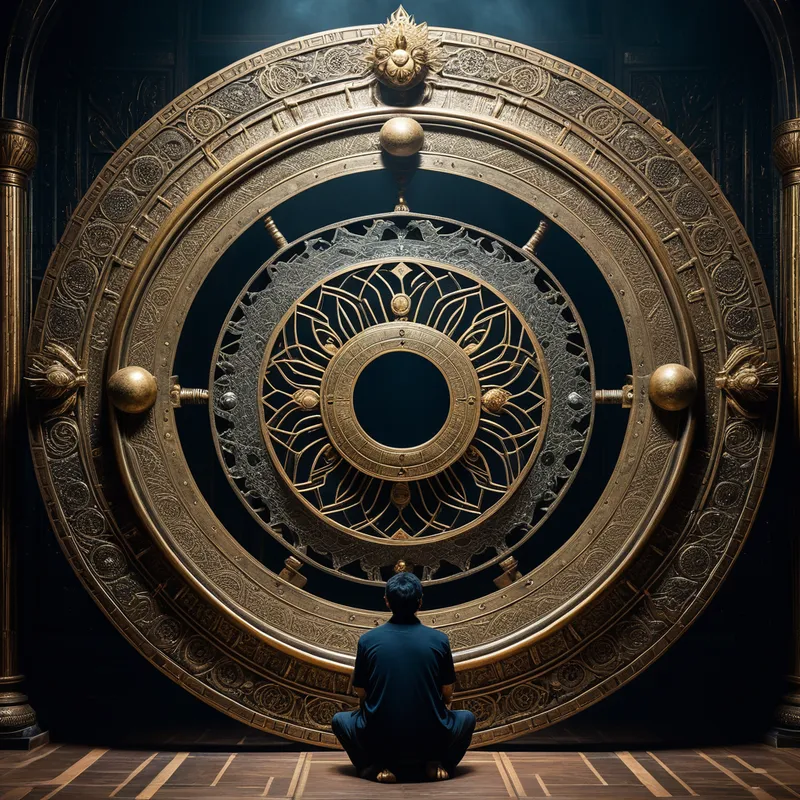
The myth of Wisanggeni is a perfect map for the alchemical process of individuation, specifically the stage of nigredo and albedo. The initial, fiery birth is the inflammatio—the awakening of a divine, restless energy that shatters mundane existence. The persecution represents the mortificatio—the painful death of the old personality as it clashes with this new consciousness.
The forge of Empu Ramadi is the vas or sacred vessel of transformation. Here, the fiery spirit (spiritus) is not extinguished, but conjoined with the art of the soul (ars).
The retreat to the forge is the conscious engagement with this process. The dreamer must become both the raw material and the blacksmith. This is the separatio—distilling one’s essential fire from the dross of others’ expectations—and the coniunctio—marrying that fire with skillful form (the crafted kris). The return to Suralaya is the rubedo, the reddening or triumphant return of the transformed self to the world. The old king (the dominant conscious attitude) is not killed, but redeemed by being forced to acknowledge a greater principle. The integrated individual no longer rebels against authority externally, but embodies an authentic inner authority that commands respect from both the inner and outer worlds. The smokeless fire becomes a steady, illuminating presence, a light born of one’s own essence.
Associated Symbols
Explore related symbols from the CaleaDream lexicon:
- Fire — The primordial element of Wisanggeni’s birth, representing pure transformative energy, divine will, purifying destruction, and the unstoppable spark of individual consciousness.
- Hero — Wisanggeni embodies the hero’s journey in its most internalized form, battling not external monsters but the entrenched gods of the psychic establishment to claim his selfhood.
- Rebellion — The core action of the myth, symbolizing the necessary, often painful, uprising of the authentic self against internalized oppressive structures and inherited destinies.
- Forge — The sacred workshop of Empu Ramadi, representing the unconscious psyche where raw potential is consciously worked, shaped, and transformed into a tool of destiny.
- Father — Batara Guru represents the archetypal authoritarian father complex, the internalized rule of law and tradition that the emerging self must confront and redefine its relationship with.
- Destiny — Not a pre-written fate, but a self-forged path; Wisanggeni’s destiny is to become himself, a purpose he actively creates through trial and inner alchemy.
- Weapon — The self-created kris, symbolizing the differentiated function of the individuated psyche—a focused, sharp, and spiritually aligned power used for discernment and defense of one’s truth.
- Order — The celestial rule of Suralaya, representing the necessary but often stagnant structure of the conscious mind and society, which must be challenged and renewed by dynamic spirit.
- Lightning — A sudden, illuminating, and disruptive force of divine energy, akin to Wisanggeni’s sudden appearance and his revolutionary impact on the cosmic order.
- Sacrifice — The surrender of the conventional, “flesh-born” identity to the purifying flames, a necessary loss for the gain of a more authentic, potent existence.
- Spirit — The essential, non-corporeal essence of Wisanggeni, his true nature as a being of will and fire, untethered from material or genealogical constraints.