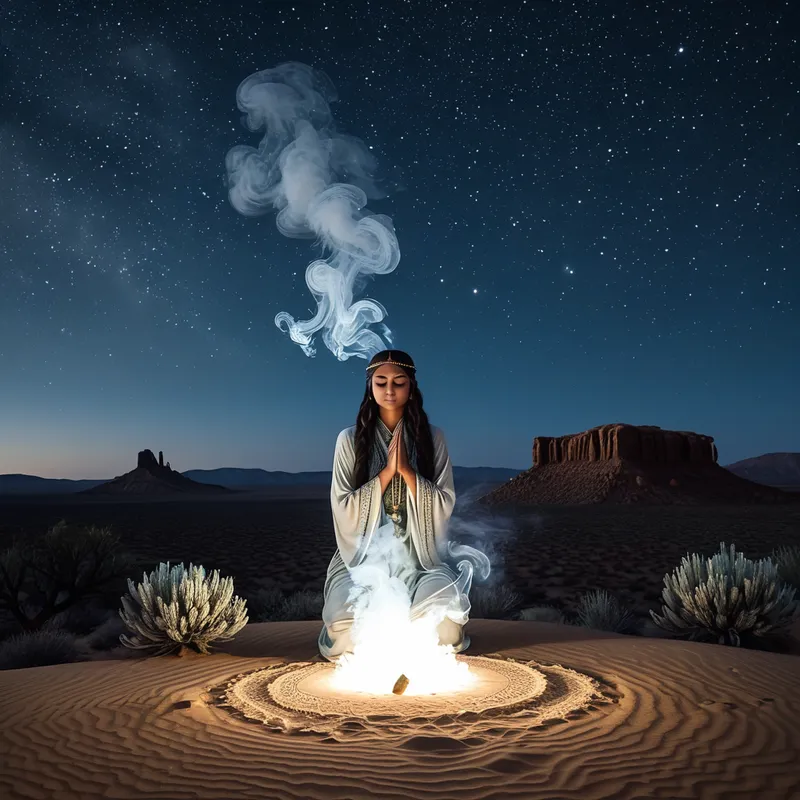
White Sage Ceremony Myth Meaning & Symbolism
A sacred being offers its essence as smoke to cleanse the world, teaching that true purification is born from sacrifice and sacred reciprocity.
The Tale of White Sage Ceremony
Before the world was cluttered with noise, when the breath of the earth was the only song, there was a being of pure, clear light. Its name is not spoken, for it is the essence of the breath itself. It lived in the high, dry places where the sun’s touch was fierce and the night’s cold was a sharp, clarifying blade. This being watched the two-legged ones, the humans, as they stumbled through their new world. He saw how they carried the dust of their fears, the sticky residue of their conflicts, and the heavy shadows of their dreams. Their spirits became clouded, and the clarity between them and the Great Mystery grew dim.
A great sorrow moved within the being of clear light. It saw that the people could not hear the guidance of the wind, nor feel the heartbeat of the stone, for their own inner chambers were choked. One night, beneath a bowl of stars so vast it felt like drowning, the being made a choice. It went to the driest canyon, where a humble, silvery-green plant grew stubbornly from the cracked earth. This plant was tough, resilient, holding the scent of sun-baked rock and clean wind.
The being spoke to the plant, and the plant listened. “Little sister,” whispered the being of light, “the people are lost in their own fog. They need a bridge, a sacred smoke to carry their confusion to the heavens and bring down clarity.”
The plant, in its simple wisdom, agreed. “But what can I do? I am small. My scent is strong, but it is of the earth.”
“You must become more,” said the being. And with a breath that was not a breath, the being of clear light began to pour its own essence into the silvery leaves. It was not a gentle giving, but a sacred alchemy. The being’s luminous form began to dim, its substance weaving into the very fibers of the plant. The plant trembled, its leaves turning a pale, luminous grey-green—the color of dawn mist and moonlight. It became the White Sage.
When the transformation was complete, the being of light was gone from its form. All that remained was its voice on the wind and the imbued plant. The wind carried the knowledge to a dreaming shaman. In the dream, the shaman saw the plant, heard the crackle of dry leaves, and smelled the piercing, clean scent. He understood.
At the next gathering, with the people heavy with discord, the shaman took a bundle of the white sage. He struck a flame, not from anger, but from the focused will of a sun-ray caught in stone. He touched the flame to the leaves. They did not blaze, but smoldered, releasing a thick, aromatic smoke.
As the smoke rose, it did something miraculous. It sought out the spiritual grime, the clinging shadows of anger and sickness. The smoke wrapped around the people, not as a blanket, but as a discerning spirit. It lifted the psychic weight from their shoulders, carrying it upwards where the wind could scatter it into nothingness. In its place, it left a resonant silence, a space so clean that the people could suddenly hear the subtle song of their own souls and the vast, humming song of the world around them. The first ceremony was born, a covenant written in smoke and breath.
Cultural Origins & Context
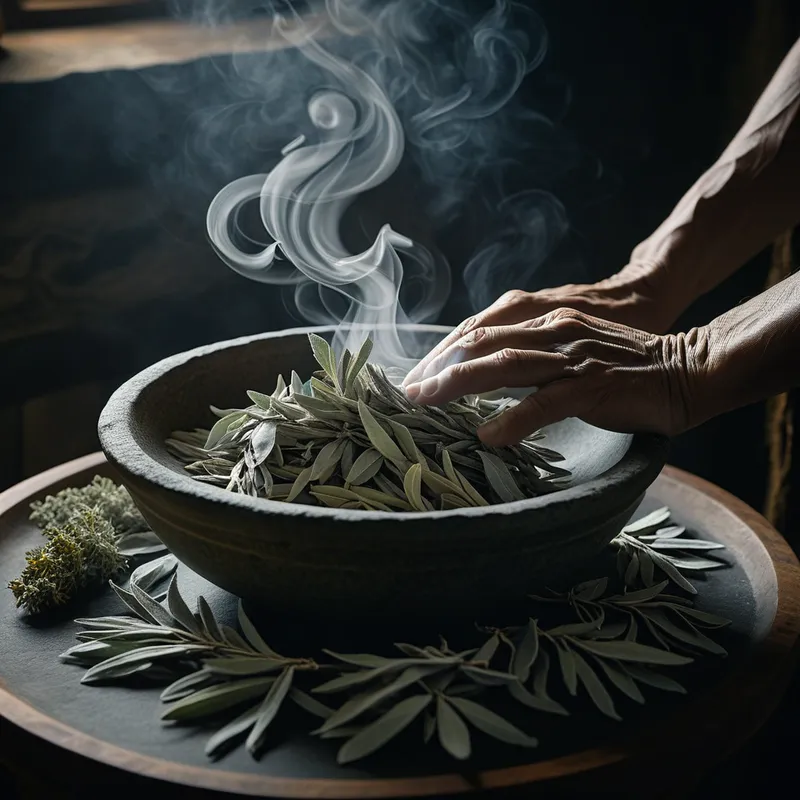
The narrative of the White Sage Ceremony is not a single, codified myth from one nation, but a living tapestry of understanding woven across many Native American cultures of the Southwest and Great Basin regions, particularly among peoples like the Chumash, Cahuilla, and others for whom Salvia apiana is a native plant. Its transmission was oral, practical, and deeply integrated into the fabric of life. Elders and medicine people did not merely “tell” the story; they enacted it, passing down the knowledge of the plant’s spirit, the proper way to harvest it (often with a prayer of gratitude and an offering of tobacco or song), and the sacred protocol of its use.
Societally, the ceremony functioned as a spiritual technology for maintaining balance. It was used before important councils to ensure clear thinking and truthful speech, after conflicts to cleanse the space of lingering discord, before hunts or journeys for protection, and in healing rituals to purge spiritual illness. The smoke was seen as a visible prayer, a mediator between the physical and spiritual realms. This practice ensured that the community’s “psychic hygiene” was maintained, preventing the accumulation of negative energy that could lead to disharmony, illness, or bad fortune.
Symbolic Architecture
At its heart, the myth is a profound map of purification, but not a superficial cleansing. It symbolizes a sacred exchange and the transformation of substance into spirit.
The being of clear light represents the archetypal principle of pure consciousness or spirit itself—unattached, all-seeing. Its sacrifice is not one of death, but of descent; it voluntarily enters the manifest world (the plant) to serve as a bridge. The white sage plant symbolizes the embodied spirit, the marriage of the resilient, earthly body with the transcendent, cleansing soul. It is matter infused with sacred purpose.
The smoke is the soul in motion—the visible breath of sacrifice, carrying what is heavy up to what is light.
The act of burning is the critical alchemical moment. It represents the necessary destruction of one form to release its essential, higher nature. The physical leaf must be transformed by fire to release its spiritual medicine. This mirrors the psychological process where an ego-attachment (a fear, a grudge, an illusion) must be “burned” in the fire of conscious awareness to be transmuted and released. The smoke does not attack the impurity; it displaces it through its higher vibrational presence, offering a model for transformation not through battle, but through resonant clarity.
The Dreamer’s Resonance
When this mythic pattern surfaces in modern dreams, it often signals a profound inner process of psychic purification and the need to create sacred space within the self. Dreaming of white sage smoke, or of performing a smudging ceremony, points to a psyche actively engaged in shadow work.
The somatic sensation is key. One might dream of choking on thick, grey fog (accumulated psychic material) and then experiencing relief as a clear, aromatic smoke clears the air. This reflects the body-mind’s intuition that it is carrying a burden—perhaps the unresolved residue of a past conflict, the internalized “dust” of a toxic environment, or the stagnant energy of an old identity that no longer serves. The dream is the psyche’s own ceremony, initiating a cleansing process that the conscious mind may have been avoiding. It is a call to engage in deliberate practices of release: journaling to “smoke out” hidden feelings, setting boundaries to cleanse relational spaces, or simply sitting in meditation to let the inner smoke rise and clear.

Alchemical Translation
For the modern individual walking the path of individuation, the White Sage Ceremony offers a masterful model for psychic transmutation. Our inner world is constantly gathering “dust”—the complexes, the persona’s exhaust, the unprocessed emotions of daily life. The myth teaches that we must become both the sacrificing spirit and the shaman.
First, we must identify within ourselves the being of clear light—our own witnessing consciousness, which can see the clutter without being it. This consciousness must then make the sacrifice of attention, deliberately descending into the dense, earthy parts of our psyche (the sage plant—our habits, memories, and emotional patterns). We “harvest” these aspects not with judgment, but with the prayer of curiosity.
Then comes the sacred fire: the courageous application of conscious awareness. We bring the heat of honest inquiry to our patterned leaves. We “burn” the story of resentment by feeling its full heat and watching it transform. We smolder the identity of victimhood, not to destroy ourselves, but to release its trapped essence. The smoke that rises is the liberated insight, the cleared emotion, the newfound clarity.
Individuation is the ceremony where the self sacrifices its attachments to become its own purifying smoke, creating an inner space clear enough to hear the soul’s true song.
The final, crucial step of the ceremony is reciprocity. The myth is rooted in a covenant. The sage gave its body; the spirit gave its essence. In our internal alchemy, this translates to gratitude and giving back. As we cleanse ourselves, we are compelled to contribute clarity, not more chaos, to the world around us. The ceremony is never complete; it is a perpetual, sacred loop of taking in, transforming, and offering back—the very rhythm of a soul in right relationship with itself and the Great Mystery.
Associated Symbols
Explore related symbols from the CaleaDream lexicon: