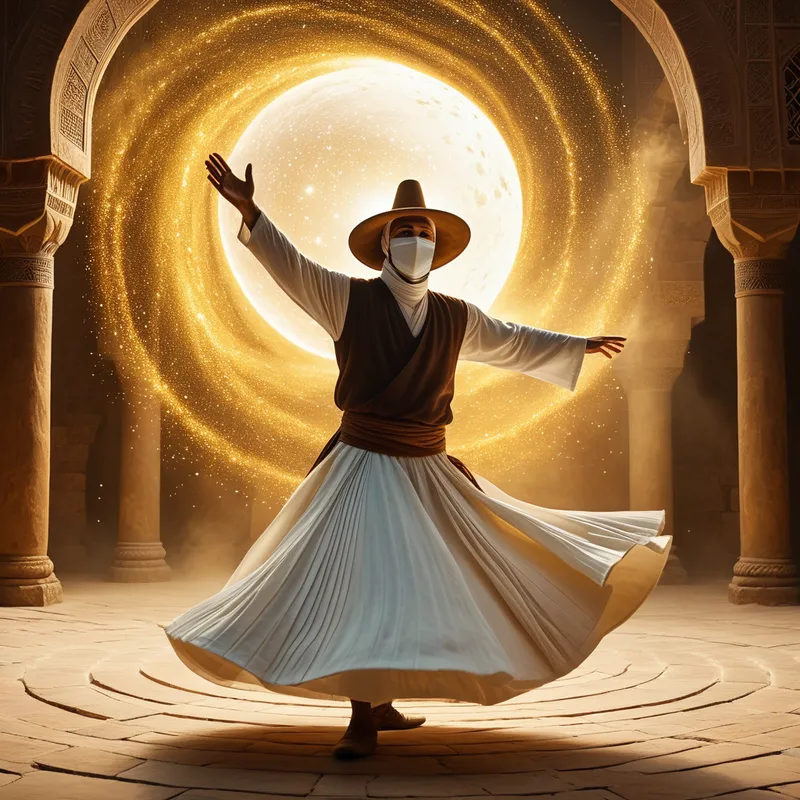
Whirling Dervishes Myth Meaning & Symbolism
A mystic's ecstatic dance, a sacred spiral dissolving the self into the One, where the whirling body becomes a prayer and the cosmos turns within.
The Tale of Whirling Dervishes
Listen. There is a silence so deep it begins to turn. In the heart of Konya, under a sky bruised purple with approaching dusk, a man stands in the center of an empty space. His name is lost to us; he is simply the Seeker. His chest is a cavern of ache, a hollow carved by a love for the Divine so vast it threatens to unmake him. The world—the chatter of the market, the weight of his name, the very bones of his body—feels like a distant rumor.
He lifts his right foot. It is not a step, but a surrender. He places it down, and the universe shifts. His left foot follows, and a current, ancient and sweet, rises from the earth through his soles. It is the call. He begins to turn.
Slowly at first, a leaf caught in a gentle eddy. His arms are crossed over his heart, holding the secret of his longing tight. With each rotation, the walls of his self begin to soften. The memory of his father’s voice, the taste of yesterday’s bread, the pride in his craft—all these garments of identity start to loosen their threads.
He unfolds his arms. His right palm opens to the sky, a vessel to receive. His left palm turns to the earth, a channel to pour forth. He is no longer turning; he is being turned. The room, the watching disciples, the stone walls—they dissolve into a blur of color and light. He is the axis. The cosmos spins around him, stars and planets tracing their frantic orbits, yet at his core there is a point of perfect, still silence.
The music is not outside him. The plaintive cry of the ney, the rhythmic pulse of the drum—these are merely echoes of the turning already happening in his blood, in the space between his atoms. His white skirt, the tennure, billows into a perfect circle, a galaxy in motion. His tall felt hat, the sikke, remains unwavering, the fixed pole around which the heavens revolve.
Faster. The ache in his chest is not gone; it has expanded, become the engine of the world. It is no longer his pain, but the pain of separation itself, spinning itself into ecstasy. He is the moth and the flame, the drop and the ocean, the lover and the Beloved. In the furious, graceful blur, there is no longer a dancer. There is only the Dance. There is only the Turning. A whisper, not with sound but with the whole of his being, answers the call that started it all: I am with you.
The spinning slows. The world condenses back into form—floor, breath, trembling limbs. He brings his arms again to his chest, holding the now-quiet secret. He is here. And he is forever changed.
Cultural Origins & Context
This is not merely a story but a lived, breathless ritual of the Sufi path, crystallized within the Mevlevi order. Its origin is traced to the 13th century and the spiritual ecstasies of the poet and mystic Jalaluddin Rumi. Legend holds that Rumi, walking through the marketplace of Konya, heard the rhythmic hammering of goldbeaters and began to turn in a state of overwhelming divine love, stretching out his arms and spinning in a circle. This spontaneous movement of cosmic yearning became formalized by his son, Sultan Walad, and successors into the sacred ceremony of Sema.
The myth is passed down not through books alone, but through the body. It is an oral and kinetic tradition, taught from guide (sheikh) to disciple in the tekke. Its societal function was multifaceted: it was a direct method of worship, a teaching tool for embodying Sufi concepts of love and annihilation of the ego, and a public performance that invited the community to witness the possibility of transcendent union. The Sema became a moving, breathing scripture, where each gesture, each piece of clothing, and each stage of the turn is a chapter in the soul’s journey back to its source.
Symbolic Architecture
The Whirling Dervish is a living map of the soul’s alchemy. Every element is a deliberate symbol in this embodied prayer.
The whirling itself is the primary symbol. It mirrors the fundamental turning of all creation—electrons around a nucleus, planets around a star. The Dervish becomes a microcosm of the cosmos, actively participating in the divine order through conscious, loving surrender.
The right hand turned upward receives grace from the Divine; the left hand turned downward transmits that grace to the earth. The human being is not a terminus, but a conduit.
The sikke represents the tombstone of the individual ego, while the white tennure is the ego’s shroud. The spinning transforms this shroud into the circle of rebirth—the ego is not destroyed, but transfigured, its boundaries dissolved into a wider belonging. The initial standing posture, with arms crossed, signifies the number one, the unity of God. The unfolding into the turn reveals the human as a crucible where that unity is realized.
Psychologically, the Dervish represents the ego in its most profound crisis and opportunity: the crisis of its own isolation, and the opportunity to surrender its illusion of separateness to the greater reality of the Self. The whirl is the process of that surrender—a dynamic, active letting-go, not a passive dissolution.
The Dreamer’s Resonance
When this myth stirs in the modern dreamscape, it often appears not as a literal Dervish, but as a sensation or pattern of profound reorientation. One may dream of spinning uncontrollably, of the room revolving around a fixed point in one’s chest, or of becoming the still eye in a violent storm.
Such dreams signal a somatic and psychological process of ego-adjustment. The psyche is attempting to re-center, to find its true axis amidst the chaos of life’s demands and identities. The vertigo felt in the dream is the disorientation of old structures—career, relationships, self-image—losing their gravitational pull. The dream-whirl is the psyche’s innate, archetypal method for processing overwhelming energy—be it creative inspiration, grief, or love—that cannot be contained by linear thought. It is the body-mind’s way of saying, “This experience is too large for your current story. You must let it turn you, reshape you from the core outward.”

Alchemical Translation
For the individual on the path of individuation, the myth of the Whirling Dervish models a supreme act of psychic transmutation. The goal is not to become a mystic in a robe, but to engage the principle of the sacred turn.
The first step is the standing in the hollow—the conscious recognition of a sacred discontent, a longing for meaning that worldly achievements cannot satisfy. This is the “call” that grounds the seeker.
The whirl itself is the alchemical solve et coagula: dissolve and reconstitute. In the spin, the rigid complexes of the personality—our defended identities, our cherished wounds—are dissolved in the solvent of a larger awareness (the music of the spheres, the call of the Self). This is an active, often turbulent process of letting old patterns and stories lose their solidity.
The fixed point is not stillness as stagnation, but stillness as perfect alignment. It is the Self, the inner divine center, around which the chaos of the persona must learn to orbit in harmonious order.
Finally, the return to stillness with arms crossed once more over the heart is the coagula—the reconstitution. The individual returns to the world, but now centered from that unmoving point within. The ego, having surrendered its claim to absolute sovereignty, is now free to serve as a capable, humble vessel for the will of the greater Self. The struggle is the resistance to the turning; the triumph is the realization that one is not the whirlwind, but the axis. The modern individual learns to turn their life, not from the frantic periphery of reaction, but from the calm, loving center of conscious response.
Associated Symbols
Explore related symbols from the CaleaDream lexicon: