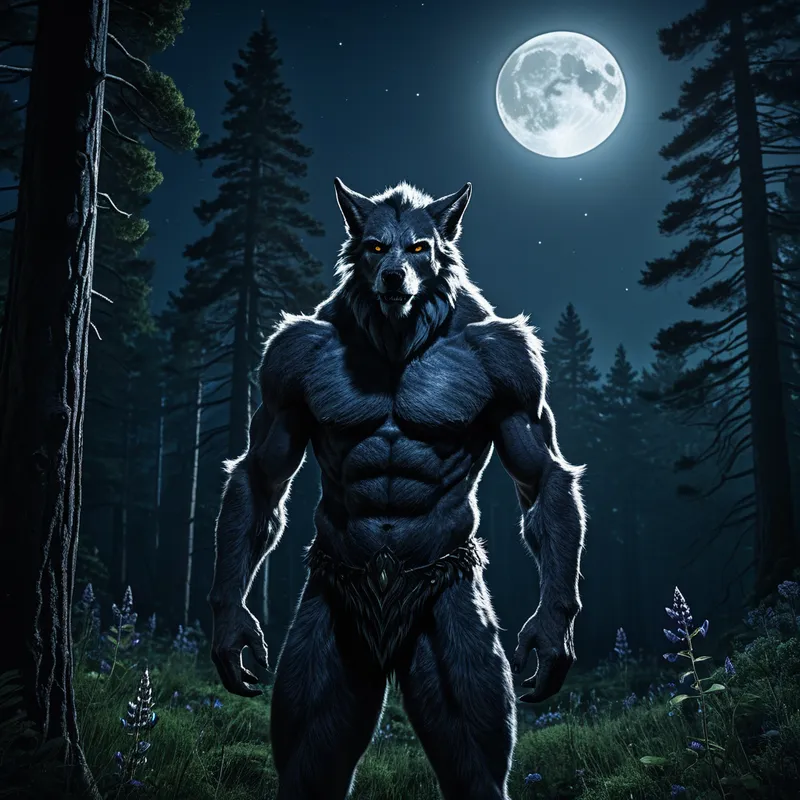
Werewolf Myth Meaning & Symbolism
A tale of cursed transformation where man becomes beast, exploring the primal shadow, societal fear, and the agonizing duality of human nature.
The Tale of the Werewolf
Listen, and hear the tale that is told when [the hearth](/myths/the-hearth “Myth from Norse culture.”/)-fire burns low and [the wind](/myths/the-wind “Myth from Various culture.”/) howls from the forest. It begins not with a monster, but with a man. A good man, perhaps—a farmer, a soldier, a lord. He is one of us. But he carries a secret stain, a hidden flaw. Perhaps he trespassed on sacred ground, or angered an old spirit of the wild wood. Perhaps he was born under an ill-omened moon. Or perhaps he simply desired the power of the untamed.
The change never comes gently. First, a fever burns in the blood, a restlessness that no hearth can soothe. [The moon](/myths/the-moon “Myth from Tarot culture.”/), that cold silver eye in [the sky](/myths/the-sky “Myth from Persian culture.”/), becomes a tyrant. When it swells to fullness, the man’s world dissolves in agony. His bones groan and reshape themselves, a sound like cracking branches. His senses sharpen until he can hear the heartbeat of a rabbit a league away and smell fear on the wind. Coarse pelt erupts from his skin. His teeth become fangs, his hands cruel claws. His mind, that citadel of reason and prayer, is flooded by a single, pure, and terrible instinct: to hunt.
He crashes into the night, a creature of muscle and rage. The village below, with its locked doors and whispered prayers, becomes a landscape of scent and sound. The civilized man is gone, drowned in the red tide of the beast. He runs on all fours, a phantom of the deep forest, and his howl is a hymn of perfect, amoral freedom. He kills. Not for food, but for the savage joy of the chase, for the hot copper taste that confirms his terrible power. When the dawn bleeds into the sky, the tyranny of the moon breaks. He awakens in some foul ditch or lonely thicket, naked, shivering, and human. And he remembers. The memories are shards of nightmare—the taste of blood, the sound of screams—and with them comes a guilt that gnaws deeper than any hunger.
This is his curse: to live two lives, forever divided. By day, he walks among men, haunted by his own shadow. By night, [the shadow](/myths/the-shadow “Myth from Jungian culture.”/) consumes him. There is no cure, only whispers: wolfsbane, silver, a wound from one who loves him. His end is never peaceful. It comes as a torch-lit mob, a silver-tipped arrow from a hunter who was once his friend, or the final, merciful stroke of his own hand as he feels the moon-rise begin again. He dies as both man and monster, a testament to the wild [thing](/myths/thing “Myth from Norse culture.”/) that sleeps, uneasily, in every human soul.
Cultural Origins & Context
[The werewolf](/myths/the-werewolf “Myth from Various culture.”/) is not a single story but a deep, persistent stain on the European [psyche](/myths/psyche “Myth from Greek culture.”/), woven from fear, folklore, and harsh reality. Its roots are ancient, tangled with pre-Christian beliefs in shape-shifting shamans and warrior cults who donned wolf pelts to channel the animal’s ferocity, like the legendary Berserkers. The Church later demonized these pagan remnants, framing the transformation as a diabolical pact or a divine punishment.
The myth thrived in the communal imagination of medieval and early modern villages, living on the breath of winter tales. It served a potent societal function. In a world bordered by vast, unknown forests, the werewolf gave a name and a shape to very real terrors: the wolf packs that preyed on livestock and children, and the hidden violence that could erupt from within a seemingly peaceful community. Werewolf trials, like the infamous case of [Peter](/myths/peter “Myth from Biblical culture.”/) Stumpp, reveal how the legend was weaponized, often targeting outsiders or the mentally ill. The werewolf became the ultimate [scapegoat](/myths/scapegoat “Myth from Biblical culture.”/), a container for projected fears about the breakdown of the moral and natural order.
Symbolic Architecture
At its core, the [werewolf](/symbols/werewolf “Symbol: The werewolf symbolizes the duality of human nature, representing both civilization and primal instinct.”/) is the [archetype](/symbols/archetype “Symbol: A universal, primordial pattern or prototype in the collective unconscious that shapes human experience, behavior, and creative expression.”/) of [the divided self](/myths/the-divided-self “Myth from Platonic culture.”/), the ultimate [symbol](/symbols/symbol “Symbol: A symbol can represent an idea, concept, or belief, serving as a powerful tool for communication and understanding.”/) of the [Shadow](/symbols/shadow “Symbol: The ‘shadow’ embodies the unconscious, repressed aspects of the self and often represents fears or hidden emotions.”/) made flesh. The [human](/symbols/human “Symbol: The symbol of a human represents individuality, complexity of emotions, and social relationships.”/) represents our conscious [identity](/symbols/identity “Symbol: Identity represents the sense of self, encompassing personal beliefs, cultural background, and social roles.”/)—civilized, moral, striving for control. The [wolf](/symbols/wolf “Symbol: Wolves in dreams symbolize instinct, intelligence, freedom, and a deep connection to the wilderness and primal instincts.”/) is the untamed totality of the unconscious: our [primal instincts](/symbols/primal-instincts “Symbol: Primal Instincts represent the basic drives and survival mechanisms inherent in every individual, harkening back to our animalistic nature.”/), raw aggression, sexual drive, and innate wildness.
The curse is not the beast, but the refusal to acknowledge it. The true horror is the wall of amnesia between the day-self and the night-self.
The involuntary transformation under the full [moon](/symbols/moon “Symbol: The Moon symbolizes intuition, emotional depth, and the cyclical nature of life, often reflecting the inner self and subconscious desires.”/) speaks to forces beyond egoic control. The moon symbolizes the cyclical, tidal [nature](/symbols/nature “Symbol: Nature symbolizes growth, connectivity, and the primal forces of existence.”/) of the unconscious, which periodically overwhelms the conscious mind. The silver [bullet](/symbols/bullet “Symbol: A bullet symbolizes aggression, conflict, or the potential for harm, often representing feelings of vulnerability or danger.”/), the only thing that can kill the [beast](/symbols/beast “Symbol: The beast often represents primal instincts, fears, and the shadow self in dreams. It symbolizes the untamed aspects of one’s personality that may need acknowledgment or integration.”/), is not merely a [metal](/symbols/metal “Symbol: Metal in dreams often signifies strength, transformation, and the qualities of resilience or coldness.”/) but a symbol of reflected [consciousness](/symbols/consciousness “Symbol: Consciousness represents the state of awareness and perception, encompassing thoughts, feelings, and experiences.”/)—the luminous, penetrating quality of self-[awareness](/symbols/awareness “Symbol: Conscious perception of self, surroundings, or internal states. Often signifies awakening, insight, or heightened sensitivity.”/) that can finally integrate and “kill” the autonomous, destructive [aspect](/symbols/aspect “Symbol: A distinct feature, quality, or perspective of something, often representing a partial view of a larger whole.”/) of the shadow.
The Dreamer’s Resonance
To dream of becoming a werewolf is to experience a profound somatic confrontation with one’s own repressed power and instinctual life. The dreamer is not dreaming of a monster “out there,” but of a psychic reality within. The feeling of bones reshaping is the psyche’s literal encoding of a painful but necessary restructuring of the personality. The heightened senses indicate an awakening of intuitive, non-rational ways of knowing that the conscious mind has neglected.
Such dreams often emerge during life transitions that demand more aggression, assertiveness, or connection to the body—a new career, the end of a relationship, a creative awakening. The terror in the dream is [the ego](/myths/the-ego “Myth from Jungian culture.”/)‘s fear of being dissolved by these powerful, unfamiliar energies. The guilt upon “waking” in the dream mirrors the dreamer’s own shame or anxiety about embracing a more authentic, perhaps less “nice,” version of themselves. The dream presents the conflict in its raw, mythological form: the civilized [persona](/myths/persona “Myth from Greek culture.”/) is at war with the instinctual self.
Alchemical Translation
The myth of the werewolf maps directly onto the alchemical and Jungian process of individuation. The initial state is one of [nigredo](/myths/nigredo “Myth from Alchemical culture.”/)—blackness, curse, and suffering under the autonomous shadow. The beast runs rampant because it is denied, creating chaos and guilt.
The alchemical work begins not with slaying the wolf, but with recognizing it as part of [the self](/myths/the-self “Myth from Jungian culture.”/). This is the stage of albedo, the whitening, where the silver light of consciousness is turned inward. The seeker must, in full awareness, descend into the forest of the unconscious and meet the beast not as an enemy to be destroyed, but as a lost, powerful, and vital part of their own nature.
The goal is not to cure the man of the beast, but to cure the beast of its mindless rage by gifting it the light of awareness.
The final transmutation, [rubedo](/myths/rubedo “Myth from Alchemical culture.”/) (the reddening), is the integration. It is the conscious harnessing of the wolf’s strengths—its loyalty, its fierce protectiveness, its keen senses, its untamed vitality—into the service of the whole personality. The fully integrated individual no longer transforms involuntarily under the moon’s compulsion. Instead, they can call upon their “inner wolf” with conscious intent, accessing primal courage and instinct without being consumed by it. The curse becomes a difficult gift, the shadow becomes a source of strength, and the divided self becomes a sovereign, whole being who has made peace with the wildness within.
Associated Symbols
Explore related symbols from the CaleaDream lexicon: