Well of Wisdom Myth Meaning & Symbolism
A sacred well grants divine wisdom, but its guardian demands a terrible sacrifice, testing the seeker's resolve for ultimate knowledge.
The Tale of the Well of Wisdom
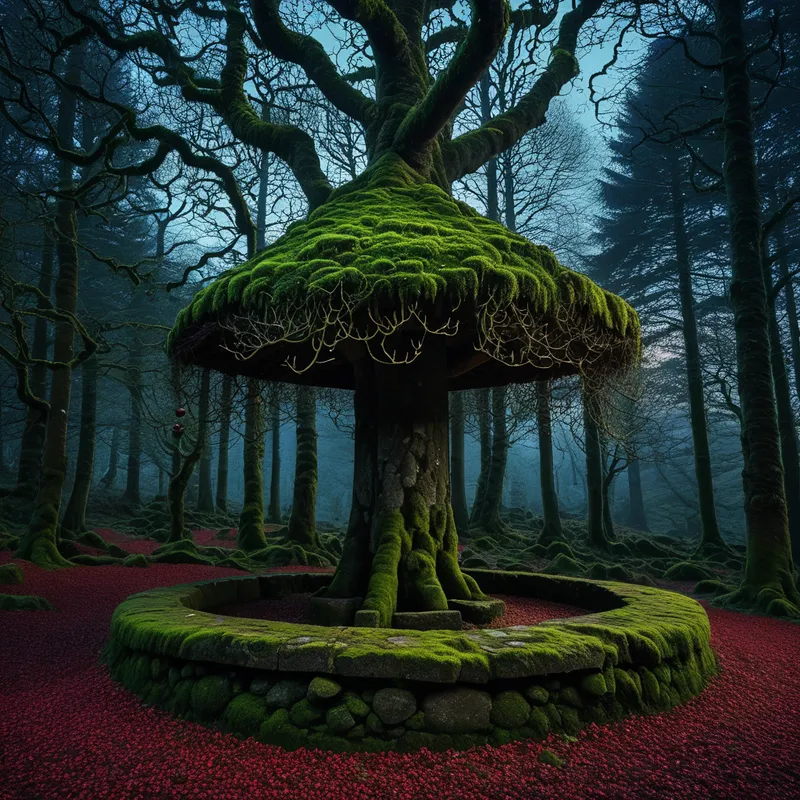
Listen. In the time before time, when [the world](/myths/the-world “Myth from Tarot culture.”/) was raw and the gods walked the green hills of Éire, there existed a place of profound silence. It was not a place for mortal feet. Deep in the [Sídhe](/myths/sdhe “Myth from Celtic / Irish culture.”/)-haunted woods, where shadows held their breath, lay the Connla’s Well.
Nine sacred hazel trees of perfect crimson nut encircled it, their roots delving deep into [the Otherworld](/myths/the-otherworld “Myth from Celtic culture.”/) below the [water](/myths/water “Myth from Chinese culture.”/). These were the Hazels of Buan. When the nuts of wisdom ripened, they would fall into the still, dark waters with a soft plip. At that sound, a sacred salmon dwelling in the depths would rise and consume the nut. For each nut eaten, a spot of brilliant knowledge would appear upon the salmon’s silver side. The well’s [water](/myths/water “Myth from Chinese culture.”/), infused with this essence, bubbled up into seven branching streams, carrying all the knowledge of poetry, prophecy, and the world’s secrets out into the land.
But such a font was not unguarded. Its keeper was Boann, she of the white cows, and more formidably, the fierce and ancient god Neit. Some say his other name was [Goibniu](/myths/goibniu “Myth from Celtic culture.”/), or that the guardian was the stern Miach. But all tales agree: he was the master of the well, and its price was absolute.
The seeker who came was Fionn mac Cumhaill, not yet the great leader, but a youth hungry for the wisdom that would let him lead and judge justly. He found the old guardian by the well, his single eye seeing all that had been and would be. The air hummed with the potential of the falling nuts.
“You seek the wisdom of the salmon,” the guardian stated, his voice like stone grinding on stone. “The knowledge of the seven streams. The sight that pierces time.”
Fionn nodded, his heart a drum in his chest.
“The price is not gold, nor service, nor pledge,” the guardian intoned. “The well demands a sacrifice of essence. A sacrifice of sight. You must give of your very self to receive of the All. Will you pay?”
Fionn, with the fire of destiny upon him, agreed. The guardian’s hand moved, swift as a striking adder. There was a moment of blinding, white-hot agony. Fionn gasped, clutching his face. When he lowered his hand, the world was halved in shadow. Where his eye had been was a hollow of searing pain. But in his palm, resting in a film of his own blood and tears, lay a single, perfect crimson hazelnut of wisdom.
“Now,” whispered the guardian, “prepare the salmon.”
With his one remaining eye streaming, Fionn cooked the Silver One. As the fish roasted, its skin blistering with the spots of knowledge, a drop of its hot, sacred fat burst from the flesh and landed upon Fionn’s wounded thumb. Instinctively, he brought his thumb to his mouth to soothe the burn.
The world exploded.
Not in light, but in knowing. The seven streams poured into his mind. He saw the patterns of the stars and the roots of the mountains. He heard the poetry of growing grass and the lament of falling stones. Past, present, and possible futures unfolded before his inner sight. The agony in his socket faded, replaced by the cool, boundless depth of the well itself. He had paid with an eye of flesh and gained the Eye of Wisdom. From that day forth, whenever he sought an answer, he need only place his thumb between his teeth, and the knowledge of the Bradán Feasa would rise within him.
Cultural Origins & Context
This myth, primarily known as the story of Fionn and [the Salmon of Knowledge](/myths/the-salmon-of-knowledge “Myth from Celtic culture.”/), is a cornerstone of the Fenian Cycle of Irish mythology. It was preserved not in grand epics, but in the oral tradition of the fili, the poet-seers who were the custodians of history, law, and sacred lore. For them, this was not merely an adventure tale; it was a foundational narrative of their own vocation.
The well, often identified as Tobar Segais, is the symbolic source of the [River Boyne](/myths/river-boyne “Myth from Celtic culture.”/), a river deeply associated with the goddess Boann and with inspiration. The myth served a crucial societal function: it sacralized the pursuit of knowledge while rigorously defining its cost. In a culture where poetic satire could raise blisters on a king’s face and legal judgment held the power of life and death, wisdom was not a casual intellectual pursuit. It was a dangerous, transformative force that required a radical exchange. The myth taught that true, transformative understanding—the kind needed to lead, to judge, to compose poetry that could alter reality—demands a piece of the seeker’s own wholeness. It legitimized the imbas, the inspired knowledge of the fili, as something earned through a symbolic ordeal.
Symbolic Architecture
At its [heart](/symbols/heart “Symbol: The heart symbolizes love, emotion, and the core of one’s existence, representing deep connections with others and self.”/), [the Well of Wisdom](/myths/the-well-of-wisdom “Myth from Celtic culture.”/) is an archetypal map of the [psyche](/myths/psyche “Myth from Greek culture.”/)’s deepest resources and the perilous [journey](/symbols/journey “Symbol: A journey in dreams typically signifies adventure, growth, or a significant life transition.”/) to access them. The well represents the unconscious itself—the dark, nourishing, boundless [depths](/symbols/depths “Symbol: Represents the subconscious, hidden emotions, or foundational aspects of the self, often linked to primal fears or profound truths.”/) from which all creative and intuitive [life](/symbols/life “Symbol: The symbol of ‘Life’ represents a journey of growth, interconnectedness, and existential meaning, encompassing both the joys and challenges that define human experience.”/) springs. The nine hazels signify the organic, natural processes of the unconscious (nine being a sacred [number](/symbols/number “Symbol: Numbers in dreams often symbolize meaning, balance, and the quest for understanding in the dreamer’s life, reflecting their mental state or concerns.”/) of completion and [gestation](/symbols/gestation “Symbol: A period of development and preparation before a significant birth or emergence, symbolizing potential, transformation, and the journey toward manifestation.”/) in Celtic thought), which periodically produce the “nuts” of [insight](/symbols/insight “Symbol: A sudden, deep understanding of a complex situation or truth, often arriving unexpectedly and illuminating hidden connections.”/), inspiration, or psychic content.
The guardian of the well is the psychopomp of the threshold, the severe aspect of the Self that demands a sacrifice of ego-consciousness before granting access to the collective unconscious.
The salmon is the [symbol](/symbols/symbol “Symbol: A symbol can represent an idea, concept, or belief, serving as a powerful tool for communication and understanding.”/) of the integrated wisdom that results from this process—the conscious ego (Fionn) must “[cook](/symbols/cook “Symbol: The act of cooking symbolizes nurturing, transformation, and the creation of sustenance, reflecting both the physical and emotional nourishment of oneself and others.”/)” or assimilate the raw contents of the unconscious (the nut-eating salmon) to make them usable. The sacrifice of the eye is the critical pivot. It represents the necessary devaluation of a one-sided, purely [outward](/symbols/outward “Symbol: Movement or orientation away from the self or center; expansion, expression, or externalization of inner states into the world.”/)-looking [consciousness](/symbols/consciousness “Symbol: Consciousness represents the state of awareness and perception, encompassing thoughts, feelings, and experiences.”/). To gain inner [sight](/symbols/sight “Symbol: Sight symbolizes perception, awareness, and insight, representing both physical and inner vision.”/), one must relinquish a portion of the conventional, object-oriented way of perceiving the world. The physical eye sees surfaces; the wisdom-eye perceives essences, connections, and the flow of time.
The Dreamer’s Resonance
When this mythic pattern stirs in the modern dreamer, it signals a profound crossroads in the process of self-knowledge. To dream of a deep, dark well in a wooded place is to sense the call of the deep psyche. Dreaming of losing an eye, or of an eye being transformed, points directly to a shift in perception being demanded by the unconscious.
The somatic experience is often one of anxiety mixed with awe—a tightness in the chest, a literal sense of “seeing through a veil” upon waking. Psychologically, the dreamer is likely grappling with a situation where their old ways of understanding the world are failing. They are being asked, by life itself, to “pay the price”: to sacrifice a long-held belief, a comfortable identity, or a narrow perspective. The dream may present a teacher or an imposing figure (the guardian) offering a terrible bargain. This is the psyche’s dramatization of the choice between clinging to familiar blindness or embracing the painful, illuminating surgery required for genuine growth. The dream’s resolution—or lack thereof—mirrors the dreamer’s readiness to make that sacrifice.

Alchemical Translation
The alchemical process mirrored here is the [nigredo](/myths/nigredo “Myth from Alchemical culture.”/)-albedo transition. The initial state is the seeker’s [prima materia](/myths/prima-materia “Myth from Alchemical culture.”/)—Fionn’s raw potential. The confrontation at the well is the [nigredo](/myths/nigredo “Myth from Alchemical culture.”/): the dark night, the moment of mutilation and despair, where the old form is brutally broken down. The sacrifice of the eye is the ultimate mortificatio, the killing of a literal part of [the self](/myths/the-self “Myth from Jungian culture.”/).
The thumb that receives the burning fat is the point of transmutation—where the searing pain of insight is integrated into the body of the self, becoming a reliable, somatic touchstone for wisdom.
From this blackness comes the albedo, the whitening or illumination. Fionn’s new wisdom is not abstract; it is embodied. He does not “think” of answers; he tastes them through the ritual of the thumb. This models the goal of individuation: not to become a disembodied repository of facts, but to develop an organ of perception rooted in the unified psyche. The modern individual’s “well” may be the neglected depths of their own soul. The “salmon” is the latent, integrated Self waiting to be nourished by hard-won insights. The process teaches that our most profound transformations are not additive but substitutive: we must give up something precious and familiar to gain something integral and eternal. We trade the eye that scans [the horizon](/myths/the-horizon “Myth from Various culture.”/) for the thumb that tastes the truth.
Associated Symbols
Explore related symbols from the CaleaDream lexicon: