Wabi-sabi Aesthetics Myth Meaning & Symbolism
A myth of finding profound beauty and truth in the weathered, the transient, and the incomplete, born from the rejection of worldly perfection.
The Tale of Wabi-sabi Aesthetics
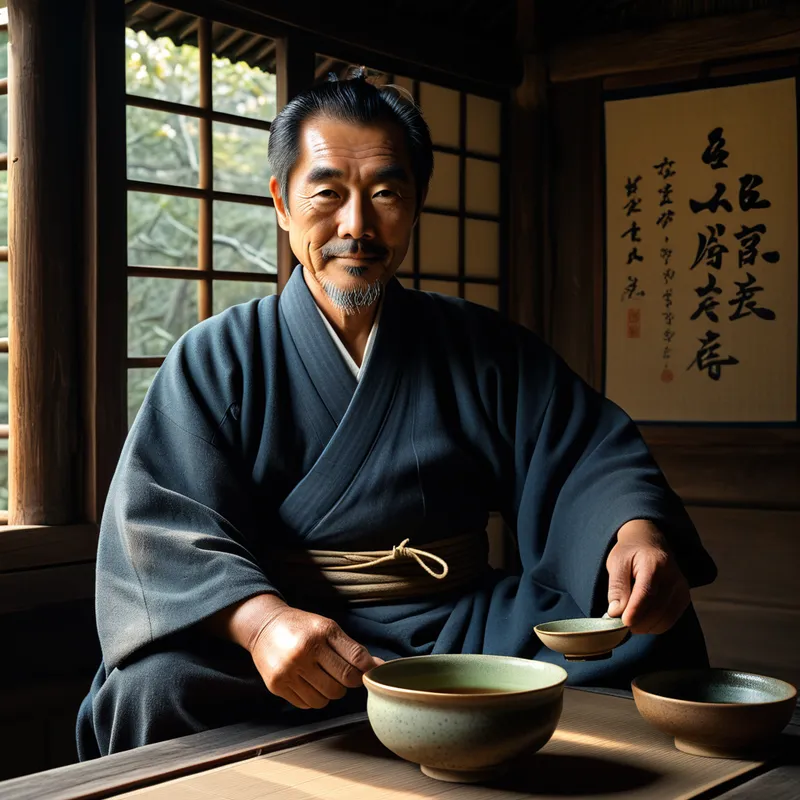
Listen. There was a time when beauty was a shout, a clamor of gold leaf and polished jade, a perfection so loud it silenced the soul. In the glittering courts, where cherry blossoms were forced to bloom out of season, there lived a seeker named Sen no Rikyū. But his heart was a parched riverbed. The splendor around him felt like a gilded cage, its symmetry a prison, its brilliance a kind of blindness.
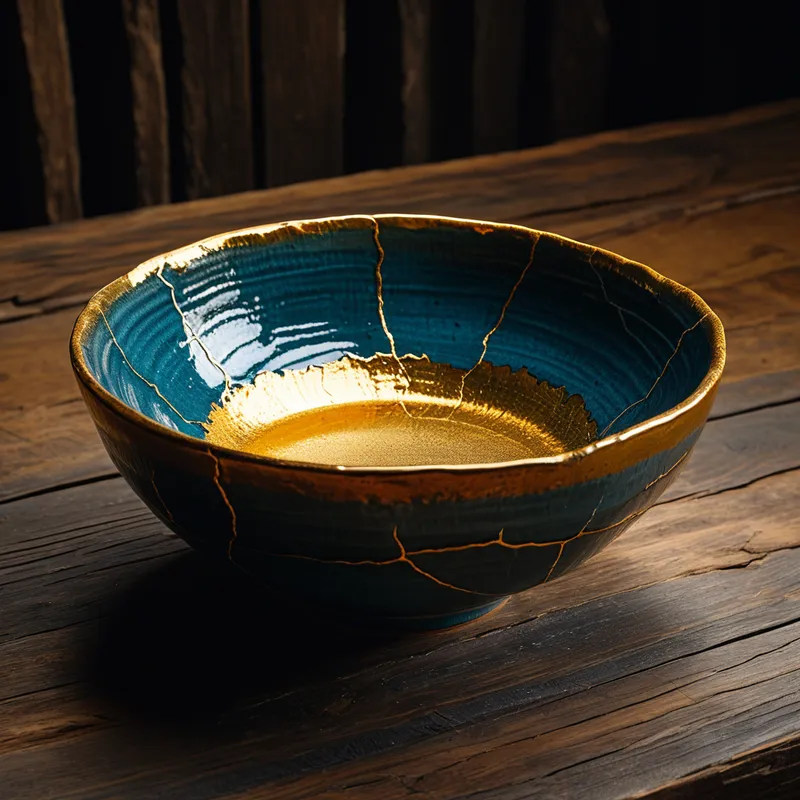
He turned his back on the palace. He walked into the mountains, where the pines were gnarled by [the wind](/myths/the-wind “Myth from Various culture.”/) and the rocks were cloaked in silent moss. He sought a teacher, but found only the teachings of [the world](/myths/the-world “Myth from Tarot culture.”/) itself: the sigh of a branch shedding its last autumn leaf, the patient drip of [water](/myths/water “Myth from Chinese culture.”/) wearing away stone, the humble, asymmetrical curve of a bird’s nest. In a forgotten valley, he built not a temple, but a hut. He gathered clay not to make a perfect vessel, but to make a bowl that would fit his hands, and in the firing, the kiln’s spirit cracked it. Instead of discarding it, he gathered lacquer and dusted it with powdered gold, tracing the fault line with a river of light. He called this [kintsugi](/myths/kintsugi “Myth from Japanese culture.”/).
One day, the great warlord Toyotomi Hideyoshi, hearing of this strange hermit and his “broken beauty,” came to the mountains. He arrived in full regalia, expecting a grand [tea ceremony](/myths/tea-ceremony “Myth from Japanese culture.”/). Instead, Rikyū led him to the simple hut. Hideyoshi, annoyed, noted the thatched roof was leaking, [the bamboo](/myths/the-bamboo “Myth from Taoist culture.”/) fence was leaning. “Where is the perfection?” he demanded. Rikyū said nothing. He went outside, and with a gentle shake, he loosened a few more autumn leaves from a maple tree to scatter upon the mossy garden path, breaking the sterile order.
Inside the hut, the only sound was the kettle singing over the charcoal—a sound like wind in a distant gorge. The light was dim, falling through a small, irregular window. Hideyoshi was given the repaired bowl to hold. As his fingers traced the golden seam, he felt not a flaw, but a story. He saw his own battles, his own cracks, held not with shame but with a luminous dignity. In the quiet, in the imperfect space, in the bowl that had known breakage and repair, the warlord’s striving heart finally stilled. He did not see poverty, but a profound richness. He did not see accident, but the deliberate embrace of fate. In that moment, the myth was born not of gods, but of perception transformed. The aesthetic of wabi—the lonely beauty of [the hermit](/myths/the-hermit “Myth from Tarot culture.”/)’s hut—married the aesthetic of sabi—the patina of time. Together, they became a silent scripture written in cracks, moss, and asymmetrical light.
Cultural Origins & Context
This is not a myth with celestial deities, but a terrestrial one, born in the Muromachi and refined in the Momoyama and Edo periods of Japan (14th-17th centuries). Its primary vessel was chadō, the tea ceremony. Figures like Murata Jukō and, most pivotally, Sen no Rikyū, transformed a Chinese-influenced practice of rare ceramics and lavish display into a spiritual discipline of radical simplicity.
The myth was passed down not through epic poetry, but through practice: the building of sōan tea huts, the crafting of irregular raku ware, the meticulous yet seemingly artless arrangement of a [tokonoma](/myths/tokonoma “Myth from Japanese culture.”/). Its societal function was counter-cultural. In an era of civil war and rigid social hierarchy, [wabi-sabi](/myths/wabi-sabi “Myth from Japanese culture.”/) offered an inner sanctuary. It was a philosophical and aesthetic resistance to the brittle, arrogant perfection of temporal power, aligning instead with Zen Buddhist principles of mujō, non-attachment, and the direct appreciation of suchness.
Symbolic Architecture
At its core, the myth of wabi-sabi is an alchemical instruction for the [soul](/symbols/soul “Symbol: The soul represents the essence of a person, encompassing their spirit, identity, and connection to the universe.”/). It symbolizes the profound shift from an egoic [consciousness](/symbols/consciousness “Symbol: Consciousness represents the state of awareness and perception, encompassing thoughts, feelings, and experiences.”/), which seeks to control, perfect, and eternalize, to an ecological consciousness, which learns to participate, accept, and release.
The cracked [bowl](/symbols/bowl “Symbol: A bowl often represents receptivity, nourishment, and emotional security, symbolizing the dreamer’s needs and desires.”/), repaired with gold, is the central [mandala](/symbols/mandala “Symbol: A sacred geometric circle representing wholeness, the cosmos, and the journey toward spiritual integration.”/). The crack represents [fate](/symbols/fate “Symbol: Fate represents the belief in predetermined outcomes, suggesting that some aspects of life are beyond human control.”/), [trauma](/symbols/trauma “Symbol: A deeply distressing or disturbing experience that overwhelms the psyche, often manifesting in dreams as unresolved emotional wounds or psychological injury.”/), failure—the inevitable fractures in any [life](/symbols/life “Symbol: The symbol of ‘Life’ represents a journey of growth, interconnectedness, and existential meaning, encompassing both the joys and challenges that define human experience.”/) or [identity](/symbols/identity “Symbol: Identity represents the sense of self, encompassing personal beliefs, cultural background, and social roles.”/). The cultural [reflex](/symbols/reflex “Symbol: An involuntary, automatic response to a stimulus, often representing primal instincts, unconscious reactions, or lack of conscious control.”/) is to hide, discard, or deny these breaks. Wabi-sabi proposes the opposite: to illuminate them. The kintsugi is the act of conscious [integration](/symbols/integration “Symbol: The process of unifying disparate parts of the self or experience into a cohesive whole, often representing psychological wholeness or resolution of internal conflict.”/). The break becomes a unique feature, a record of [history](/symbols/history “Symbol: History in dreams often represents the dreamer’s past experiences, lessons learned, or unresolved issues that continue to influence their present.”/) that makes the object more valuable, not [less](/symbols/less “Symbol: The concept of ‘less’ often signifies a need for simplicity, reduction, or minimalism in one’s life or thoughts.”/).
The most profound beauty is not in spite of the flaw, but because of it; the gold does not hide the crack, it reveals its sacred geography.
The weathered tea hut represents the conscious dwelling in limitation and simplicity—the wabi. It is [the ego](/myths/the-ego “Myth from Jungian culture.”/) stripped of its pretensions, finding sufficiency in the essential. The [moss](/symbols/moss “Symbol: Moss symbolizes ancient nourishment, primal connection to earth, and subtle growth through patience and resilience in challenging environments.”/) and [patina](/symbols/patina “Symbol: A surface layer formed by age, wear, or chemical change, symbolizing the beauty of time’s passage and the value of lived experience.”/)—the sabi—represent the grace of time and the [acceptance](/symbols/acceptance “Symbol: The experience of being welcomed, approved, or integrated into a group or situation, often involving validation of one’s identity or actions.”/) of decay as a natural, beautiful phase of the cycle, not a terrifying end. Together, they symbolize the soul’s homecoming to its own authentic, unadorned, and time-worn [nature](/symbols/nature “Symbol: Nature symbolizes growth, connectivity, and the primal forces of existence.”/).

The Dreamer’s Resonance
When this myth stirs in the modern [psyche](/myths/psyche “Myth from Greek culture.”/), it often manifests in dreams of finding beauty in forgotten places: an abandoned, overgrown garden; a beloved, threadbare piece of clothing; a house with visible wear that feels deeply like home. One may dream of repairing something broken not to make it “like new,” but in a way that honors the break. Conversely, dreams of franticly polishing tarnished silver or hiding a stain on a perfect white surface may signal a resistance to this mythic current.
Somatically, this process feels like a deep sigh of release—the unclenching of a jaw held tight in the pursuit of performance, the softening of a shoulder braced against perceived inadequacy. Psychologically, it is the process of moving from shame to reverence for one’s own history. The dream ego is being invited to stop curating a “perfect” self for the internalized gaze of others and to instead inhabit its own authentic, asymmetrical, and beautifully weathered vessel.
Alchemical Translation
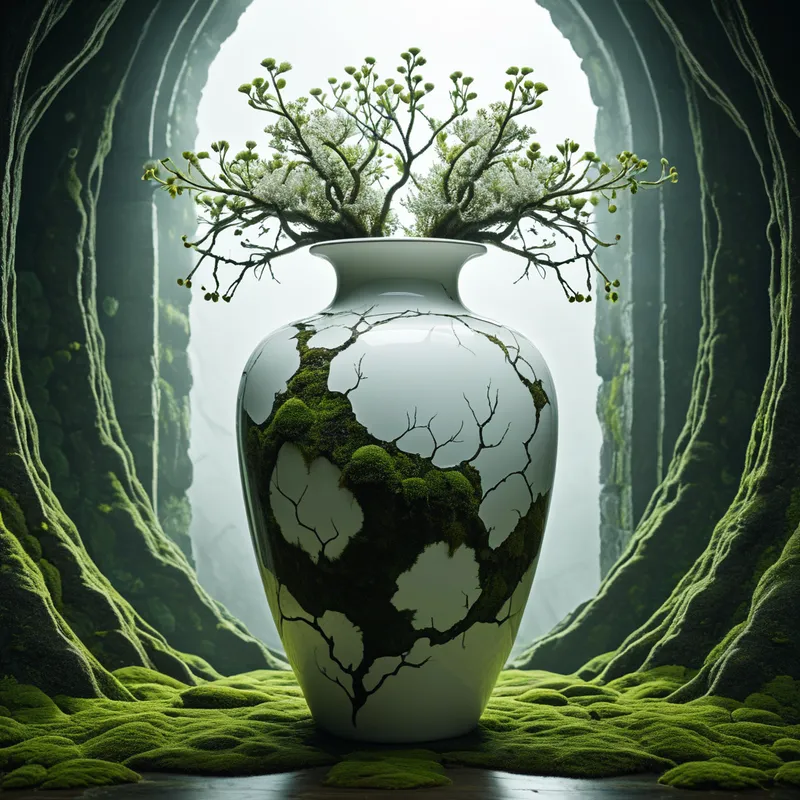
The individuation journey is, in many ways, the practice of wabi-sabi applied to [the self](/myths/the-self “Myth from Jungian culture.”/). We begin identified with the cultural ideal—the shiny, unscathed, symmetrical vase. Life, inevitably, brings cracks: failures, losses, illnesses, the simple wear of years. The ego’s first alchemical task is the [nigredo](/myths/nigredo “Myth from Alchemical culture.”/), the blackening: to acknowledge the break, to feel the despair of imperfection and [impermanence](/myths/impermanence “Myth from Buddhist culture.”/).
Wabi-sabi models the next stage: albedo. This is the conscious gathering of the pieces—not to pretend they never broke, but to examine them with care. The golden lacquer is the loving attention of awareness itself. It is the act of journaling, therapy, meditation, or creative expression that traces the narrative of our wounds and sees them not as random defects, but as formative events that shaped our unique contour.
The goal of this alchemy is not a perfected, static self, but a repaired one—a self whose value is amplified by its conscious, luminous scars, a self at home in the quiet, imperfect, and fleeting beauty of its own existence.
Finally, the [rubedo](/myths/rubedo “Myth from Alchemical culture.”/) is lived out as a wabi-sabi life. It is the courage to live simply, to embrace one’s natural aging, to find depth in solitude (<abbr title=“Wabi), and to appreciate the poignant beauty of autumn and twilight (<abbr title=“Sabi). The psyche transmutes its leaden shame over being human—flawed, temporary, incomplete—into the gold of authentic presence. One becomes the tea master in the weathered hut, serving from a repaired bowl, creating a space where others, too, can put down the burden of perfection and finally rest in the sublime truth of what is.
Associated Symbols
Explore related symbols from the CaleaDream lexicon: