
Vyasa Myth Meaning & Symbolism
The myth of the sage Vyasa, born in a river, who organizes cosmic knowledge and fathers the epic Mahabharata, embodying the archetype of the eternal compiler.
The Tale of Vyasa
Listen, then, to the tale of the one who is not one, but many. The tale of the compiler, the arranger, the father of the story.
In a time when [the world](/myths/the-world “Myth from Tarot culture.”/) was thick with the perfume of sacrifice and the murmur of forgotten hymns, there lived a fisher-girl. Her name was Satyavati, and she carried the scent of [the river](/myths/the-river “Myth from Buddhist culture.”/) in her hair, a scent so potent it could bewitch a king. But her destiny was not woven with royal threads alone. On the banks of the Yamuna, she ferried sages across the dark waters. One such sage, the fierce and potent Parashara, was overcome. He shrouded them in a mist of his own will, and upon that island of fog, upon the rocking boat, a child was conceived and born in the span of a single hour. A child already old with wisdom, his skin the color of a storm cloud, his body smelling of smoke and sacred ash. He was [Krishna](/myths/krishna “Myth from Hindu culture.”/), he was Dvaipayana. He was Vyasa. He left for the forest the moment he was born, promising his mother he would return when called.
The call came in a time of terrible silence. The great knowledge, the Vedas, were a roaring cataract of truth, too vast, too furious for mortal minds to hold. The world was forgetting. Vyasa heard the silence growing. He went to a place where [the earth](/myths/the-earth “Myth from Hindu culture.”/) met [the sky](/myths/the-sky “Myth from Persian culture.”/), and with the power of his [tapas](/myths/tapas “Myth from Hindu culture.”/), he did not create new knowledge, but he divided the one river into four streams. He arranged the chaos into the Rig, Yajur, Sama, and Atharva. He gave the torrent banks and a course. He was the first librarian of the cosmos.
But his greatest work was born from a deeper, more human silence—the silence of a barren womb. His half-brother, the king, was dying without an heir. Satyavati called her son from [the wilderness](/myths/the-wilderness “Myth from Biblical culture.”/), her voice laced with desperation and royal duty. Through the ancient, fearsome law of niyoga, Vyasa entered the chambers of the widowed queens. His ascetic’s form, wild and terrible, frightened them. One closed her eyes and bore a blind son, Dhritarashtra. One turned pale and bore a pale son, Pandu. A servant girl, who did not flinch, received his grace and bore a wise son, Vidura. From this fraught, sacred union, the seeds of the greatest war were sown.
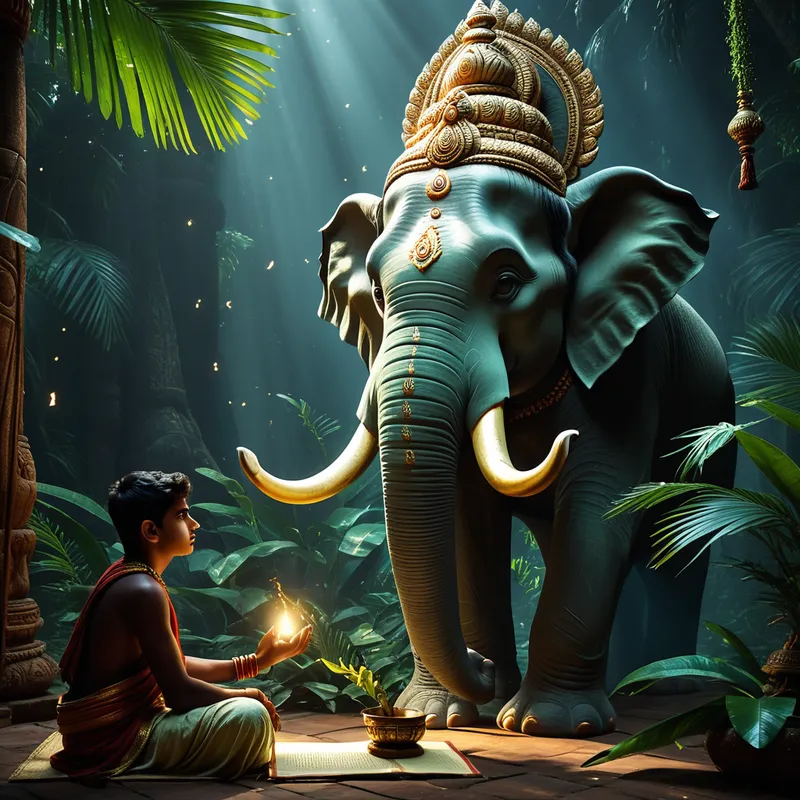
Years later, Vyasa witnessed the fruit of that sowing: the apocalyptic war of Mahabharata, a war that decimated a generation. He saw the wheel of dharma shatter. And from the ashes of that vision, he knew the story must be told. But who could write it? Who could hold such a terrible, beautiful, contradictory truth? He summoned [Ganesha](/myths/ganesha “Myth from Hindu culture.”/), the lord of thresholds, and laid down a condition: “Write only if you understand my dictation without pause.” [Ganesha](/myths/ganesha “Myth from Hindu culture.”/) agreed, but added his own: “Speak only without hesitation.” And so the dance began. The sage, his consciousness a river in full flood, poured forth the epic—every battle, every betrayal, every sermon, every secret. The god-scribe, his tusk a pen, raced to inscribe it on the scroll of the world. When the torrent threatened to overwhelm, Ganesha would pause, and in that sacred pause, Vyasa would compose a verse so profound it would give them both time to breathe. Thus, the 100,000 verses were born, a story containing all stories, compiled by the one who was present at every beginning.
Cultural Origins & Context
The figure of Vyasa is not merely a character in Hindu tradition; he is a meta-function of the tradition itself. The title “Vyasa” (which means “arranger” or “compiler”) is accorded to the sage who organizes the Vedas in each cycle of time, suggesting Vyasa is an eternal archetype that re-manifests when cosmic knowledge becomes disordered. Historically, the Vyasa of the current age is situated in the distant, mythic past, credited with composing the Mahabharata, the Brahmanas, and the foundational Vedanta philosophy.
The myth was passed down through the very channels he is said to have established: the oral tradition of the Puranas and the epic recitations by bards and sutas. His story served a crucial societal function: it legitimized the monumental, encyclopedic texts that formed the bedrock of classical Indian civilization. By attributing them to a semi-divine sage born of both royal and ascetic lineages, the tradition fused authority with profundity, political history with spiritual truth. He is the ultimate author-function, the guarantor of the canon’s authenticity.
Symbolic Architecture
Vyasa is the [archetype](/symbols/archetype “Symbol: A universal, primordial pattern or prototype in the collective unconscious that shapes human experience, behavior, and creative expression.”/) of the [Logos](/myths/logos “Myth from Christian culture.”/) applied to the [primordial chaos](/symbols/primordial-chaos “Symbol: The formless, undifferentiated state before creation in many cosmologies, representing potential, disorder, and the raw material of existence.”/) of the unconscious. He does not create the waters; he gives them form. His [birth](/symbols/birth “Symbol: Birth symbolizes new beginnings, transformation, and the potential for growth and development.”/) from the [river](/symbols/river “Symbol: A river often symbolizes the flow of emotions, the passage of time, and life’s journey, reflecting transitions and movement in one’s life.”/) and [the mist](/myths/the-mist “Myth from Celtic culture.”/) symbolizes the [emergence](/symbols/emergence “Symbol: A process of coming into being, rising from obscurity, or breaking through a barrier, often representing birth, transformation, or revelation.”/) of [consciousness](/symbols/consciousness “Symbol: Consciousness represents the state of awareness and perception, encompassing thoughts, feelings, and experiences.”/) from the undifferentiated, fluid [realm](/symbols/realm “Symbol: The symbol of ‘Realm’ often signifies the boundaries of one’s consciousness, experiences, or emotional states, suggesting aspects of reality that are either explored or ignored.”/) of the [mother](/symbols/mother “Symbol: The symbol of ‘Mother’ represents nurturing, protection, and the foundational aspect of one’s emotional being, often associated with comfort and unconditional love.”/), the Narayana.
He is the psyche’s innate drive to find pattern in chaos, meaning in suffering, and narrative in the raw data of existence.
His dark complexion links him to the fertile, unmanifest potential, while his [role](/symbols/role “Symbol: The concept of ‘role’ in dreams often reflects one’s identity or how individuals perceive their place within various social structures.”/) as an ascetic signifies the disciplined focus required to shape that potential. The [division](/symbols/division “Symbol: Represents internal conflict, separation of self, or unresolved emotional splits. Often indicates a need for integration or decision-making.”/) of the [Vedas](/symbols/vedas “Symbol: Ancient Hindu scriptures representing divine knowledge, cosmic order, and ultimate spiritual truth.”/) represents the essential psychic act of discrimination—separating thought from feeling, [intuition](/symbols/intuition “Symbol: The immediate, non-rational understanding of truth or insight, often described as a ‘gut feeling’ or inner knowing that bypasses conscious reasoning.”/) from [sensation](/symbols/sensation “Symbol: Sensation in dreams often represents the emotional and physical feelings experienced in waking life, highlighting one’s intuition or awareness.”/), to create a functioning consciousness.
Most profoundly, his fathering of the warring lineages through the terrified queens is a masterful [symbol](/symbols/symbol “Symbol: A symbol can represent an idea, concept, or belief, serving as a powerful tool for communication and understanding.”/) of how [trauma](/symbols/trauma “Symbol: A deeply distressing or disturbing experience that overwhelms the psyche, often manifesting in dreams as unresolved emotional wounds or psychological injury.”/) and [shadow](/symbols/shadow “Symbol: The ‘shadow’ embodies the unconscious, repressed aspects of the self and often represents fears or hidden emotions.”/) are woven into the fabric of our personal and collective [history](/symbols/history “Symbol: History in dreams often represents the dreamer’s past experiences, lessons learned, or unresolved issues that continue to influence their present.”/). The children—blind, pale, and wise—are not random; they are the direct, symbolic [offspring](/symbols/offspring “Symbol: Represents legacy, responsibility, and the future self. Often symbolizes creative projects or personal growth.”/) of the encounter between raw, untamed [spirit](/symbols/spirit “Symbol: Spirit symbolizes the essence of life, vitality, and the spiritual journey of the individual.”/) (Vyasa) and an unprepared, fearful [psyche](/myths/psyche “Myth from Greek culture.”/) (the queens). The epic war that follows is the inevitable playing out of these unconscious complexes on the battlefield of [life](/symbols/life “Symbol: The symbol of ‘Life’ represents a journey of growth, interconnectedness, and existential meaning, encompassing both the joys and challenges that define human experience.”/).
The Dreamer’s Resonance
When the pattern of Vyasa stirs in the modern dreamer, it often signals a profound process of psychic integration. One may dream of a vast, incomprehensible library where books are melting into one another, or of a torrent of information—emails, voices, memories—that threatens to drown the dreamer. The appearance of a calm, authoritative figure who begins to sort, label, or narrate this chaos points directly to the Vyasa complex activating within.
Somatically, this can feel like a pressure in the head, a need to “write things down,” or a restless energy that seeks a channel. Psychologically, it is [the Self](/myths/the-self “Myth from Jungian culture.”/) organizing a new level of coherence. The dreamer may be undergoing a life transition where disparate experiences—a career shift, relational endings, creative projects—are demanding to be synthesized into a single, meaningful narrative. The dream-Vyasa does not solve problems; he compiles them into a story that can be contemplated, transforming overwhelming data into digestible epic.

Alchemical Translation
The alchemical work modeled by Vyasa is the opus contra naturam—the work against nature—not in defiance, but in conscious shaping of nature’s raw ore. [The prima materia](/myths/the-prima-materia “Myth from Alchemical culture.”/) is the unprocessed experience of a lifetime: joy, trauma, banality, and ecstasy, all in a chaotic mix. Vyasa’s first act, dividing [the Vedas](/myths/the-vedas “Myth from Hindu culture.”/), is the [separatio](/myths/separatio “Myth from Alchemical culture.”/). The modern individual must perform this by journaling, therapy, or artistic expression, pulling apart the tangled threads of their history.
The ultimate goal is not to become the author of a perfect story, but to become the sacred space where the story can be faithfully transcribed by a wisdom greater than oneself.
The niyoga episode represents the courageous, often uncomfortable, integration of [the shadow](/myths/the-shadow “Myth from Jungian culture.”/). Inviting the “wild sage” (one’s own unintegrated spirit, genius, or trauma) into the inner chamber to father the future is a terrifying but necessary act. The children born—our blind spots (Dhritarashtra), our vulnerabilities (Pandu), and our innate wisdom (Vidura)—become the dramatis personae of our inner world.
Finally, the dictation to Ganesha is the pinnacle of the individuation process. Here, the conscious ego (Vyasa) aligns with the transcendent function, the archetype of meaning (Ganesha), to produce [the magnum opus](/myths/the-magnum-opus “Myth from Alchemical culture.”/) of one’s own life story. The condition of “no pause” means living with total commitment to truth-telling; the condition of “no hesitation” from the scribe means the universe reciprocates by providing the means for manifestation. The pauses for profound verses are the moments of reflection, the synchronicities, and the insights that allow the process to continue without the psyche collapsing under its own weight. To live the Vyasa myth is to become the compiler of one’s own soul, arranging the scattered verses of experience into an epic that, finally, makes sense.
Associated Symbols
Explore related symbols from the CaleaDream lexicon: