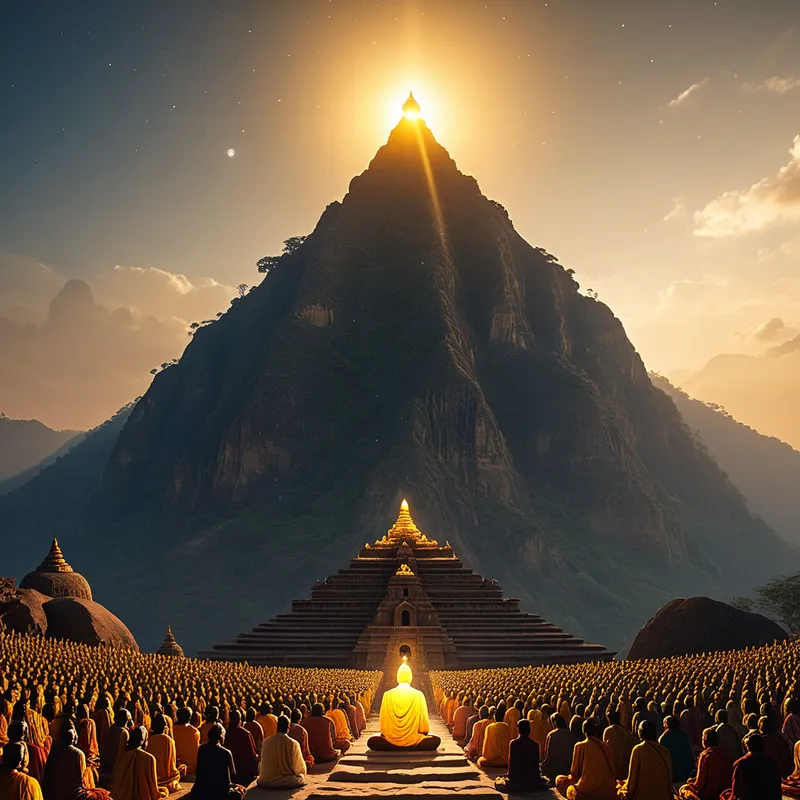
Vulture's Peak Myth Meaning & Symbolism
The Buddha transmits the essence of reality in perfect silence from a mountain shaped like a vulture, leaving only one disciple to understand.
The Tale of Vulture’s Peak
Gather close, and let the dust of the Ganges settle. Let the chatter of the mind grow still. We journey to a place where the earth itself reaches for the sky in the form of a patient, waiting bird—Gṛdhrakūṭa, the Vulture’s Peak.
The air here is thin, charged with a presence that stills the very wind. Upon a great stone platform, beneath the vast, open vault of heaven, sits Śākyamuni. He is the still point in the turning world. Arrayed before him is the entire cosmos of his disciples: thousands of bhikkhus and bhikkhunīs, celestial devas, and mighty nāgas, all having gathered, drawn by a rumor of a teaching beyond teachings. The silence is not empty; it is full, a palpable weight of expectation.
The Buddha does not rise. He does not clear his throat to recite a sutra on emptiness or the chain of causation. He simply gazes out, his eyes holding the peace of a deep, unfathomable lake. The assembly waits, breaths held. Minutes stretch. The cry of a distant vulture circles on the thermals.
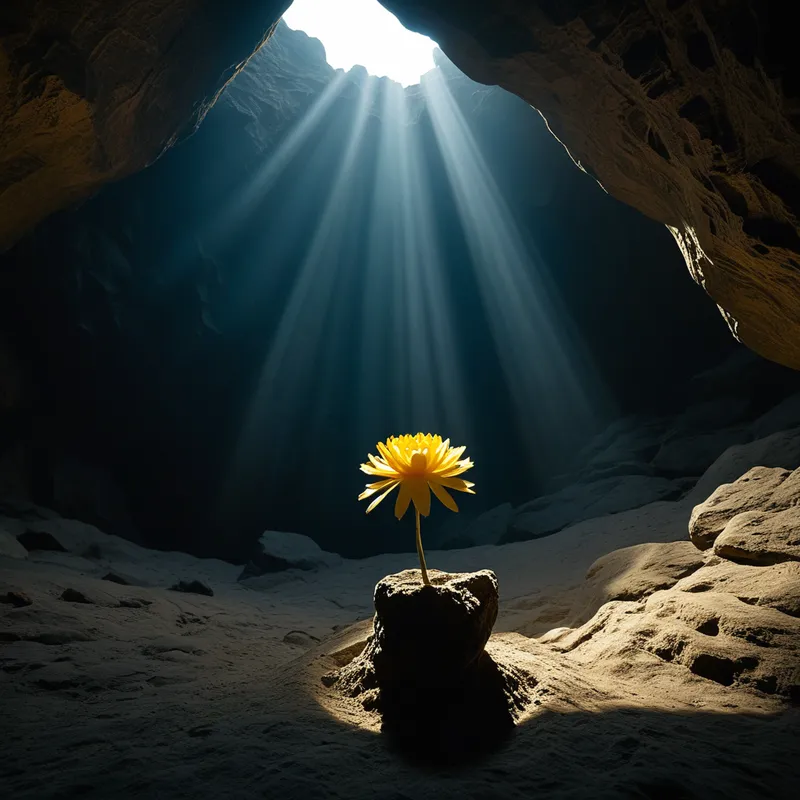
Then, without a word, the World-Honored One lifts his hand. Between his finger and thumb, he holds a single flower. It is a simple, golden blossom. He holds it aloft, turning it slowly, as if examining its perfection for the first time. The action is absurd in its simplicity. Grand doctrines on suffering and its end hang in the balance, and the teacher offers a flower.
A ripple of confusion passes through the ranks. Learned elders frown, their minds racing through commentaries. Celestial beings exchange glances. The silence now becomes awkward, thick with misunderstanding. What parable is this? What lesson is encoded in this petal and stem?
All but one. In the back of the assembly, a disciple named <abbr title=""Kāśyapa”, the Buddha’s disciple known for his asceticism”>Mahākāśyapa, his robes ragged from austere practice, looks upon the flower. And he does not think. He does not analyze. A dawn breaks within him, not of light, but of profound, wordless recognition. The corners of his mouth lift, not in a smile of joy, but in the serene expression of one who has come home. He understands.
The Buddha’s eyes meet his. In that glance, across the sea of bewildered faces, the entire Dharma—the inexpressible truth of reality—is transmitted. Not a single word has been spoken. The Buddha speaks at last, his voice the sound of a mountain stream: “I possess the true Dharma eye, the marvelous mind of Nirvana, the true form of the formless, the subtle Dharma gate that does not rest on words or letters but is a special transmission outside of the scriptures. This I entrust to Mahākāśyapa.”
The flower, the glance, the smile. The teaching is complete. The vultures continue their silent circles, guardians of a peak that witnessed the sound of one hand clapping.
Cultural Origins & Context
This story, known as “The Flower Sermon,” is a foundational kōan within the Chan and Zen traditions. While Vulture’s Peak is a real geographical location near Rajgir, India, revered as a site where the Buddha delivered many important sutras (like the Prajñāpāramitā teachings), this specific silent sermon is not found in the earliest Pali Canon. It emerges later, within the mytho-poetic lineage histories of Chan, first appearing in texts from the 11th century.
Its primary function was not historical biography but legitimation. It served as the mythical origin point for the Chan/Zen concept of <abbr title=""Mind-to-mind transmission,” the direct passing of enlightenment from master to disciple”>ishin-denshin (心伝心). It established an unbroken, wordless lineage from the Buddha himself to the patriarchs of China, privileging direct experiential insight over scholastic scriptural study. The story was told and retold by masters to shock disciples out of intellectual reliance, pointing them toward immediate, intuitive awakening. It was a narrative weapon against dogma, enshrining the ineffable at the very heart of the tradition.
Symbolic Architecture
The myth is a perfect mandala of symbols pointing to the nature of consciousness and reality.
The Peak: Gṛdhrakūṭa is not just a setting; it is a state of being. The vulture, a creature that soars at great heights and feeds on what is dead, symbolizes transcendent insight that rises above the mundane and consumes the carcass of illusion. The mountain represents the immutable, foundational ground of reality—the suchness of things.
The Flower: It is the ultimate symbol of the paradox. It is delicate, ephemeral, beautiful, and utterly natural—a direct manifestation of the cosmic law (Dharma) without any need for explanation. It represents the phenomenal world in its pristine, thus-ness.
The Silence: This is the core. The silence is not an absence of sound, but the presence of the unconditioned. It is the space in which direct perception occurs, unmediated by the conceptual mind (vijñāna). The Buddha’s silence is the teaching of śūnyatā itself.
The Smile: Mahākāśyapa’s subtle smile is the alchemical moment of gnosis. It is the recognition that the flower, the mountain, the Buddha, and his own mind are not separate. It is the flash of non-dual awareness.
The true teaching is not in the turning of the scripture, but in the turning of the heart upon seeing a flower held in silence.
The Dreamer’s Resonance
When this myth stirs in the modern psyche, it often manifests in dreams of profound, frustrating silence. You may dream of standing before a wise figure who refuses to speak, or of being in a critical meeting where you are given a mundane object instead of the answer you crave. The somatic feeling is one of tense anticipation collapsing into bewildered stillness.
Psychologically, this signals a confrontation with the limits of the rational, problem-solving ego. The dream-ego arrives with its questions—“What is my purpose? How do I fix this?”—and is met with a symbolic, non-verbal answer. This is the psyche’s way of initiating a shift from seeking knowledge to cultivating knowing. The frustration is the death throes of the old paradigm. The dream invites you to stop trying to think your way to understanding and to begin perceiving directly, to receive the “flower” of an intuition, a somatic feeling, or a simple, beautiful fact of your existence without immediately layering interpretation upon it.
Alchemical Translation
The process modeled here is the quintessential alchemy of individuation: the transmutation of leaden intellectual certainty into the gold of embodied wisdom. The assembly represents the complex of the conscious mind—educated, expectant, and reliant on external authority and formulated doctrine (the known scriptures).
The Buddha as the Self, the central archetype of wholeness, performs the critical operation: he withholds the expected content. This creates the vas, the sealed vessel of the sacred space on the peak, where pressure builds. The ego’s tools are rendered useless. In that crisis, the figure of Mahākāśyapa emerges—the archetype of the inner disciple, the part of the psyche capable of ascetic devotion to truth (tapas). He is not the learned scholar, but the one who has practiced simplicity and direct attention.
The transmission is the moment of integration. The ego (the assembly) does not disappear, but it is no longer in charge. The center of gravity shifts to a deeper, more intuitive function that can perceive the symbolic, living reality of the Self’s communication. The smile is the sign of this integration—a peaceful accord between the conscious mind and the ineffable Self.
Individuation is not the accumulation of more answers, but the refinement of the capacity to behold the question, and the world, as a flower held in eternal, silent offering.
For the modern individual, the “Flower Sermon” instructs us to create our own Vulture’s Peak moments. To sit in meditation without a goal. To walk in nature without commentary. To listen to a piece of music without analysis. In these silences, when we cease demanding that life explain itself in our terms, we may, if we are still enough, glimpse the flower—and, perhaps, allow the long-awaited smile of understanding to dawn.
Associated Symbols
Explore related symbols from the CaleaDream lexicon: