
Voodoo Doll Myth Meaning & Symbolism
A story of a shaman who, through a doll of clay and cloth, learns that to bind another is to bind oneself, forging a covenant of shared fate.
The Tale of the Voodoo Doll
Listen, and hear the tale not of malice, but of consequence. It begins not in a palace, but in a hut at the edge of the village, where the air smells of dried herbs and old earth. Here lived Mama Nyla, whose eyes held the patience of deep roots and whose hands knew the language of clay and cloth.
A young man, Kofi, came to her, his spirit a storm of bruised pride. A rival had bested him in trade, had spoken words that festered like thorns. “Bind him,” Kofi pleaded, his voice tight. “Let him feel the sting of my discontent. Make a charm to turn his luck to ash.”
Mama Nyla studied him, hearing the unspoken hurt beneath the anger. She did not refuse. Instead, she asked for something of the rival—a thread from his garment, a clipping from his field. And she asked for something of Kofi—a lock of his own hair, a drop of his sweat. “To weave a connection,” she said, “you must be in the weave.”
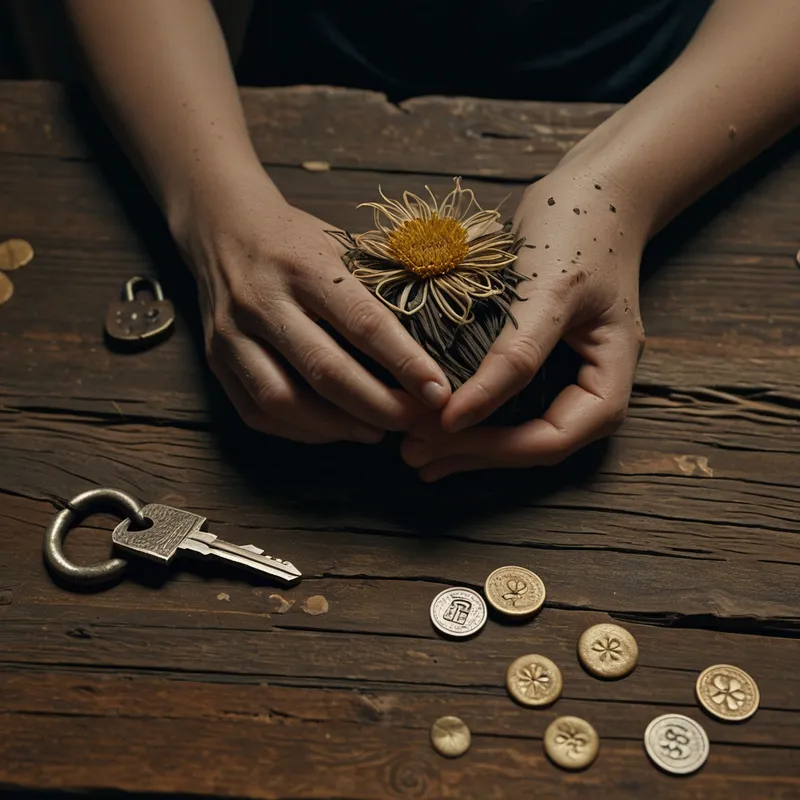
Under the guttering light of a single candle, she took river clay, red and cool. She mixed it with water and began to shape a crude figure, humming a tune that was neither a lullaby nor a dirge, but something older than both. She pressed the rival’s thread into the clay back, and wrapped Kofi’s hair around its middle. She clothed it in a scrap of cloth, and with a thorn from a sacred acacia, she pricked her own finger, letting a single bead of her blood darken the clay where a heart would be.
“Now,” she said, her voice filling the hut. “The law is simple, and the law is absolute. What you do to this form, you do to the man. But hear this, Kofi: the thread runs both ways. The channel you open cannot carry one river. It carries two.”
She placed the doll in Kofi’s eager hands. That night, in secret, he took a pin and pressed it into the doll’s foot, whispering his grievance. Across the village, his rival cried out, stumbling with a sudden limp. Elated, Kofi pressed another pin, and another. With each small vengeance, a coldness settled in his own limbs, a creeping numbness. He laughed it off as fatigue.
But anger, once given form, hungers. Kofi’s pinpricks became burns from a candle flame. The rival fell ill with fever. And as the rival burned, so too did Kofi feel a fire in his own veins. He grew weak, his skin hot to the touch. In his hut, clutching the now-warm doll, he realized Mama Nyla’s truth was not a warning, but a description. He was not a puppeteer, but a participant in a dreadful, intimate dance.
Terrified, he stumbled back to Mama Nyla at dawn. She found him shivering, the doll clutched to his chest as if for warmth. Without a word, she took it. She removed each pin with gentle, deliberate care, singing a song of release. She washed the doll in water infused with forgiveness—not for the rival, but for Kofi’s own bound heart. She placed it on a bed of cooling mint and sage.
“As the connection was made, so it must be unmade,” she intoned. “But not severed. Transformed.” She guided Kofi’s hand to place the doll upon the soft earth at the base of a great kapok tree. “Let the rains soften it. Let the worms digest your spite. Let the roots draw out the poison and turn it to nourishment. Your fate is no longer bound to his hurt, but to the healing of the ground that holds you both.”
And as the doll dissolved back into the earth, Kofi felt the fever break. The numbness receded. He looked at his hands, no longer instruments of remote harm, and understood they were now empty, ready to touch the world directly once more.
Cultural Origins & Context
The narrative of the sympathetic figure, of which the “voodoo doll” is the most sensationalized example, is a profound thread in the global tapestry of folklore. Its most direct anthropological roots are often traced to the Hoodoo and Vodou traditions, where pwen (points) and pakèt (packets) serve as ritual foci for intention. However, the core concept—that a representation of a person can become a conduit for influence—is near-universal. It appears in European poppet magic, in cunning-craft, and in countless indigenous practices worldwide.
This story was not scripture, but lived wisdom, passed from elder to apprentice, from grandmother to grandchild, often in hushed tones by the hearth. Its primary societal function was dual: it was a narrative container for the very real human experience of powerless rage and the desire for agency, and it was a powerful ethical teaching tool. It codified a fundamental law of a relational universe: action begets reaction, and magic, like any force, obeys the principle of reciprocity. The story served as a mythic circuit-breaker, warning that the pursuit of power over another inevitably entangles the self.
Symbolic Architecture
At its heart, the myth is not about control, but about connection and the terrifying responsibility it entails. The doll is the ultimate symbol of the shadow projection—the aspects of ourselves we refuse to acknowledge, which we then perceive and attack in others.
The doll is the made-thing, the concretized intention. It is the point where thought leaves the nebulous realm of desire and enters the world of form, taking on a life—and a law—of its own.
The ritual ingredients—clay (the primordial flesh), personal tokens (the essence of identity), the maker’s blood (the sacrifice of self that true creation demands)—symbolize the construction of a psychic bridge. This bridge does not discriminate; it carries traffic in both directions. The pins are not merely weapons; they are focal points of attention. Where we focus our energy—especially the sharp, piercing energy of hatred or envy—we create a channel, and through that channel flows not only our intention but a part of our own vitality.
The true “magic” of Mama Nyla is not in the binding, but in the unbinding through integration. The dissolution of the doll into the kapok tree is the alchemical key: the toxic, personal conflict is returned to the impersonal, nourishing body of the Anima Mundi. The individual’s pain is composted into something that can support new growth.
The Dreamer’s Resonance
When this mythic pattern surfaces in modern dreams, it signals a critical moment of psychic reckoning with the dynamics of influence and entanglement. To dream of making or using a voodoo doll often coincides with feelings of powerlessness, resentment, or a secret desire to manipulate a situation or person. The somatic experience upon waking may be a tight chest, a sense of constriction, or even localized pain—the body literalizing the “pinpricks” of bound energy.
Conversely, dreaming of being the doll, of feeling pins or remote manipulations, points to the dreamer’s perception of being controlled, victimized by external forces, or of having surrendered their agency. The dream is a stark depiction of the psychological state of projection identification, where one has unconsciously accepted the “role” assigned by another’s negativity or one’s own inner critic.
The most potent dream variation is finding a doll connected to you by threads, or realizing your actions upon it affect you simultaneously. This is the unconscious presenting the myth’s core lesson: you are in a reciprocal field. The dream-ego is being forced to confront the consequences of its own psychic emissions, urging a move from blame to responsibility.
Alchemical Translation
For the modern individual navigating a world of complex social and digital ties, this myth models the process of psychic hygiene and ethical individuation. The initial creation of the doll represents the unavoidable human act of forming mental representations of others—our opinions, judgments, and stories about them. The problem is not the creation, but the belief that this representation is separate from us, a tool we can wield without cost.
The alchemical work is to withdraw the projection, to take back the pins. This is not an act of forgiveness granted to another, but of reclamation of the energy trapped in the binding.
The “Mama Nyla” within is the observing Self that understands all relationships are systems. Her ritual dissolution is the internal process of sublimation: taking the raw, heated energy of hatred, jealousy, or hurt and consciously transforming it. This might be through artistic expression, through journaling to understand one’s own complicity, or through the deliberate practice of compassion—not for the other’s sake, but to break the corrosive circuit.
The final stage, leaving the doll to be absorbed by the great tree, symbolizes releasing the personal drama to a higher order. It is the understanding that your growth—your individuation—is not dependent on another’s defeat or submission, but on your ability to compost your own shadows and channel that energy into your own rooted, upward growth. You cease trying to manipulate the reflection and instead turn to tend the source. The myth of the voodoo doll, therefore, culminates not in a spell of control, but in the ultimate spell of liberation: the realization that the only binding that ever truly exists is the one you have the power to consciously unmake within yourself.
Associated Symbols
Explore related symbols from the CaleaDream lexicon: