Vitrum Philosphorum Myth Meaning & Symbolism
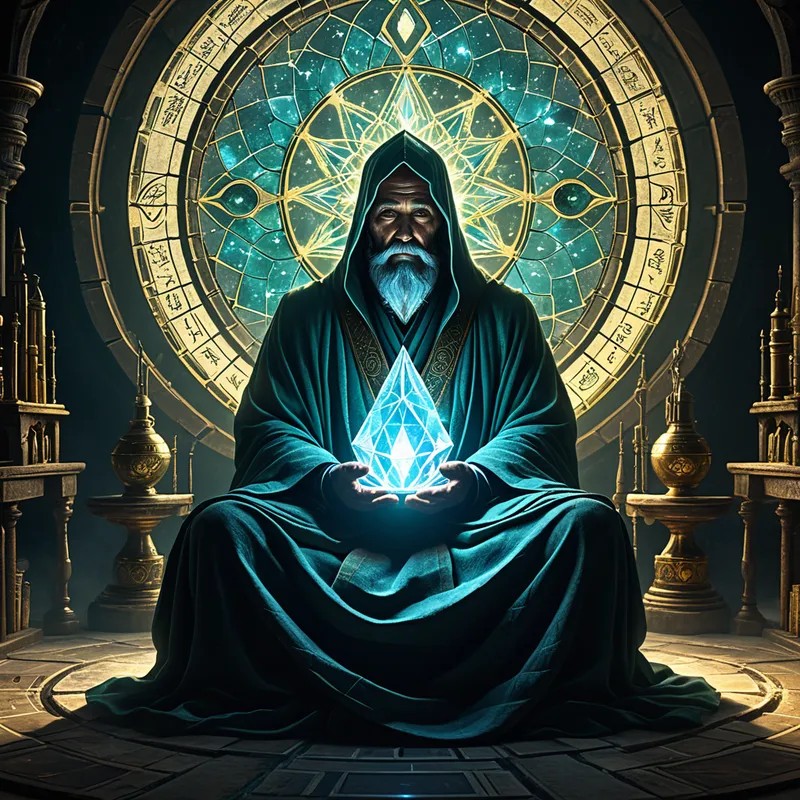
A myth of a sage who becomes a vessel of pure consciousness, shattering the self to become a transparent lens for the divine light.
The Tale of Vitrum Philosphorum
Listen, and I will tell you of the one who sought to know the sun, not by staring at its face, but by becoming its vessel.
In the deep, silent hours when [the world](/myths/the-world “Myth from Tarot culture.”/) is held between midnight and dawn, there lived a seeker named Philosophus. He was not a king, nor a warrior, but a man of the quiet mind, whose kingdom was the cluttered sanctuary of his laboratory. His life was a long vigil before the Alembic, his fingers stained with the salts of [the earth](/myths/the-earth “Myth from Hindu culture.”/) and the tinctures of strange metals. He sought not gold, but the secret behind gold’s gleam; not longevity, but the principle of life itself.
For years, his work was a dance of separation. He divided the volatile from the fixed, the subtle from the gross, the soul from the body of matter. He mastered the [Nigredo](/myths/nigredo “Myth from Alchemical culture.”/), the blackening, where all things rot to their essence. He endured the Albedo, the bleaching asceticism of the spirit. Yet the final mystery, the [Rubedo](/myths/rubedo “Myth from Alchemical culture.”/), eluded him. The great union, the marriage of soul and spirit, king and queen, remained a diagram in a dusty manuscript.
The turning point was not a discovery, but a despair. One evening, gazing at his most perfect elixir—a liquid that held the captured light of a thousand full moons—he understood his error. He had been trying to capture the light, to bottle the divine. He had become a collector of reflections, not a source of illumination. In that moment of shattering humility, he took his cherished elixir, the work of a lifetime, and poured it not into a vessel, but onto the bare stone floor of his tower. He declared to the silent stars: “If I am to know the light, I must not hold it. I must be held by it.”
He then began the ultimate, terrifying operation: upon himself. Using the principles of his art, he began a slow, deliberate dissolution. Not of his body, but of the opaque container of his self—his prejudices, his certainties, the very story of who he was. It was an interior [Solve et Coagula](/myths/solve-et-coagula “Myth from Alchemical culture.”/). He felt his identity crack like a shell. His memories, his fears, his desires, all the colored glass of his personality, began to lose their hue, becoming clear, then transparent.
The process was agony, a psychic freezing and firing. He felt himself becoming brittle, fragile, a [thing](/myths/thing “Myth from Norse culture.”/) that could be shattered by a single harsh word. But as the opacity faded, a new perception dawned. He no longer saw the world through a lens of self; the world began to see itself through him. The light of the dawn did not fall upon his face; it passed through him, casting a spectrum upon the wall. The song of a bird did not enter his ear; it resonated within the crystalline lattice of his being.
He had become the [Vitrum](/myths/vitrum “Myth from Alchemical culture.”/) Philosphorum. He was no longer a man who knew things, but a space in which knowing occurred. He was [the alembic](/myths/the-alembic “Myth from Alchemical culture.”/) and the elixir, [the vessel](/myths/the-vessel “Myth from Alchemical culture.”/) and the content. The final secret was not a substance to be grasped, but a state of being: perfect, fragile transparency. The myth ends not with a [triumph](/myths/triumph “Myth from Roman culture.”/), but with a silent, enduring presence. The sage sits in his tower, a living prism, through whom the undivided light of the world is endlessly, beautifully, fractured into understanding.
Cultural Origins & Context
The allegory of the Vitrum Philosphorum emerges from the late European alchemical tradition, particularly within the Hermetic and Rosicrucian streams of the 16th and 17th centuries. Unlike more straightforward recipes for the [Philosopher’s Stone](/myths/philosophers-stone “Myth from Alchemical culture.”/), this myth belongs to the theoria of alchemy—its spiritual and psychological dimension. It was never a story for the masses, but a cryptic teaching passed between adepts, encoded in emblem books, personal letters, and oral instruction.
Its societal function was subversive and initiatory. In an age of rigid dogma, it proposed that the ultimate authority was not external scripture, but the light of consciousness experienced directly through a purified self. The “glass” was a radical metaphor for a mind cleared of the “lead” of worldly illusion and doctrinal impurity. Telling this story was an act of pointing, not explaining. It served as a mirror for the aspiring adept: “Your goal is not to possess a thing, but to become a specific quality of vessel. Are you willing to be emptied, to be made fragile, for that purpose?”
Symbolic Architecture
The myth’s power lies in its profound inversion of the heroic [quest](/symbols/quest “Symbol: A quest symbolizes a journey or search for purpose, fulfillment, or knowledge, often representing life’s challenges and adventures.”/). The [treasure](/symbols/treasure “Symbol: A hidden or valuable object representing spiritual wealth, inner potential, or divine reward.”/) is not won; the [seeker](/symbols/seeker “Symbol: A person actively searching for meaning, truth, or a higher purpose, often representing the dreamer’s own quest for identity or fulfillment.”/) becomes the treasure by ceasing to be a seeker.
The ultimate vessel is not one that holds, but one that transmits. The highest knowledge is not owned, but hosted.
The [Laboratory](/symbols/laboratory “Symbol: A controlled environment for experimentation, discovery, and analysis, representing the pursuit of knowledge through methodical processes.”/) symbolizes the [psyche](/myths/psyche “Myth from Greek culture.”/) itself—the enclosed [space](/symbols/space “Symbol: Dreaming of ‘Space’ often symbolizes the vastness of potential, personal freedom, or feelings of isolation and exploration in one’s life.”/) where the experiments of self-confrontation and [integration](/symbols/integration “Symbol: The process of unifying disparate parts of the self or experience into a cohesive whole, often representing psychological wholeness or resolution of internal conflict.”/) occur. The [Elixir](/symbols/elixir “Symbol: A mythical substance representing ultimate healing, immortality, or spiritual transformation, often sought as the pinnacle of alchemical or mystical achievement.”/) represents a lifetime of accumulated [knowledge](/symbols/knowledge “Symbol: Knowledge symbolizes learning, understanding, and wisdom, embodying the acquisition of information and enlightenment.”/) and spiritual [achievement](/symbols/achievement “Symbol: Symbolizes success, mastery, or reaching a goal, often reflecting personal validation, social recognition, or overcoming challenges.”/). Pouring it out is the critical act of sacrificing [the ego](/myths/the-ego “Myth from Jungian culture.”/)’s accomplishments. It is the [death](/symbols/death “Symbol: Symbolizes transformation, endings, and new beginnings; often associated with fear of the unknown.”/) of spiritual pride, the understanding that even our finest insights can become idols that block the light.
The process of becoming [glass](/symbols/glass “Symbol: Glass in dreams often symbolizes clarity, transparency, fragility, and the need for introspection.”/) or [crystal](/symbols/crystal “Symbol: Crystals often symbolize clarity, purity, and the amplification of energy and intentions within dreams.”/) is the core [symbol](/symbols/symbol “Symbol: A symbol can represent an idea, concept, or belief, serving as a powerful tool for communication and understanding.”/). It represents the achievement of objective [consciousness](/symbols/consciousness “Symbol: Consciousness represents the state of awareness and perception, encompassing thoughts, feelings, and experiences.”/). The opaque, colored [glass](/symbols/glass “Symbol: Glass in dreams often symbolizes clarity, transparency, fragility, and the need for introspection.”/) of personal complexes (Complexes) and subjective bias is subjected to the fierce heat of introspection and the cooling [bath](/symbols/bath “Symbol: A bath symbolizes cleansing, rejuvenation, and an opportunity to release emotional or psychological burdens.”/) of humility until it achieves [transparency](/symbols/transparency “Symbol: A state of clarity, openness, and unobstructed visibility where truth, intentions, or processes are fully revealed without deception or hidden elements.”/). The Vitrum Philosphorum is thus the Self realized as a perceptual [organ](/symbols/organ “Symbol: An organ symbolizes vital aspects of life and health, often representing one’s emotional or physical state.”/)—no longer distorting [reality](/symbols/reality “Symbol: Reality signifies the state of existence and perception, often reflecting one’s understanding of truth and life experiences.”/) with personal desire, but allowing reality to perceive itself in its pure form.
The Dreamer’s Resonance
When this myth stirs in the modern unconscious, it often manifests in dreams of profound fragility and luminous clarity. A dreamer may find themselves in a house of glass, beautiful but terrifyingly exposed. They may see their own body cracking like ice or [porcelain](/myths/porcelain “Myth from Chinese culture.”/), not to reveal blood and bone, but a shining, crystalline structure beneath. They may hold a precious object—a gem, a vial of light—only for it to dissolve in their hands, leaving them feeling empty yet strangely peaceful.
Somatically, this can correlate with a period of intense sensitivity—where the “skin” of the personality feels thin, where the world feels too bright, too loud, too raw. Psychologically, this is the process of de-integration. A previously solid identity is dissolving. The dreamer is not breaking down into illness, but into a more fundamental, less defended state. The ego is experiencing its own transparency, realizing it is not the source of light, but a temporary, fragile lens. It is a frightening but necessary stage where one must learn to hold the tension of being a conduit rather than a controller.

Alchemical Translation
For the modern individual navigating the path of Individuation, the Vitrum Philosphorum models the final stages of psychic transmutation. The early work is indeed Nigredo and Albedo: confronting [the shadow](/myths/the-shadow “Myth from Jungian culture.”/), cleaning out neurotic patterns, and building a competent ego. But the myth warns that this can become a spiritual cul-de-sac—the “perfect elixir” of a well-adjusted [persona](/myths/persona “Myth from Greek culture.”/), a spiritually-identified ego.
The Rubedo, the final red gold, is not a better version of you. It is the moment your “you-ness” becomes diaphanous enough for the transpersonal to shine through.
The alchemical translation is this: our lifelong project of “self-improvement” must eventually culminate in an act of self-surrender. Not surrender to another, but surrender of the central, controlling fiction of a separate, solid self. We are invited to become a Vas for the world. The goal is to transform from a person who has experiences to a presence through which experience flows without distortion.
This is not passivity, but the most intense form of participation. It is to feel the world’s joy and sorrow not as something that happens to you, but as movements within a field of consciousness you are part of. You become a clear pane in the window of being. The struggle is the fear of fragility—of being “shattered” by reality. The triumph is realizing that in that very transparency, in that willingness to be a fragile lens, you achieve an invulnerability that no fortress of ego could ever provide. You become, at last, a true philosopher: not a lover of wisdom, but a space where wisdom lovingly reveals itself.
Associated Symbols
Explore related symbols from the CaleaDream lexicon: