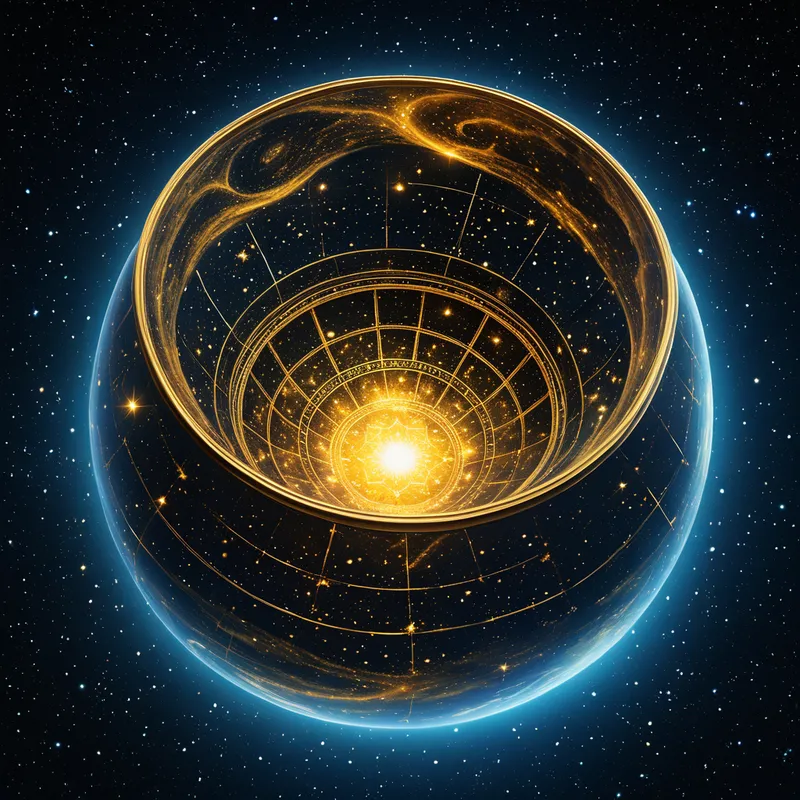
Vitrum Philosophorum Myth Meaning & Symbolism
The myth of the Philosopher's Glass, a vessel of impossible clarity that shatters to reveal the true gold within the soul's hidden depths.
The Tale of Vitrum Philosophorum
Listen, and I will tell you of the glass that is not glass, the vessel that is a void, the crucible of the soul known as the Vitrum Philosophorum.
In the beginning was the Matter—the Prima Materia—a formless, leaden sea of potential and despair. From this gloom, the ancient Artificers, those first Adepts, sought to distill a vessel worthy of containing the divine fire. They did not seek gold in the earth, but the sun in the soul. For generations, they toiled, their forges breathing in the dark. They blew vessels from sand and fire, from breath and will, but each would cloud, or crack, or contain only a distorted shadow of the truth.
Then came a solitary figure, known only as the Solitarius. He had studied the failures. He saw that every vessel had been shaped by desire—the desire for purity, for perfection, for an end to the work. This desire, he understood, was the final impurity. In the deepest cellar of his tower, where the only sound was the drip of condensed night, he began anew. He gathered not the finest silica, but the dust of his own broken experiments. He used not the bellows of ambition, but the slow, patient heat of attention. He sang not incantations of power, but a single, sustained note of silence.
For seven times seven cycles of the moon, he worked. The vessel that formed was unlike any other. It was not beautiful. It had no ornate sigils. It was a simple, asymmetrical form, seemingly blown from frozen breath and starlight. It was utterly transparent, yet when you looked into it, you did not see the other side of the room. You saw only a depth that pulled at your gaze, a clarity so absolute it became a kind of blindness. This was the Vitrum Philosophorum.
The Solitarius then performed the Great Work. Into the Glass, he poured the lead of his worldly failures, the mercury of his fleeting thoughts, the salt of his bitter tears—the entire Tria Prima of his being. He sealed the vessel and placed it in the Athanor, the furnace of endurance. The fire was not violent, but constant, a gentle, terrible persistence.
He watched. Within the Glass, the elements raged. They swirled in a black, chaotic Nigredo. They fought and merged, dissolved and coagulated. The Glass held it all, imparting no judgment, only perfect observation. As the process continued, a miracle occurred. The chaotic mass began to settle. A white light, the Albedo, dawned from within. Then, a glorious, ruby redness—the Rubedo—suffused the vessel. At its heart, a nugget of living, radiant gold pulsed with a light that was both material and divine.
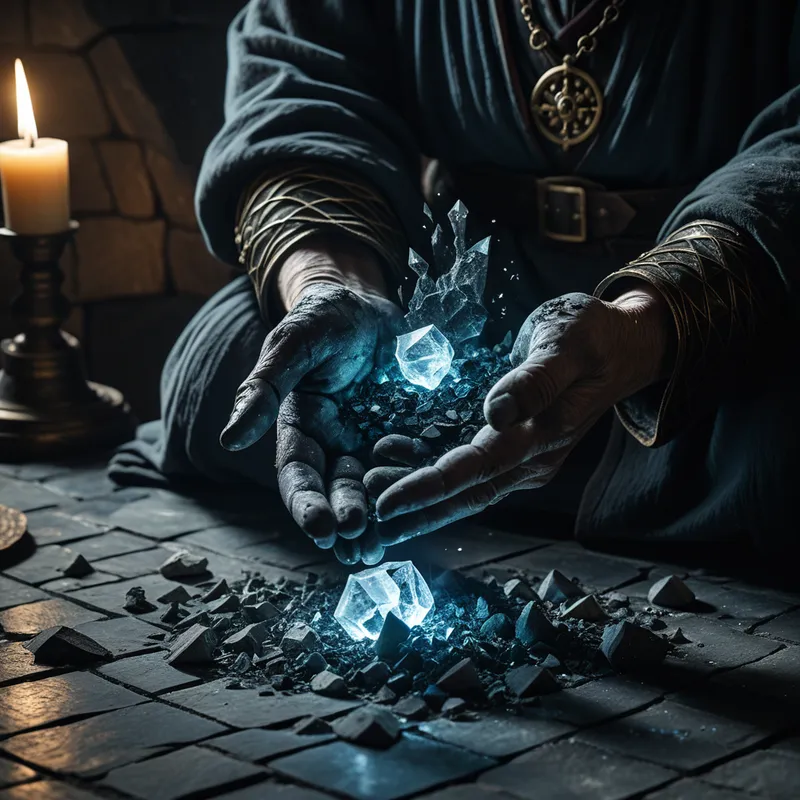
In his moment of triumph, the Solitarius reached for the Glass. But as his fingers, calloused and eager, touched its surface, a sound like the cracking of the world’s egg echoed through the tower. A web of fractures raced across the Vitrum Philosophorum. He cried out, a sound of utter loss. The Glass shattered into a thousand crystalline fragments, scattering across the stone floor.
The gold was gone. Despair gripped him. But as he looked down at the glittering ruins, he saw it. The light was not gone. It did not reside in a single shard, nor had it vanished. The radiant gold now glowed from within his own chest, illuminating the dark cellar from the inside out. The vessel had to break for the content to be freed. The work was not in the holding, but in the release. The Philosopher’s Stone was not in the Glass, but was what remained when the Glass was no more.
Cultural Origins & Context
The myth of the Vitrum Philosophorum is not a single story from a specific grimoire, but a pervasive, almost secret, narrative thread woven through the tapestry of Western alchemical tradition from the late medieval period through the Renaissance. It emerges not in popular texts, but in the marginalia of manuscripts, in the cryptic dialogues between masters and apprentices, and in the symbolic sequences of emblem books like the Mutus Liber and the Rosarium Philosophorum.
Its tellers were the Adepts themselves, writing in a language of metaphor and symbol designed to conceal as much as reveal, protecting the Arcanum from the profane. The myth functioned as a spiritual roadmap and a profound psychological warning. It served a society of seekers operating on the fringes of sanctioned religion and science, offering a model of inner transformation that paralleled the outer work in the laboratory. It taught that the true vessel for transformation was not a physical flask, but the totality of the practitioner’s own being—their consciousness, their suffering, their attention. The shattering of the Glass was the ultimate test of the alchemist’s understanding: had they mistaken the container for the content?
Symbolic Architecture
The Vitrum Philosophorum is the symbol of the integrated, observing ego-consciousness at the peak of its development. It represents the hard-won ability to contain the full spectrum of psychic experience—the leaden depression, the mercurial chaos, the salty bitterness—without identification or flight.
The ultimate vessel is not one that withstands, but one that transmits. Its perfection is its transparency; its strength is its willingness to dissolve.
The Prima Materia poured into it is the raw, unprocessed stuff of the personal and collective unconscious. The Athanor is the sustained heat of conscious attention—the often painful, patient work of analysis, reflection, and holding tension. The glorious production of the inner gold symbolizes the emergent Self, the psychic center that transcends the ego. The shattering, then, is the critical, paradoxical climax. It signifies the necessary death of the ego’s identification with its own achievement, its own perfected state. The vessel of consciousness must break open to release the Self into the wider world of being. The ego becomes a servant to the Self, not its proud container.
The Dreamer’s Resonance
When this myth stirs in the modern unconscious, it often manifests in dreams of profound fragility and unexpected liberation. One may dream of a precious, crystal-clear object—a globe, a lens, a beloved piece of art—that suddenly cracks. Initially, this brings terror and grief, a sense of irreversible loss. But upon closer inspection, the dreamer finds that the broken pieces now refract light into beautiful, complex patterns, or that a warm, guiding light shines from the place where the object was, not from the object itself.
Somatically, this can correlate with a release of tension held in the chest or solar plexus—the area symbolically associated with the heart and the seat of identity. Psychologically, the dreamer is navigating the final stage of a long, difficult process of self-work. They have built a strong, clear sense of self (the Glass), have contained their conflicts (the alchemical process), and are on the verge of a breakthrough. The dream presents the terrifying but necessary next step: the de-integration of that carefully constructed identity to allow for a more authentic, less ego-centric mode of being to emerge. It is the psyche’s preparation for a sacred defeat.
Alchemical Translation
For the modern individual, the myth of the Vitrum Philosophorum models the complete arc of Individuation. We all, consciously or not, spend our early lives building our Glass. We construct a personality, a set of defenses, a worldview—a vessel to hold our experiences and present a coherent self to the world. This is necessary work.
The alchemical process begins when life, inevitably, pours the Prima Materia of crisis, suffering, love, and failure into our vessel. The work of transformation is to submit this mixture to the gentle, persistent fire of honest self-reflection (the Athanor). We learn to observe our inner chaos without being destroyed by it. We move through the blackness of despair (Nigredo), the washing clarity of insight (Albedo), and the passionate integration of newfound wholeness (Rubedo). We may even feel we have achieved the gold—a state of hard-won peace, understanding, or success.
The final transmutation is not from lead to gold, but from possession to presence. The Stone is not something you have, but something you are when you cease clutching.
But the myth warns us: to stop here is to commit the ultimate error. To identify with the perfected vessel, the “healed” self, the “enlightened” ego, is to create a new, more subtle prison. The true culmination is the shattering—the voluntary or involuntary dissolution of our identification with our own achievement. It is the humility that comes after mastery, the simplicity that follows complexity, the service that succeeds self-actualization. The gold of the Self is then freed to animate our daily life, not as a trophy, but as a quiet, radiant source of being. We are no longer the Glass that contains the light. We become the space through which the light passes.
Associated Symbols
Explore related symbols from the CaleaDream lexicon: