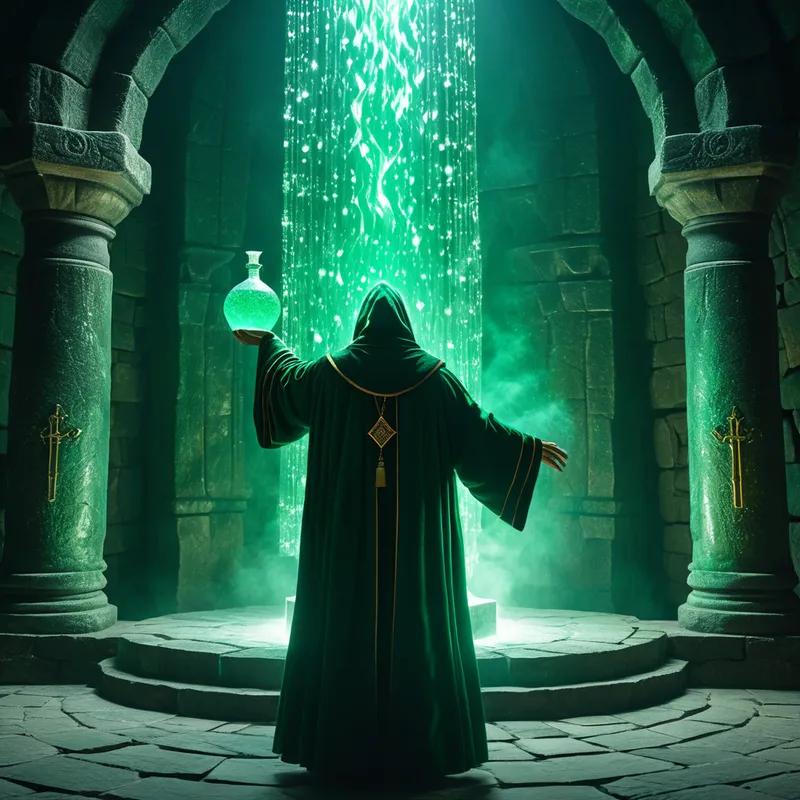
Vitriol Myth Meaning & Symbolism
The myth of the corrosive, sacred substance that dissolves all falsehood, revealing the hidden truth within the depths of the self.
The Tale of Vitriol
Listen, and I will tell you of [the Green Lion](/myths/the-green-lion “Myth from Alchemical culture.”/) that devours the Sun.
In the beginning, there was the Stone. Not the Philosopher’s Stone of legend, but [the Prima Materia](/myths/the-prima-materia “Myth from Alchemical culture.”/)—the First Matter. It was the raw, unformed substance of [the world](/myths/the-world “Myth from Tarot culture.”/), dense and sleeping, holding within its dark heart all potential and all poison. The early alchemists, those first priests of the furnace, called it the Chaos. It was heavy, mute, and promised nothing.
One among them, a seeker whose name is lost to the smoke of time, grew weary of prayers over cold matter. He took the rough ore, this [Nigredo](/myths/nigredo “Myth from Alchemical culture.”/), and subjected it to a terrible marriage. He wedded it to fire and to a sharp, mineral [water](/myths/water “Myth from Chinese culture.”/) drawn from the deepest veins of [the earth](/myths/the-earth “Myth from Hindu culture.”/). In the sealed womb of the alembic, a slow torment began. A seething, a groaning from within the glass.
For forty days and forty nights, the matter wept. It sweated a bitter, greenish liquid that ate at the very vessel that contained it. This was no gentle rain, but a corrosive tears. [The alchemist](/myths/the-alchemist “Myth from Various culture.”/) watched in horror and fascination as his prized matter did not purify, but dissolved. The solid forms he knew—the shape of the ore, the residue of earth—melted into a chaotic, shimmering pool. All order was undone. [The laboratory](/myths/the-laboratory “Myth from Alchemical culture.”/), once a place of measured hope, filled with the acrid scent of failure and the eerie, beautiful glow of this green poison. It was the putrefaction, the death of the known.
In his despair, believing he had created only a powerful acid to ruin his work, the alchemist nearly cast [the vessel](/myths/the-vessel “Myth from Alchemical culture.”/) aside. But a whisper, perhaps from the Anima Mundi itself, stayed his hand. He looked deeper into the swirling, vitriolic chaos. And there, beneath the surface of the corrosive green, he saw a glimmer. Not a reconstruction of the old stone, but something new: a seed of light, a tiny, indestructible crystal of truth that the Vitriol itself had revealed by consuming everything that was not it.
The Green Lion had not destroyed the work. It had devoured the dross, the false identities, the rigid forms, to reveal the hidden, essential core that was always there, waiting within the dark stone.
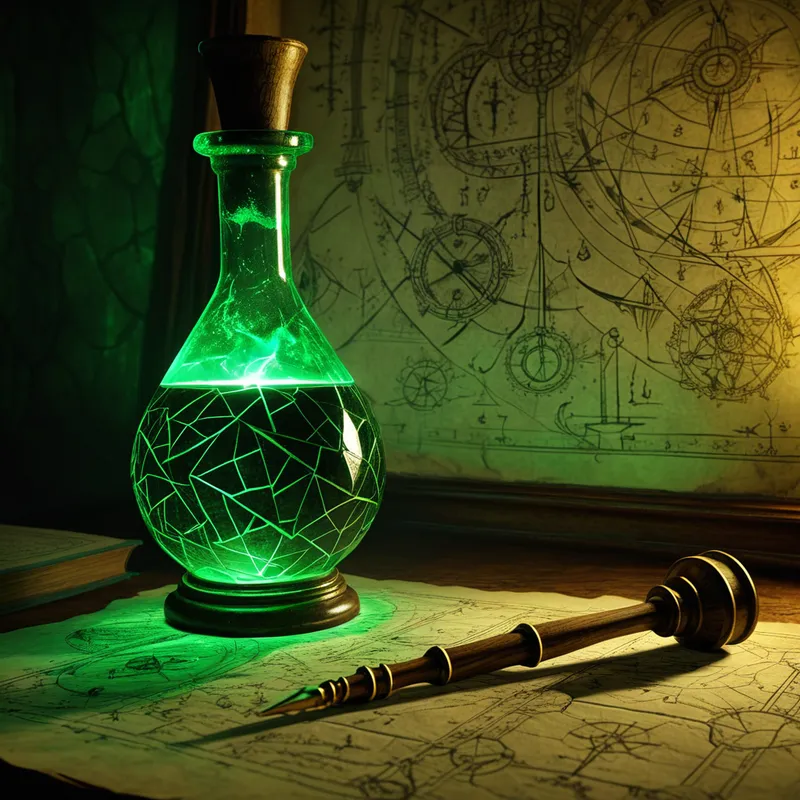
Cultural Origins & Context
The myth of Vitriol is not a story told in epics, but one encoded in the cryptic manuscripts and emblematic drawings of European alchemy, particularly from the Renaissance onward. It was a practical parable passed between initiates in workshops and scriptoria. The term itself, Vitriol, derives from [vitrum](/myths/vitrum “Myth from Alchemical culture.”/), Latin for glass, referring to the glassy appearance of its crystals, but its mythic weight is captured in the famous acrostic: Visita Interiora Terrae Rectificando Invenies Occultum Lapidem — “Visit the interior of the earth; by rectifying, you will find [the hidden stone](/myths/the-hidden-stone “Myth from Alchemical culture.”/).”
This was the core of the alchemical culture: a profound, hands-on spirituality. The myth was not merely recited; it was performed at the furnace. The alchemist was both the hero of the tale and its author, enacting the dissolution with real, dangerous chemicals. The society functioned as a mystery tradition, where this process of creating and confronting the Vitriol was the central, terrifying rite of passage. It separated the dabblers from the true philosophers, for it required one to endure the psychological equivalent of one’s own certain knowledge being dissolved into chaos.
Symbolic Architecture
At its [heart](/symbols/heart “Symbol: The heart symbolizes love, emotion, and the core of one’s existence, representing deep connections with others and self.”/), the myth of Vitriol is the archetypal [drama](/symbols/drama “Symbol: Drama signifies narratives, emotional expression, and the exploration of human experiences.”/) of necessary [dissolution](/symbols/dissolution “Symbol: The process of breaking down, dispersing, or losing form, often representing transformation, release, or the end of a state of being.”/). The [Prima Materia](/myths/prima-materia “Myth from Alchemical culture.”/) represents [the ego](/myths/the-ego “Myth from Jungian culture.”/) in its natural, unconscious state—solid, identified with its form, yet burdened and constricted by its own latent complexities.
The Vitriol is the acid of truth that burns away the persona, leaving only the raw, authentic nerve of being exposed.
The Green [Lion](/symbols/lion “Symbol: The lion symbolizes strength, courage, and authority, often representing one’s inner power or identity.”/) is a perfect [symbol](/symbols/symbol “Symbol: A symbol can represent an idea, concept, or belief, serving as a powerful tool for communication and understanding.”/) for this process: a savage, instinctual force (green of [nature](/symbols/nature “Symbol: Nature symbolizes growth, connectivity, and the primal forces of existence.”/), [lion](/symbols/lion “Symbol: The lion symbolizes strength, courage, and authority, often representing one’s inner power or identity.”/) of devouring power) that acts not from malice, but from a ruthless integrity. It represents the autonomous, purifying function of the [psyche](/myths/psyche “Myth from Greek culture.”/) itself—often experienced as a crushing depression, a sudden [loss](/symbols/loss “Symbol: Loss often symbolizes change, grief, and transformation in dreams, representing the emotional or psychological detachment from something or someone significant.”/), or a [crisis](/symbols/crisis “Symbol: A crisis symbolizes turmoil, urgent challenges, and the need for immediate resolution or change.”/) of meaning that dismantles the carefully constructed edifice of one’s [life](/symbols/life “Symbol: The symbol of ‘Life’ represents a journey of growth, interconnectedness, and existential meaning, encompassing both the joys and challenges that define human experience.”/). The sealed alembic is the contained [vessel](/symbols/vessel “Symbol: A container or structure that holds, transports, or protects something essential, representing the self, emotions, or life journey.”/) of the ordeal, the conscious ego that must hold and witness its own undoing without fleeing. The glimmer revealed at the end is the nascent Self, the indestructible core that was obscured by the very structures meant to protect it.
The Dreamer’s Resonance
When this myth stirs in the modern dreamer, it manifests not as a story of alchemists, but as the somatic experience of dissolution. One may dream of teeth crumbling to dust, of familiar houses melting into mud, of mirrors cracking to reveal not a reflection but a void. The body in the dream may feel like it is turning to liquid, or the ground may become unstable, acidic.
Psychologically, this is the psyche initiating its own Vitriol process. The dreamer is undergoing a profound de-identification. A career, a relationship, a long-held belief about oneself is being subjected to a corrosive truth that it can no longer withstand. The feeling is not of battle, but of decay and helplessness—the Nigredo. The dream imagery is the mind’s way of processing this terrifying, yet sacred, liquefaction of the ego’s foundations, preparing the psychic material for a recombination that is not yet visible.

Alchemical Translation
For the modern individual seeking wholeness, the myth of Vitriol models the non-negotiable first step of psychic transmutation: the courage to submit to dissolution. Our cultural instinct is towards integration, building, and healing. The alchemist, however, knows you must first dis-integrate.
The process begins when life itself becomes [the alembic](/myths/the-alembic “Myth from Alchemical culture.”/). A failure, a betrayal, an encounter with the limits of one’s understanding—these are the fires applied to our Prima Materia. The rising Vitriol is the surge of painful insight, regret, or shattered illusion that feels like it is destroying us. The temptation is to neutralize this acid—to rationalize, blame, or seek immediate comfort.
True rectification is not correction, but the steadfast witnessing of the corrosive process until it completes its work.
The alchemical instruction is to “seal the vessel”—to create a container of mindful observation, perhaps through journaling, therapy, or simple, disciplined endurance—and to allow the dissolution to proceed. This is the “visit to the interior of the earth,” a descent into the darkest, most bitter layers of one’s own experience. One does not find the hidden stone by building over the old rubble, but by allowing the Green Lion to consume the rubble entirely. The revelation is that what remains after this terrifying corrosion is not nothingness, but the first, authentic, and indestructible spark of what you truly are, freed from the ore of who you thought you had to be. The Lapis is not manufactured; it is revealed by the very acid that seems to be its destroyer.
Associated Symbols
Explore related symbols from the CaleaDream lexicon: