Vishvarupa Myth Meaning & Symbolism
A warrior prince, granted a divine vision, beholds the entire cosmos—past, present, and future—contained within the terrifying, magnificent form of his charioteer.
The Tale of Vishvarupa
The air on the field of Kurukshetra was thick with the scent of dust and impending blood. Two vast armies, a sea of glittering spears and painted shields, stood frozen in a moment before the storm. Between them, in a splendid chariot yoked to white steeds, stood the prince Arjuna. His famed bow, [Gandiva](/myths/gandiva “Myth from Hindu culture.”/), felt like a leaden weight in his hand. His eyes scanned the opposing ranks and saw not enemies, but fathers, grandfathers, teachers, and cousins. A great paralysis seized his heart. Duty warred with love, and love was winning, drowning him in a tide of despair.
He turned to his charioteer, his friend, the enigmatic [Krishna](/myths/krishna “Myth from Hindu culture.”/). “I will not fight,” he declared, his voice breaking. “What is a kingdom won over the bodies of my kin? I see only sin in this victory.” He cast aside his bow and sank down in [the chariot](/myths/the-chariot “Myth from Tarot culture.”/), a soul adrift.
Krishna, whose eyes held the patience of eternity, began to speak. His words were not of comfort, but of truth—a dazzling, terrifying architecture of reality. He spoke of the eternal Self, the indestructible atman, of duty without attachment, of a cosmic order where birth and death are but doors. Yet Arjuna’s grief was a fortress. The teachings were heard, but not seen. The prince remained unconvinced, lost in the duality of his human heart.
Then Krishna offered not more words, but a vision. “Since you cannot perceive my supreme form with your ordinary sight,” he said, his voice now resonating with a power that vibrated in the chariot’s very wood, “I grant you divine sight. Behold my form as the Ishvara.”
And then, [the world](/myths/the-world “Myth from Tarot culture.”/) dissolved.
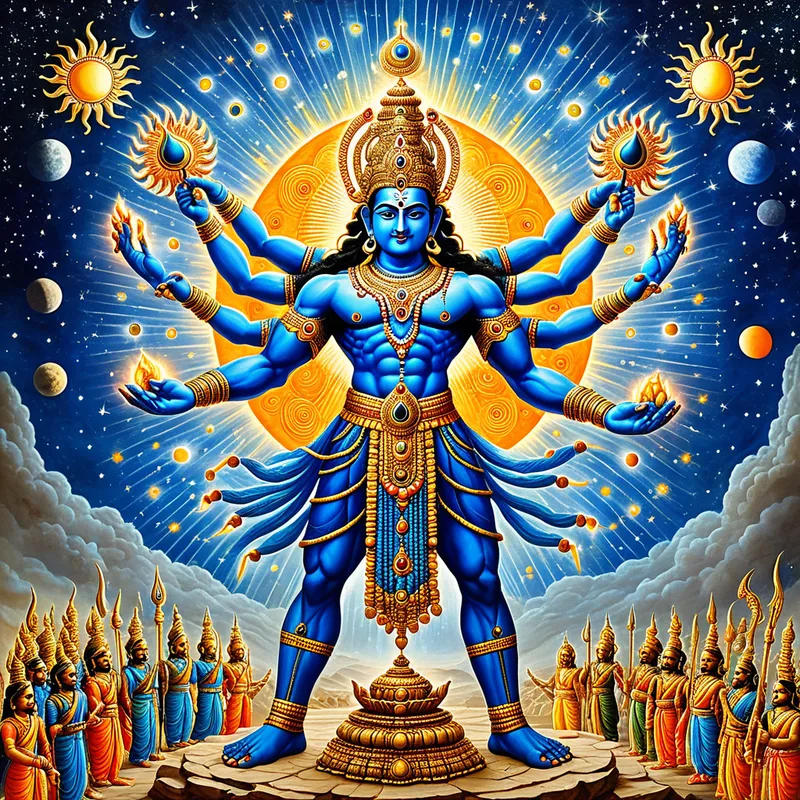
Where Krishna stood, the universe erupted. Arjuna saw a form, infinite, without beginning or end, crowned with a thousand suns. It had countless eyes witnessing all things, countless mouths consuming all time, countless arms holding every conceivable weapon and symbol of creation and destruction. Within that body, he saw the entire cosmos: the swirling galaxies, the orbiting planets, the devas in their heavens, the asuras in their depths, and every creature that crawls, walks, or flies. He saw all the warriors on the field, hurtling like moths into the flaming mouths of this boundless being. He saw the past, present, and future unfolding simultaneously in its luminous belly.
It was beauty that shattered the mind. It was terror that froze the blood. It was a truth too vast to hold. Arjuna’s senses reeled. He saw the dreadful, fiery mouths, and heard a roar that was the combined sound of all destruction. Overwhelmed, his hair standing on end, he stammered, “Who are you, of such terrible form? I bow to you, O Primeval Being! Have mercy! I wish to see you again as you were, with four arms, crowned, bearing the conch, discus, and mace.”
And as suddenly as it appeared, the vision folded in upon itself. The cosmos condensed, the terrifying radiance softened, and there stood Krishna once more, smiling gently in his charioteer’s guise, as if nothing had happened. But everything had changed. The field of Kurukshetra was the same, but the prince who beheld it was forever altered.
Cultural Origins & Context
This revelation, known as the Vishvarupa Darshana, is the climactic heart of the Bhagavad Gita, a text that is itself a portion of the immense epic, the Mahabharata. Composed and compiled over centuries, likely between the 5th century BCE and 2nd century CE, the Gita is a philosophical dialogue set on the brink of an apocalyptic war. It was not merely a story for royalty but a teaching for every human soul facing its own inner battles.
The myth was passed down through an oral tradition of recitation by learned Brahmins and storytellers, or Sutas, who would perform the epic for communities. Its function was multifaceted: it was a theological treatise establishing Krishna’s supreme divinity, a psychological manual for navigating moral crisis (dharma-sankat), and a metaphysical map of reality. The Vishvarupa served as the ultimate experiential proof of the teachings—a shift from intellectual understanding to direct, awe-struck perception of the unity behind the apparent multiplicity of the world.
Symbolic Architecture
The Vishvarupa is not a [monster](/symbols/monster “Symbol: Monsters in dreams often symbolize fears, anxieties, or challenges that feel overwhelming.”/), but a mirror. It is the [psyche](/myths/psyche “Myth from Greek culture.”/)‘s own latent [structure](/symbols/structure “Symbol: Structure in dreams often symbolizes stability, organization, and the framework of one’s life, reflecting how one perceives their environment and personal life.”/) made visible. Arjuna’s [crisis](/symbols/crisis “Symbol: A crisis symbolizes turmoil, urgent challenges, and the need for immediate resolution or change.”/) is the [human](/symbols/human “Symbol: The symbol of a human represents individuality, complexity of emotions, and social relationships.”/) crisis: the [paralysis](/symbols/paralysis “Symbol: A state of being unable to move or act, often representing feelings of powerlessness, fear, or being trapped in waking life.”/) induced by seeing the world as a collection of separate, conflicting parts—good vs. evil, [friend](/symbols/friend “Symbol: A friend in dreams often represents companionship, connection, and the desire for social support, reflecting aspects of our interactions and relationships in waking life.”/) vs. foe, duty vs. desire. Krishna’s philosophical discourse attempts to resolve this intellectually, but the mind, entrenched in duality, resists. The [vision](/symbols/vision “Symbol: Vision reflects perception, insight, and clarity — often signifying the ability to foresee or understand deeper truths.”/) bypasses the mind.
The Vishvarupa is the ultimate symbol of integration. It shows that the creator and the destroyer, the friend and the foe, the beautiful and the terrible, are not opposites, but inseparable aspects of a single, dynamic, conscious whole.
Psychologically, the countless arms and mouths represent the infinite potentialities, actions, and experiences of existence. The consuming of warriors symbolizes the impersonal, inevitable processes of time and change, which the personal ego experiences as [loss](/symbols/loss “Symbol: Loss often symbolizes change, grief, and transformation in dreams, representing the emotional or psychological detachment from something or someone significant.”/) and [death](/symbols/death “Symbol: Symbolizes transformation, endings, and new beginnings; often associated with fear of the unknown.”/). The vision forces Arjuna—and by extension, the listener—to confront the [shadow](/symbols/shadow “Symbol: The ‘shadow’ embodies the unconscious, repressed aspects of the self and often represents fears or hidden emotions.”/) of the divine: the fact that the [source](/symbols/source “Symbol: The origin point of something, often representing beginnings, nourishment, or the fundamental cause behind phenomena.”/) of all [life](/symbols/life “Symbol: The symbol of ‘Life’ represents a journey of growth, interconnectedness, and existential meaning, encompassing both the joys and challenges that define human experience.”/) is also the source of all [dissolution](/symbols/dissolution “Symbol: The process of breaking down, dispersing, or losing form, often representing transformation, release, or the end of a state of being.”/). To truly know [the Self](/myths/the-self “Myth from Jungian culture.”/), one must behold it in its totality, not just its comforting, personal [aspect](/symbols/aspect “Symbol: A distinct feature, quality, or perspective of something, often representing a partial view of a larger whole.”/). The form integrates all archetypes—the nurturing [mother](/symbols/mother “Symbol: The symbol of ‘Mother’ represents nurturing, protection, and the foundational aspect of one’s emotional being, often associated with comfort and unconditional love.”/), the fierce [warrior](/symbols/warrior “Symbol: A spiritual archetype representing inner strength, discipline, and the struggle for higher purpose or self-mastery.”/), the wise [king](/symbols/king “Symbol: A symbol of ultimate authority, leadership, and societal order, often representing the dreamer’s inner power or external control figures.”/), the terrifying [reaper](/symbols/reaper “Symbol: A personification of death, often depicted as a cloaked figure with a scythe, harvesting souls and symbolizing the end of life’s journey.”/)—into one overwhelming gestalt.
The Dreamer’s Resonance
When this mythic pattern stirs in the modern unconscious, it often manifests in dreams of overwhelming scale and paradox. One might dream of a loved one whose face suddenly becomes a landscape containing cities and forests, or of looking in a mirror to see a constellation where their reflection should be. These are not nightmares of persecution, but dreams of profound disorientation and awe.
Somatically, the dreamer may report a feeling of immense expansion, a “head too full,” or a vibrating energy, mirroring Arjuna’s trembling and awe. Psychologically, this signals a critical juncture in the process of individuation. [The ego](/myths/the-ego “Myth from Jungian culture.”/)-structure is being forcibly expanded to accommodate contents of the psyche it has previously split off or denied—perhaps immense creative potential that feels terrifying, or a recognition of one’s own capacity for destruction alongside creation. It is the psyche’s attempt to show the dreamer that they are far larger, more complex, and more connected to the universal patterns than their waking identity allows them to believe.

Alchemical Translation
The journey of Arjuna models the alchemical work of psychic transmutation for the modern individual. His initial state is the [nigredo](/myths/nigredo “Myth from Alchemical culture.”/)—the black despair and paralysis of conflicting values. Krishna’s discourse is the albedo, an attempt to clarify and purify through wisdom. But true transformation requires the [rubedo](/myths/rubedo “Myth from Alchemical culture.”/).
The vision of Vishvarupa is [the rubedo](/myths/the-rubedo “Myth from Alchemical culture.”/). It is the fiery, direct encounter with the Self, the central archetype of order. This is not a gentle integration but a volcanic one. The ego does not calmly assimilate the unconscious; it is overwhelmed by it, shattered by its magnitude, and then—if it can surrender—reconstituted on a broader foundation.
The alchemical goal is not to become the cosmic form, but to have beheld it. The transformation is in the seeing. Once you have seen that your personal drama is a single thread in an infinite tapestry, you can re-engage with it, but you can no longer be wholly consumed by it.
For us, the “battlefield” is our daily life with its conflicts and dilemmas. The “charioteer” is the inner guide, the voice of deeper consciousness. The “vision” is that moment of radical perspective, often triggered by crisis, where we suddenly perceive the hidden unity and necessary role of all the opposing forces within and around us. We are not asked to remain in that ecstatic, terrifying state. Like Arjuna, we are asked to return to our human form, pick up our bow—our specific talents and duties—and act, but now with the unshakable knowledge that we are acting within a divine play, a lila, far vaster than our individual fears and desires. The struggle remains, but the struggler is transformed.
Associated Symbols
Explore related symbols from the CaleaDream lexicon: