Vishnu's Sudarshana Chakra Myth Meaning & Symbolism
The story of the divine discus, a celestial weapon of cosmic order wielded by Vishnu to sever illusion and restore balance to the universe.
The Tale of Vishnu’s Sudarshana Chakra
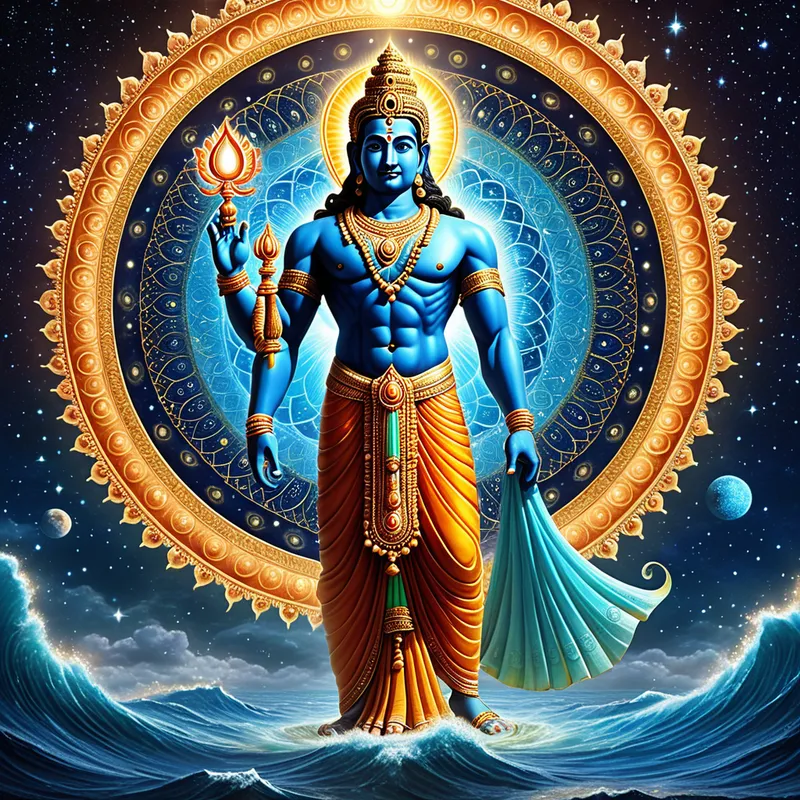
Listen. In the time before time, when the cosmos was a churning sea of milk and shadow, the great [Vishnu](/myths/vishnu “Myth from Hindu culture.”/) rested upon the coils of [the world](/myths/the-world “Myth from Tarot culture.”/)-serpent, Ananta [Shesha](/myths/shesha “Myth from Hindu culture.”/). The air was thick with the scent of [lotus](/myths/lotus “Myth from Hindu culture.”/) and the silent hum of potential. He held in his four divine hands the emblems of his sovereignty: the conch, the mace, [the lotus](/myths/the-lotus “Myth from Hindu culture.”/), and a space—an empty space where a promise of fire was yet to be born.
The promise was forged in agony and aspiration. From the heart of the sun, from the sweat of the gods, from the collective [tapas](/myths/tapas “Myth from Hindu culture.”/) of the universe yearning for order, the divine architect [Vishvakarma](/myths/vishvakarma “Myth from Hindu culture.”/) labored. The sound was not of hammer on anvil, but of mantra on matter, of will crystallizing into form. What emerged was not merely a weapon, but a principle given shape: the [Sudarshana Chakra](/myths/sudarshana-chakra “Myth from Hindu culture.”/). It was a disc of such terrifying beauty it held the patterns of galaxies within its spinning rim, its spokes the ribs of cosmic law, its edge the final, flawless cut between truth and falsehood. It was offered to Vishnu, and the empty space in his hand was filled with a wheel of blazing light.
And so it waited, this beautiful vision, until the balance of the worlds tipped. The asura Shumbha, drunk on power stolen from boons, sought to unravel the very fabric of dharma. He cast a shadow so deep it threatened to still the turning of ages. The pleas of the oppressed reached Vishnu’s ear, a dissonant chord in the universal harmony. No word was spoken. Vishnu simply extended his finger.
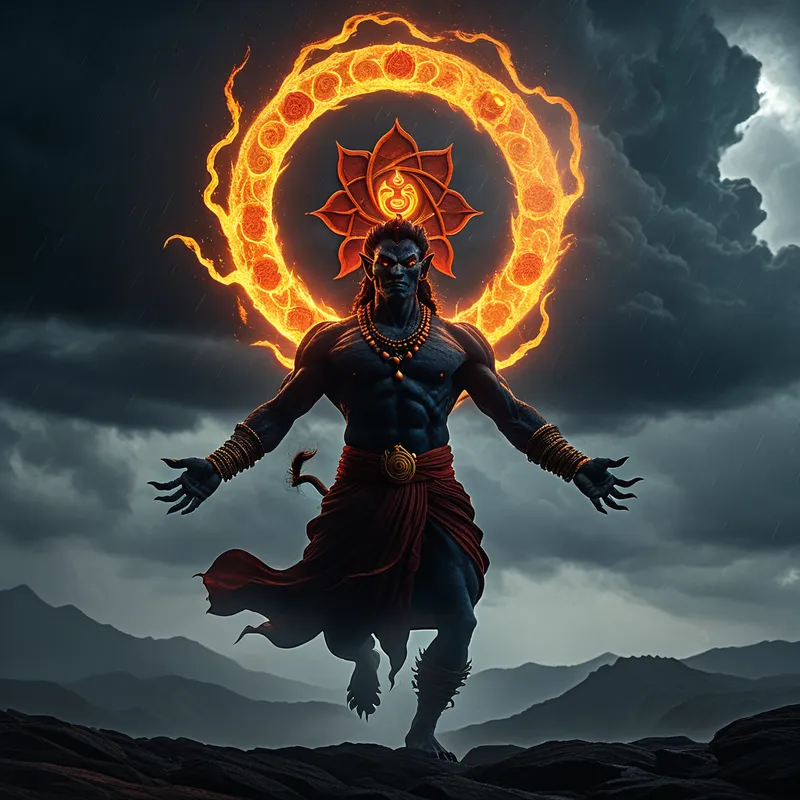
The Chakra awoke. It did not fly; it manifested along the path of its purpose. A shriek of pure energy tore the heavens, a wheel of solar fire spinning with the sound of a million sacred syllables. It pursued Shumbha across the three worlds—through the high palaces of the gods, across the mortal plains, into the deepest subterranean realms. The demon fled, his form shifting, his magic unraveling before the Chakra’s unwavering gaze. It was not a chase of speed, but of inevitability. The Chakra was the conclusion seeking its premise.
Finally, cornered at the edge of creation, Shumbha turned. He marshaled every ounce of his illusory power, casting mountains of darkness, oceans of deceit. The Sudarshana Chakra did not dodge. It spun faster, its light becoming a singular, incisive point of reality. With a sound like the breaking of a great illusion—a sigh and a snap—it passed through him. There was no gore, only a dissolution. The concentrated ego, the aggregated adharma, simply unmade itself, scattered back into the formless potential from which it arose. The wheel, its work complete, hummed softly and returned, a cooling ember, to rest upon the tip of Vishnu’s finger. The balance was restored. The universe breathed again.
Cultural Origins & Context
The Sudarshana Chakra is woven into the very fabric of Hindu sacred narrative, appearing across the vast corpus of Itihasas and Puranas. Its tales were not confined to priestly texts but were sung by traveling bards, enacted in temple rituals, and visualized in intricate iconography that adorned village walls and grand temple spires alike. As a primary attribute of Vishnu, the sustainer, the Chakra’s myth served a critical societal function: it was the ultimate symbol of divine intervention that restores dharma when human and cosmic scales tip toward chaos.
Its origin story, particularly its creation by Vishvakarma, roots it in the Vedic ideal of yajna (sacrifice) and cosmic craftsmanship. It was a weapon born of collective divine effort, signifying that the principle of order is not a passive force but an active, crafted, and consciously wielded power. In temples, especially those dedicated to Vishnu and his incarnations like [Krishna](/myths/krishna “Myth from Hindu culture.”/), the Chakra is worshipped independently as Sudarshana, often depicted as a fierce, multi-armed deity, highlighting its autonomous protective power. The myth thus moved from a narrative device to a living, invoked presence in spiritual and community life, a constant reminder of the divine capacity to cut through obstruction.
Symbolic Architecture
The Sudarshana [Chakra](/symbols/chakra “Symbol: In Hindu and yogic traditions, chakras are energy centers along the spine that govern physical, emotional, and spiritual well-being.”/) is a masterpiece of symbolic [condensation](/symbols/condensation “Symbol: In dreams, condensation represents the compression of multiple ideas, memories, or emotions into a single image, often revealing hidden connections and subconscious complexity.”/). Its very name, “beautiful [vision](/symbols/vision “Symbol: Vision reflects perception, insight, and clarity — often signifying the ability to foresee or understand deeper truths.”/)” or “auspicious [sight](/symbols/sight “Symbol: Sight symbolizes perception, awareness, and insight, representing both physical and inner vision.”/),” reveals its primary function: it is the [instrument](/symbols/instrument “Symbol: An instrument symbolizes creativity, communication, and the means by which one expresses oneself or influences the world.”/) of perfect [perception](/symbols/perception “Symbol: The process of becoming aware of something through the senses. In dreams, it often represents how one interprets reality or internal states.”/), the faculty that sees through illusion (maya) to the underlying [truth](/symbols/truth “Symbol: Truth represents authenticity, honesty, and the quest for knowledge beyond mere appearances.”/).
Its form is a [mandala](/symbols/mandala “Symbol: A sacred geometric circle representing wholeness, the cosmos, and the journey toward spiritual integration.”/)—a circle divided by spokes, often six or twelve. This represents the wheel of time ([Kala Chakra](/myths/kala-chakra “Myth from Buddhist culture.”/)), the cycles of creation and destruction, and the radiating, orderly divisions of manifested [reality](/symbols/reality “Symbol: Reality signifies the state of existence and perception, often reflecting one’s understanding of truth and life experiences.”/) from a unified center. The center is Vishnu’s will, the unmoved mover; the spinning rim is the active principle in the world.
The Chakra is not destruction, but discrimination. It does not kill the demon; it dissolves the conditions that allowed the demon to exist.
Psychologically, the [demon](/symbols/demon “Symbol: Demons often symbolize inner fears, repressed emotions, or negative aspects of oneself that the dreamer is struggling to confront.”/)—be it Shumbha or any other—represents the consolidated, inflated complex of [the ego](/myths/the-ego “Myth from Jungian culture.”/) that believes itself separate from and superior to the whole. It is [the tyranny](/symbols/the-tyranny “Symbol: A symbol of oppressive control, unjust authority, and systemic domination that suppresses individual freedom and collective well-being.”/) of a single, unchecked psychic content: unchecked desire, paralyzing fear, or rigid dogma. The Chakra represents the sharp, discerning power of [consciousness](/symbols/consciousness “Symbol: Consciousness represents the state of awareness and perception, encompassing thoughts, feelings, and experiences.”/) itself. It is the [ability](/symbols/ability “Symbol: In dreams, ‘ability’ often denotes a recognition of skills or potential that one possesses, whether acknowledged or suppressed.”/) of the observing Self (akin to Vishnu, the inner preserver) to identify, isolate, and ultimately de-integrate a complex that has grown toxic and autonomy-seeking. The [chase](/symbols/chase “Symbol: Dreaming of a chase often symbolizes avoidance of anxiety or confrontation, manifesting as fleeing from something threatening or overwhelming in one’s waking life.”/) across the three worlds mirrors the [pursuit](/symbols/pursuit “Symbol: A chase or being chased in dreams often reflects unresolved anxieties, unfulfilled desires, or internal conflicts demanding attention.”/) of a neurosis through all levels of the [psyche](/myths/psyche “Myth from Greek culture.”/)—the conscious mind, [the personal unconscious](/myths/the-personal-unconscious “Myth from Jungian Psychology culture.”/), and the collective [depths](/symbols/depths “Symbol: Represents the subconscious, hidden emotions, or foundational aspects of the self, often linked to primal fears or profound truths.”/)—until it can be faced and transformed.
The Dreamer’s Resonance
When the pattern of the Sudarshana Chakra stirs in the modern dreamer’s psyche, it often heralds a critical phase of psychic differentiation. One does not typically dream of Vishnu himself, but of the Chakra’s symbolic equivalents: a spinning, blindingly bright disc of light; a perfectly sharp, circular blade; a geometric, [mandala](/myths/mandala “Myth from Buddhist culture.”/)-like object that feels both immensely powerful and intimately personal.
The somatic experience in such dreams is key. There is often a sense of immense tension or a tangled, knotted problem (the “demon”) that feels insurmountable. The appearance of the discus brings not calm, but a focused, almost surgical intensity. The dream ego may feel pursued by it, or may witness it pursuing something else. This reflects the often uncomfortable but necessary process of the conscious mind being called to account, or of a deep-seated complex being ruthlessly exposed. The “cut” is not violent but liberating—a sudden severance of an attachment, a clarifying insight that “cuts through the bullshit,” or the end of a prolonged state of confusion. Upon waking, one might feel a strange emptiness where a psychological knot once was, a space now cleared for new growth.
Alchemical Translation
In the alchemical vessel of individuation, the myth of the Sudarshana Chakra models the stage of [separatio](/myths/separatio “Myth from Alchemical culture.”/) and sublimatio—the separation of the essential from the dross, and its elevation. The modern individual’s journey is fraught with inner “demons”: identification with [persona](/myths/persona “Myth from Greek culture.”/), possession by shadow contents, servitude to archaic inner critics. These are our Shumbhas, entities formed from granted “boons” (early coping strategies, societal conditioning) that have outlived their usefulness and now threaten the inner kingdom.
The alchemical agent here is conscious discrimination, the discernment of [the Self](/myths/the-self “Myth from Jungian culture.”/). This is not intellectual analysis, but a fiery, focused application of awareness.
The Chakra’s spin is the dynamism of consciousness in motion, refusing stagnation, constantly dividing the real from the unreal within its own sphere.
To wield this inner Chakra is to develop the capacity for ruthless self-honesty coupled with compassionate detachment. One must first recognize the demon—name the complex, the addiction, the pattern of blame. Then, one must “release the Chakra”—withhold energy from it, refuse to feed its narrative, observe its machinations without identifying with them. This pursuit through the three worlds of one’s life—relationships, work, inner fantasy—is the hard work of therapy, reflection, and shadow-work. The final dissolution is the moment of integration, where the energy bound up in the complex is freed and reclaimed by the broader psyche. The Chakra then returns, cooler, integrated, a symbol of a Self that has successfully enacted its sovereign function. The individual is not the weapon, but the wielder; not the demon, but the space in which both arise and are resolved, having restored order to their personal cosmos.
Associated Symbols
Explore related symbols from the CaleaDream lexicon: