Vishnu's Cosmic Dream Myth Meaning & Symbolism
The universe is the dream of the sleeping god Vishnu, a grand illusion of reality from which all beings must awaken to their true nature.
The Tale of Vishnu’s Cosmic Dream
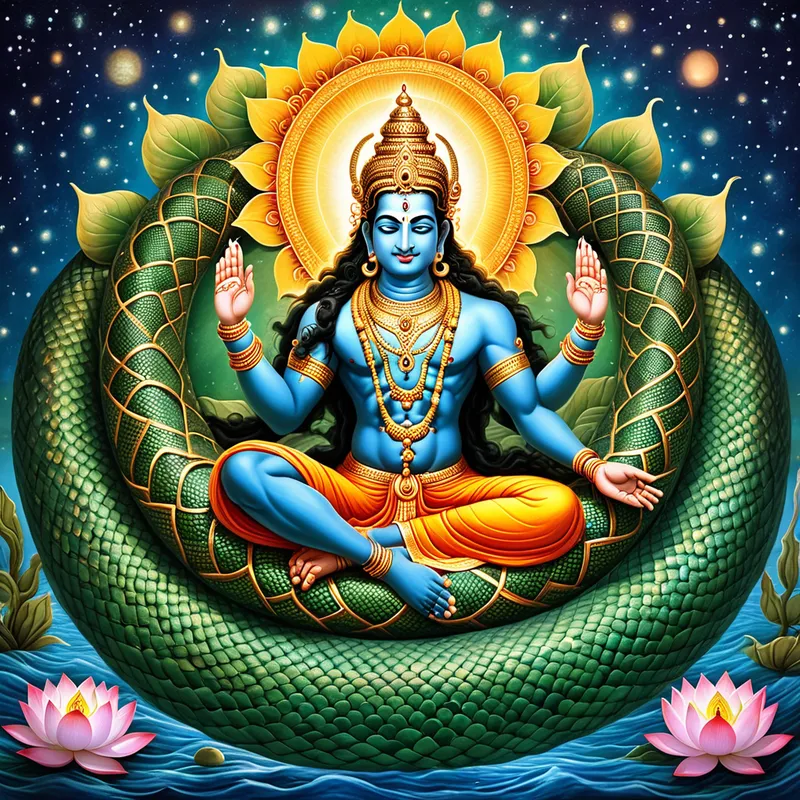
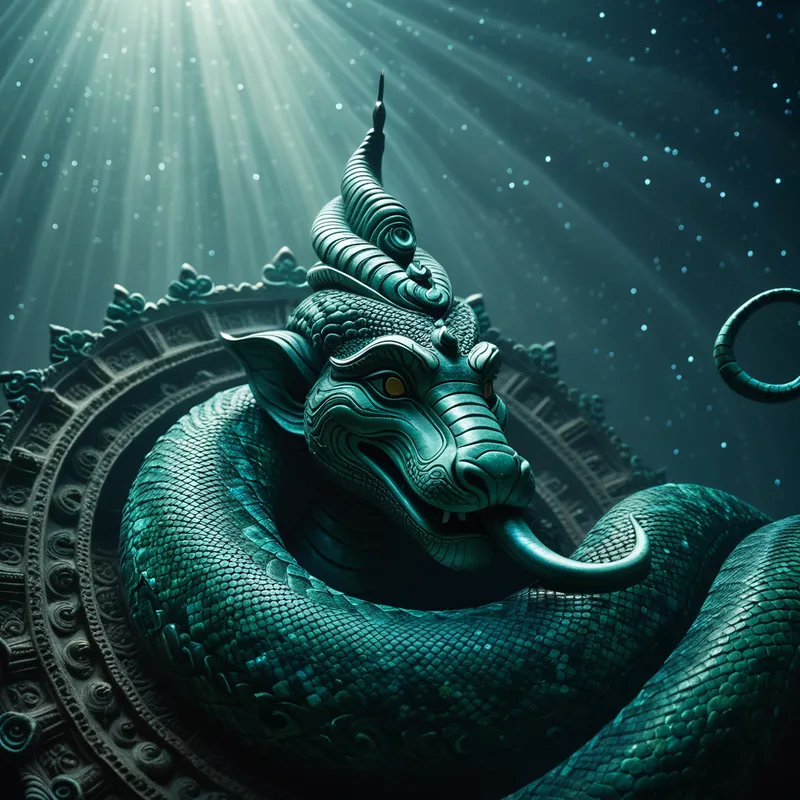
Listen. Before the before, in the silence that is not empty but full of potential, there is only the great, dark, endless ocean. It is not water as we know it, but the waters of causality, of unformed time, of pure possibility. Upon this ocean, as a bed upon the deep, rests the thousand-hooded serpent, Ananta Shesha. His coils are the foundations of eternity, and his hoods are a canopy against the void.
And upon this serpent, in the posture of divine repose, sleeps Vishnu. His body is the color of a rain-filled cloud, his garments are the yellow of celestial light. He sleeps not the sleep of oblivion, but the deep, creative sleep of the cosmos itself. His breath is the rhythm of the ages, in and out, a tide that measures the lifespan of universes.
As he sleeps, he dreams.
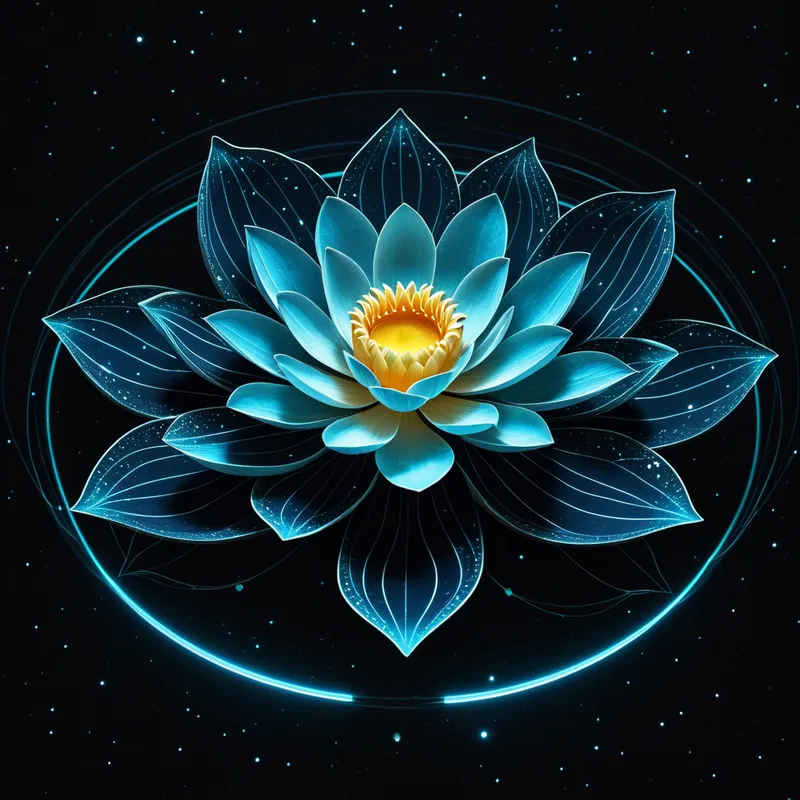
And what a dream it is! From the stillness of his slumber, a universe flowers. From his navel, a stem of light emerges, growing, reaching upward through the dark. At its apex, it blossoms into a resplendent lotus, a throne of creation. Upon that throne sits Brahma, born from Vishnu’s dreaming form. With Brahma’s awakening thought, the dream takes solid shape. He begins his work: the elements stir, the directions are defined, the gods and demons are imagined into being, the three worlds—heaven, earth, and the nether regions—unfold like petals.
The dream becomes vivid, tumultuous, dense with story. Heroes rise and fall, kings conquer and are humbled, lovers unite and are parted, sages meditate and gods battle. The great epic cycles—the Mahabharata, the Ramayana—play out like grand subplots within the god’s mind. Every joy, every sorrow, every act of courage and cowardice, every birth of a star and death of a civilization, is a ripple in the fabric of this single, all-encompassing vision. It is real to those within it, achingly, tangibly real.
For eons upon eons, the dream-drama continues. Brahma creates, Shiva dances the world to dissolution, and Vishnu, ever the preserver, sleeps on, his dream maintaining the delicate balance of it all through his incarnations and interventions. The dream has its own rules, its own time, its own compelling reality.
But even the deepest sleep must have its end. When the day of Brahma concludes—a span of time so vast it defies mortal comprehension—the dream begins to fade. The lotus withers. The worlds dissolve back into their elemental states. The stories unwind. The forms melt like mist in a morning sun, drawn back into the consciousness of the dreamer. All returns to the serpent, to the ocean, to the sleeping form of Vishnu.
There is a pause, a cosmic inhalation. The ocean is calm once more.
Then, with the next exhalation of the sleeping god, a new lotus rises. A new Brahma is born. A new universe is dreamed into being, similar yet utterly unique, another story beginning where the last one ended. The cycle continues, an eternal rhythm of dreaming, creating, preserving, dissolving, and dreaming again. The dreamer never truly wakes, for the dreaming is his eternal nature, the play of his own infinite consciousness.
Cultural Origins & Context
This profound cosmological vision is woven throughout the vast tapestry of Hindu thought, finding its most evocative expressions in the Puranas, particularly the Vishnu Purana and the Bhagavata Purana. These texts, composed and compiled over centuries beginning around the early centuries of the Common Era, were not dry philosophical treatises for the elite. They were living narratives, recited by storytellers and priests, performed in temple rituals and village gatherings.
The myth served a dual societal function. On one level, it was a grand cosmological model, explaining the origin, maintenance, and cyclical destruction of the universe in a way that was narrative and accessible. It placed human life within a context of unimaginable scale, offering both humility and a sense of cosmic belonging. On a deeper level, it was a theological cornerstone for Vaishnavism, establishing Vishnu as the supreme, transcendent source from which even the creator god Brahma emerges. The image of Vishnu reclining on Ananta Shesha became one of the most iconic in Hindu iconography, a visual mantra of divine immanence and transcendence.
Symbolic Architecture
The myth is a masterclass in metaphysical symbolism. Each element is a door to understanding the nature of reality and consciousness.
The Primordial Ocean represents the unmanifest, infinite potentiality—the unconscious ground of all being. Ananta Shesha, the “Endless Remainder,” symbolizes the eternal, cyclical time within which the drama of manifestation plays out; he is the support and the measure of the dream. Vishnu is pure consciousness itself, the ultimate subject, the witness who is both the source and the substance of the dream.
The universe is not separate from the dreamer; it is the dreamer, imagining itself as other.
The Lotus from the Navel is the point of emergence, the bindu or singularity where the unmanifest becomes manifest. It signifies spiritual awakening and purity rising from the murky depths. Brahma represents the creative, projecting faculty of the mind—the intellect and imagination that gives specific form to the dream. The entire Manifested Universe is Maya, the divine magic trick, the compelling illusion generated by consciousness.
Psychologically, this maps directly onto the human condition. Our waking “reality” is our personal dream, a construction of our senses, memories, beliefs, and cultural conditioning, projected from the depths of our own unconscious (the ocean) and given form by our ego (Brahma). We are, each of us, both Vishnu and Brahma—the dreaming consciousness and the active creator within our own experiential world.
The Dreamer’s Resonance
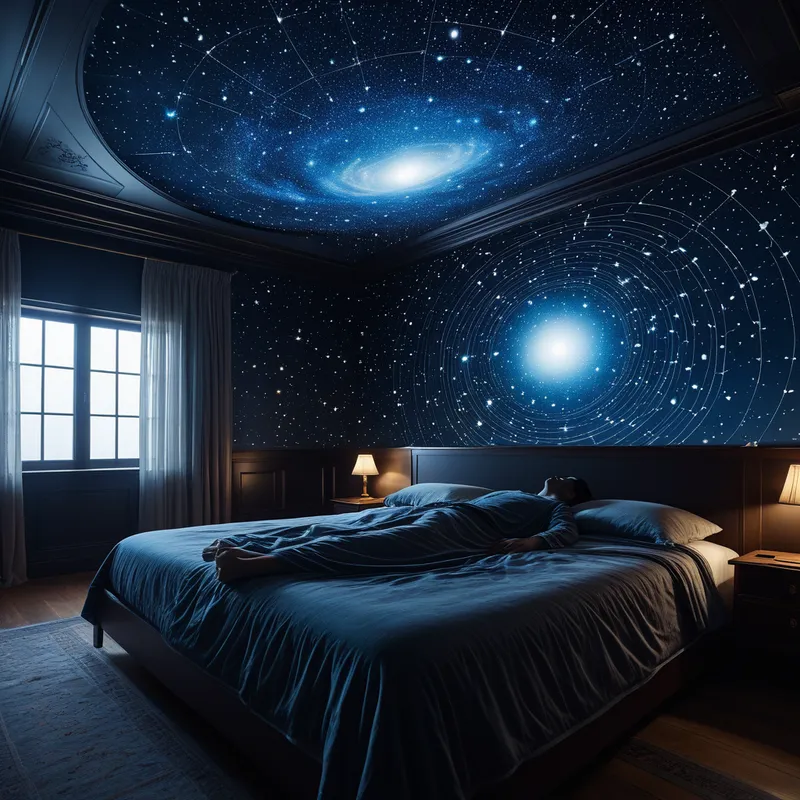
When this mythic pattern stirs in the modern unconscious, it often manifests in dreams of profound disorientation and revelation. One might dream of discovering that their entire life is a play on a stage, or that their city is a detailed model inside a vast, dark warehouse. Another may dream of meeting a sleeping giant whose thoughts become the landscape, or of realizing they are in a video game or simulation.
The somatic experience accompanying such dreams is key: a dizzying shift in perspective, a feeling of the ground of reality becoming insubstantial, often coupled with awe rather than terror. This is the psyche’s way of initiating a process of de-identification. The dreamer is being shown that the identity they have constructed—their personal history, their struggles, their very sense of a solid, separate self—is part of a narrative dream. The psychological process is the beginning of awakening from the ego’s dream of isolation, prompting the question: “If this is not ultimately real, then what am I?”
Alchemical Translation
The individuation journey, in Jungian terms, is the process of awakening from the personal and collective dream to recognize and integrate the Self. The myth of Vishnu’s Dream provides the ultimate blueprint for this alchemical work.
The first, and most challenging, step is the Nigredo: the blackening. This is the realization of Maya, the painful dissolution of the ego’s certainties. One confronts the illusion that their personal drama is the central, absolute reality. This is akin to a character in Vishnu’s dream suspecting they are in a dream—it creates a profound crisis of meaning.
The Albedo, the whitening, follows: the purification of perception. This is the stage of withdrawing projection, of ceasing to identify exclusively with the Brahma-ego (the creator of one’s personal world) and beginning to identify as the witness, the Vishnu-consciousness behind it. Meditation, introspection, and active imagination are the tools here, allowing one to “recline” in awareness and observe the dream of thoughts and emotions without being swept away.
To individuate is not to stop dreaming, but to realize you are the dreamer, and thus gain sovereignty over the plot.
Finally, the Rubedo, the reddening, represents the glorious return. This is not an escape from the world into formless void. It is the full, conscious participation in the dream, now known as a dream. The individual, having touched the transcendent Vishnu-aspect, returns to the immanent world of Brahma’s creation. They engage in life with compassion, creativity, and playfulness, no longer burdened by the illusion of a separate, fragile self, but acting as a conscious agent of the dreaming whole. They live the Lila, the divine play, with wisdom and grace. The dream continues, but the dreamer is finally awake within it.
Associated Symbols
Explore related symbols from the CaleaDream lexicon: