Vishnu's Churning of the Ocean Myth Meaning & Symbolism
A cosmic struggle between gods and demons churns the ocean of existence, yielding both poison and nectar, revealing the necessity of conflict for transformation.
The Tale of Vishnu’s Churning of the Ocean
In the time before time, when the cosmos was young and weary, a great lassitude fell upon [the world](/myths/the-world “Myth from Tarot culture.”/). The Devas had grown weak, their radiance dimmed. Their eternal foes, the Asuras, though mighty, were plagued by ambition without wisdom. Both clans languished, victims of their own nature, yearning for a power that would tip the balance of eternity.
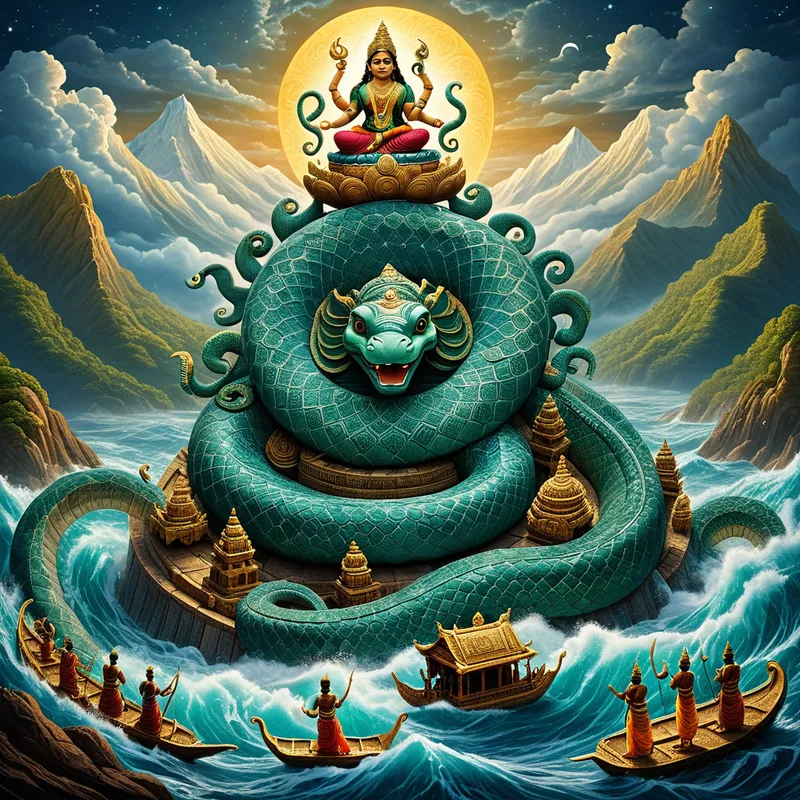
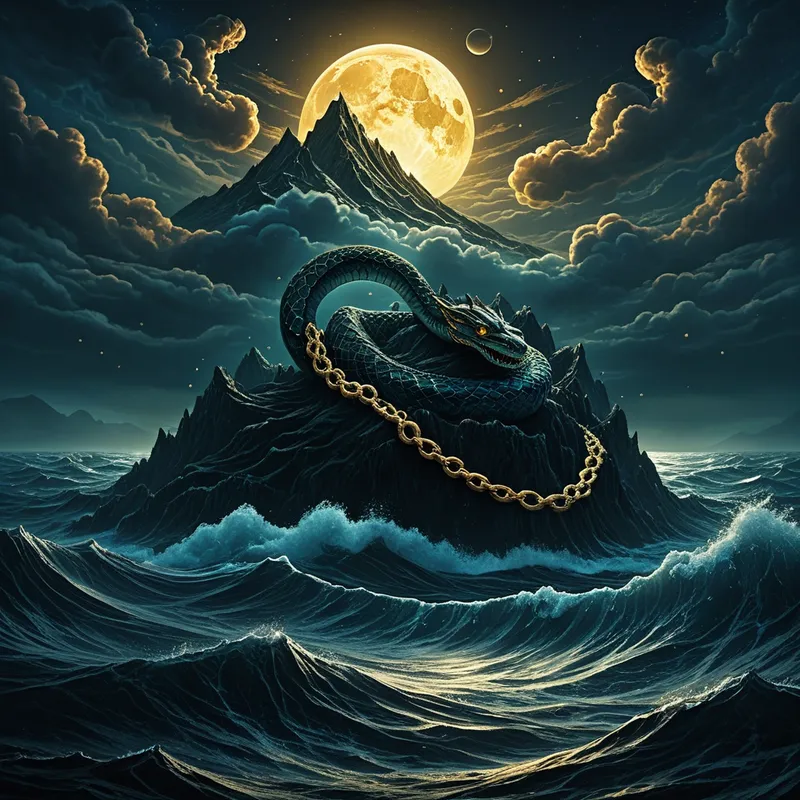
They went to the shores of the primordial [Kshirasagara](/myths/kshirasagara “Myth from Hindu culture.”/), its waters still and deep as a mirror to the infinite. There, they sought counsel from [Vishnu](/myths/vishnu “Myth from Hindu culture.”/), who rests upon the serpent Ananta [Shesha](/myths/shesha “Myth from Hindu culture.”/) in the ocean of causality. [Vishnu](/myths/vishnu “Myth from Hindu culture.”/), whose eyes hold the birth and death of universes, spoke: “The ocean holds the Amrita. But to obtain it, you must churn. You must work together. Use Mount Mandara as your staff, and the king of serpents, Vasuki, as your rope.”
And so began the grand travail. The Devas and Asuras, temporary allies in a desperate gamble, uprooted the colossal mountain. But as they placed it upon the ocean, it began to sink, swallowed by the soft, endless depths. In that moment of despair, [Kurma](/myths/kurma “Myth from Hindu culture.”/), the great [tortoise](/myths/tortoise “Myth from Greek culture.”/), dove beneath the waves. His shell, vast as a continent, became the unwavering foundation for the mountain. The world had found its pivot.
The Asuras seized the head of Vasuki; the Devas, his tail. They pulled. Back and forth, with a groaning that shook the stars, they churned [the ocean of milk](/myths/the-ocean-of-milk “Myth from Hindu culture.”/). The labor was immense. Vasuki, in agony, exhaled fiery venom that scorched the Asuras, while the Devas, at the tail, were cooled by his breath. The mountain span, grinding against the tortoise’s shell, setting the very axis of creation aflame.
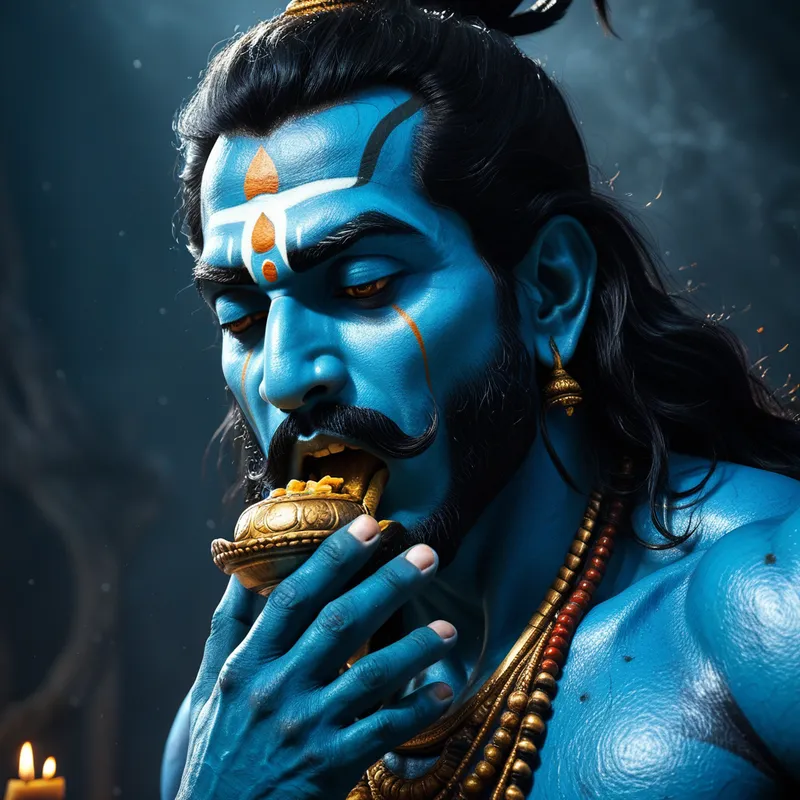
And from the churning depths, the ocean began to yield its treasures. First came Halahala, a smoke of utter blackness, a vapor of pure annihilation that threatened to consume all life. As terror seized gods and demons alike, [Shiva](/myths/shiva “Myth from Hindu culture.”/) emerged. In an act of supreme compassion, he gathered the poison and drank it, holding it in his throat, which turned blue forever—Neelakantha.
Then came wonders: the wish-fulfilling cow [Kamadhenu](/myths/kamadhenu “Myth from Hindu culture.”/), [the white elephant](/myths/the-white-elephant “Myth from Buddhist/Jataka Tales culture.”/) Airavata, the goddess of wine Varuni, [the moon](/myths/the-moon “Myth from Tarot culture.”/) Chandra, who Shiva placed in his hair. The celestial physician Dhanvantari emerged, radiant, holding the pot of Amrita. At the sight of immortality, the fragile alliance shattered. Greed erupted. The Asuras snatched the pot.
Once more, Vishnu intervened. He took the form of Mohini, a dancer of irresistible beauty. Enthralling the Asuras, she offered to serve the nectar fairly. But as she distributed it, she gave it only to the Devas. One Asura, Rahu, disguised himself and drank. Before the nectar could pass his throat, Vishnu’s discus, [Sudarshana Chakra](/myths/sudarshana-chakra “Myth from Hindu culture.”/), severed his head. His head became immortal, forever chasing the sun and moon in eclipse. Order was restored, the Devas regained their sovereignty, and the cosmos, having passed through the fire of its own contradictions, breathed anew.
Cultural Origins & Context
This myth, known as [Samudra Manthan](/myths/samudra-manthan “Myth from Hindu culture.”/), is a cornerstone of Puranic literature, found in texts like the Vishnu Purana and the epic Mahabharata. It was not merely a story for entertainment but a cosmological and ethical narrative performed and recited by priests and bards. Its function was multifaceted: to explain cosmic cycles of order and chaos, to validate the necessity of divine intervention (avatara), and to model the social and spiritual ideal of dharma—right action—even amidst necessary collaboration with adversarial forces. It served as a grand metaphor for the Vedic sacrificial ritual itself, where churning produces [the sacred fire](/myths/the-sacred-fire “Myth from Native American culture.”/) (Agni) and the intoxicating Soma, symbols of divine communion.
Symbolic Architecture
The myth is a vast symbolic engine describing the process of creation and individuation. The Kshirasagara is the unconscious, the boundless potential of the [psyche](/myths/psyche “Myth from Greek culture.”/). Mount Mandara is the [axis](/symbols/axis “Symbol: A central line or principle around which things revolve, representing stability, orientation, and the fundamental structure of reality or consciousness.”/) mundi, the [spine](/symbols/spine “Symbol: The spine symbolizes strength, support, and the foundational structure of one’s life and identity.”/) of focused [consciousness](/symbols/consciousness “Symbol: Consciousness represents the state of awareness and perception, encompassing thoughts, feelings, and experiences.”/) around which transformation occurs. The Devas and Asuras represent the eternal psychic polarity: the ascending, ordering principles ([spirit](/symbols/spirit “Symbol: Spirit symbolizes the essence of life, vitality, and the spiritual journey of the individual.”/), light, consciousness) and the descending, chaotic powers (instinct, [shadow](/symbols/shadow “Symbol: The ‘shadow’ embodies the unconscious, repressed aspects of the self and often represents fears or hidden emotions.”/), the unconscious).
The nectar of immortality is always preceded by the poison of dissolution. One cannot be had without risking the other.
The [serpent](/symbols/serpent “Symbol: A powerful symbol of transformation, wisdom, and primal energy, often representing hidden knowledge, healing, or temptation.”/) Vasuki is the coiled, ambivalent [energy](/symbols/energy “Symbol: Energy symbolizes vitality, motivation, and the drive that fuels actions and ambitions.”/) of [life](/symbols/life “Symbol: The symbol of ‘Life’ represents a journey of growth, interconnectedness, and existential meaning, encompassing both the joys and challenges that define human experience.”/) itself—[kundalini](/symbols/kundalini “Symbol: A dormant spiritual energy coiled at the base of the spine, representing untapped potential and awakening consciousness through ascension.”/), desire, the primal force that can be used for creation or destruction. That the Asuras hold the head and suffer its [venom](/symbols/venom “Symbol: Venom represents a potent, often hidden, toxic influence that can cause harm or transformation. It symbolizes both danger and potential healing.”/) speaks to the perils of identifying solely with egoic, aggressive consciousness. Kurma, the [foundation](/symbols/foundation “Symbol: A foundation symbolizes the underlying support systems, values, and beliefs that shape one’s life, serving as the bedrock for growth and development.”/), symbolizes the patient, grounding, earthly support (the [body](/symbols/body “Symbol: The body in dreams often symbolizes the dreamer’s self-identity, personal health, and the relationship they have with their physical existence.”/), the [material](/symbols/material “Symbol: Material signifies the tangible aspects of life, often representing physical resources, desires, and the physical world’s influence on our existence.”/) world) necessary for any spiritual endeavor. The [emergence](/symbols/emergence “Symbol: A process of coming into being, rising from obscurity, or breaking through a barrier, often representing birth, transformation, or revelation.”/) of both poison (Halahala) and nectar (Amrita) reveals the fundamental law: profound creation is a destructive process. The psyche must confront its own toxic shadows—its repressed fears, rages, and desires—before it can access its transcendent, unifying essence.
The Dreamer’s Resonance
When this myth stirs in modern dreams, it signals a profound somatic and psychological churning. The dreamer may feel caught in a vast, exhausting struggle, pulling on a rope in a team that feels both cooperative and adversarial. This is the psyche laboring to integrate opposites: ambition and rest, [persona](/myths/persona “Myth from Greek culture.”/) and shadow, logic and intuition. The dream-ocean may be turbulent, yielding bizarre or frightening images—the “poisons” of anxiety, shame, or old trauma surfacing.
The body often echoes this in sensations of vertigo, nausea, or deep fatigue—the somatic cost of inner work. To dream of the supportive tortoise is to yearn for stability amid upheaval. To dream of Mohini or the pot of nectar is to encounter the tantalizing, often deceptive promise of a quick fix or salvation from without, when the true work remains within. The dream is a map of the individuation process in its most active, tumultuous phase.
Alchemical Translation
For the modern individual, [the Samudra Manthan](/myths/the-samudra-manthan “Myth from Hindu culture.”/) is the ultimate alchemical allegory. The [prima materia](/myths/prima-materia “Myth from Alchemical culture.”/)—the raw, chaotic stuff of the soul—is the ocean of milk. The goal is [the philosopher’s stone](/myths/the-philosophers-stone “Myth from Alchemical culture.”/): the integrated Self, symbolized by the Amrita. The process requires [the conjunction](/myths/the-conjunction “Myth from Alchemical culture.”/) of opposites (Devas and Asuras), which in psychological terms means consciously engaging with one’s shadow, those rejected parts of the personality we project onto “enemies” or find repulsive.
Individuation is not about becoming purely light, but about developing the capacity to hold the poison without being destroyed by it, and to earn the nectar without being corrupted by it.
The churning is the disciplined, often painful work of therapy, meditation, or creative endeavor—the repeated engagement with conflict and contradiction that alone produces transformation. Shiva’s act of holding the poison is the crucial step of containment: not acting out our destructive impulses, but consciously bearing the tension of their existence. Kurma reminds us that this work must be grounded in the body and in humble, patient presence. Finally, the deception of Mohini reveals that [the immortal](/myths/the-immortal “Myth from Taoist culture.”/) essence cannot be seized by the greedy, grasping ego (the Asuric consciousness). It is received only when [the ego](/myths/the-ego “Myth from Jungian culture.”/) is tricked, bypassed, or surrendered. The integrated Self is not possessed; it is a state of grace that emerges when the war within becomes a sacred dance.
Associated Symbols
Explore related symbols from the CaleaDream lexicon: