Vinegar on the Cross Myth Meaning & Symbolism
A moment of final, bitter offering at the crucifixion, where a sponge of vinegar becomes a symbol of ultimate rejection and paradoxical fulfillment.
The Tale of Vinegar on the Cross
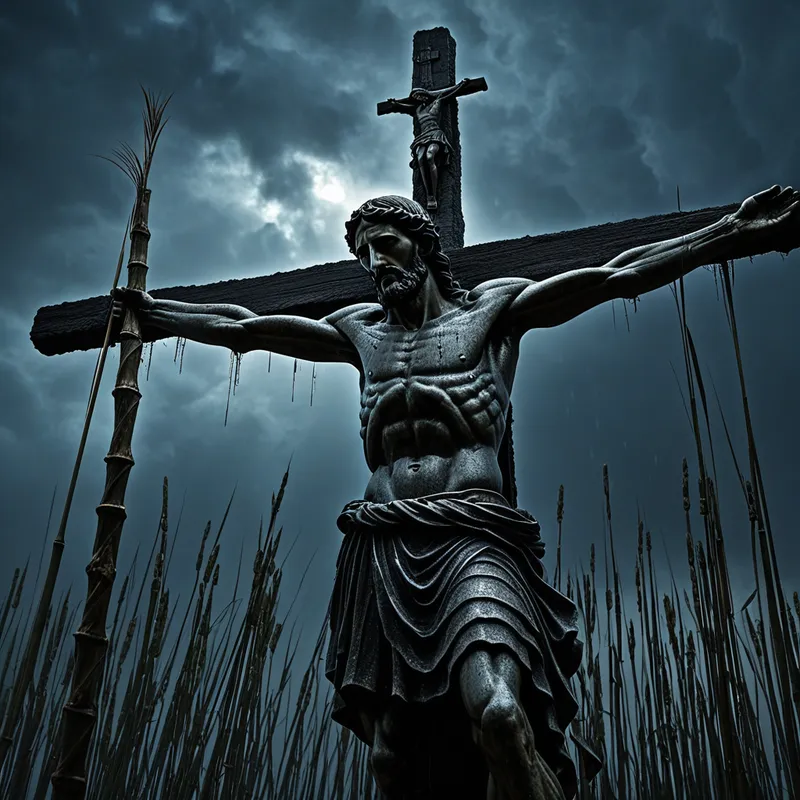
The sky was a wound, torn and bruise-purple over the place of the skull. The air, thick with the iron scent of blood and the dust of despair, carried the ragged symphony of agony—the groans of the condemned, the weeping of the few who remained, and the cruel laughter of the crowd that had come to see a spectacle. At the center of it all, suspended between heaven and the unforgiving earth, hung the man they called Christ. His body was a map of torment, each breath a labor against the crushing weight of his own flesh.
Hours had bled into one another. A thirst had taken root in him, a desert that grew from within, more profound than the agony of nail and thorn. It was a thirst for the world itself, for every sorrow he carried. From cracked lips, a whisper tore itself loose, a scripture from a ancient psalm made flesh: “I thirst.”
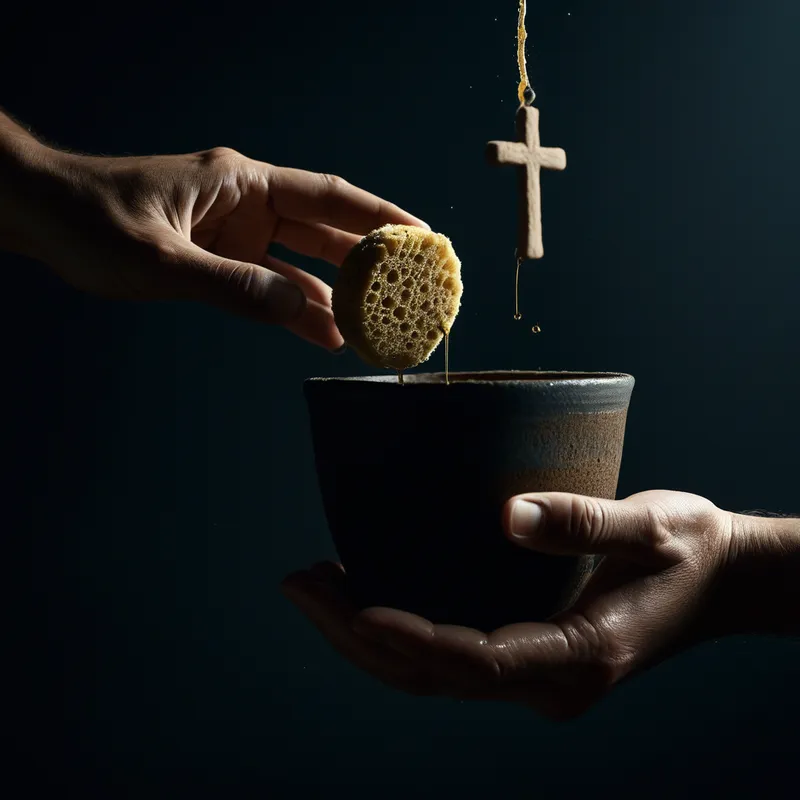
In the shadows below the cross, the words landed. Some heard a cry of mere mortal weakness. But one of the soldiers, a man whose soul had been calloused by a hundred such executions, moved. There was no mercy in the gesture, only a grim practicality, or perhaps the final flourish of mockery. A jar of vinegar stood nearby, the bitter drink of the legion. He took a sponge, soaked it in the sharp, acidic liquid, fixed it on the stalk of a hyssop plant, and lifted it.
The sponge, dripping its sour offering, was raised on the reed. It hovered before the parched lips, a cruel parody of a king’s chalice. This was the world’s last drink for its scapegoat—not wine, not water, but the dregs of its bitterness. The man on the cross received it. He tasted the full, acrid tang of humanity’s rejection, the vinegar of failed expectations and soured hopes. And in that moment of ultimate, bitter acceptance, he spoke words that seemed to shake the very foundations of the underworld: “It is finished.” Then, bowing his head, he surrendered his spirit. The sponge fell, the vessel emptied, and a strange silence fell, deeper than the preceding darkness.
Cultural Origins & Context
This stark moment is recorded in the Gospel of John (19:28-30), a text composed in the latter half of the first century. It is not a folk myth born of campfires, but a theological narrative woven into the passion account of early Christian communities. The tellers were evangelists, writing for communities facing persecution and existential doubt, seeking to find profound meaning in the grotesque horror of the crucifixion.
The detail is not random. It serves a specific literary and theological function: to demonstrate the fulfillment of Hebrew scripture. The cry “I thirst” echoes Psalm 69:21, “They gave me vinegar for my thirst.” For the early audience, this was a powerful signifier. It wasn’t merely a historical accident; it was a destined note in a sacred score, proving that even in this nadir of suffering, the script of prophecy was being followed to its bitter end. The use of hyssop—a plant associated with purification and the Passover lamb’s blood in Exodus—further layers the event with sacrificial symbolism. The myth was passed down as a cornerstone of faith, a story that transformed an act of brutal derision into a key moment of divine purpose, teaching believers that God’s plan could work through even the most bitter offerings of a fallen world.
Symbolic Architecture
At its core, the vinegar is the symbol of the world’s final, unreserved “no.” It is the antithesis of sustenance, a draught that exacerbates thirst rather than quenches it. Psychologically, it represents every soured promise, every bitter pill of reality that contradicts our deepest needs and spiritual thirst. It is the job that drains the soul, the relationship that offers only acidity, the dream that curdles upon touch.
The ultimate acceptance is not of the sweet wine of fulfillment, but of the vinegar of reality as it is, in its most unpalatable form.
The figure on the cross, in accepting it, performs the ultimate act of conscious suffering. He does not refuse the bitterness; he drinks it fully. This is not masochism, but the complete assimilation of the shadow. The shadow here is the collective rejection, cruelty, and failure of the world. By taking it in—literally internalizing it—he transforms its meaning. The act of drinking declares, “I will include even this in my experience. I will let this bitter truth be real.” The subsequent cry, “It is finished,” signals that the process of assimilation is complete. The debt of suffering is paid; the archetypal pattern of the rejected savior is fulfilled.

The Dreamer’s Resonance
When this myth stirs in the modern soul, it may manifest in dreams of being offered a poisoned or spoiled drink, reaching for water only to find vinegar, or being parched with no relief in sight. Somaticly, the dreamer may awaken with a dry mouth or a tightness in the throat.
These dreams often surface during life passages of profound disillusionment or “bitter pill” moments—the end of an idealistic venture, the confrontation with a harsh truth about oneself or a loved one, the experience of ingratitude or betrayal after great personal cost. The psyche is processing a deep, spiritual thirst (for meaning, recognition, love) that is being met with the “vinegar” of reality. The dream is not merely a reflection of pain, but an unconscious enactment of the mythic pattern: the Self is orchestrating a scenario where the ego is brought to the point of accepting the unacceptable. The dream asks: Can you drink this? Can you acknowledge this bitterness as part of your story without letting it annihilate your spirit? It is the psyche’s gruesome, sacred ritual of incorporation.
Alchemical Translation
The alchemical journey is one of solve et coagula—dissolve and coagulate. The myth of the vinegar presents a supreme model for this psychic transmutation. The first stage is the dissolution: the ego’s cherished ideals—of being saved, rewarded, or comforted in its hour of greatest need—are utterly dissolved in the acid of reality. The expected “wine” of divine intervention or human compassion is not forthcoming.
The transmutation begins not when the gold is found, but when the base metal is fully tasted and acknowledged as one’s own substance.
The offering of vinegar is the crucial moment of mortificatio, the blackening, where all hope seems lost. But the alchemical secret lies in the acceptance. By consciously drinking the vinegar, the individual performs the coagula. They take the bitter, rejected, and painful elements (the prima materia of their suffering) and, by the act of conscious acceptance, begin to coagulate a new, more resilient psychic substance. The “finished” work is the birth of a consciousness that has integrated the shadow of rejection. The individual is no longer a victim of life’s bitterness but has consciously included it in their wholeness. They become the individuated self who, having tasted the dregs, finds a paradoxical freedom. The thirst itself is transformed; it is no longer a desperate need for the world to be sweet, but a deep, abiding capacity to hold the full, complex flavor of existence—sweet, sour, and bitter alike. The cross becomes the athanor, the furnace, and the vinegar itself becomes the paradoxical aqua vitae, the water of life, found only at the bottom of the cup of despair.
Associated Symbols
Explore related symbols from the CaleaDream lexicon: