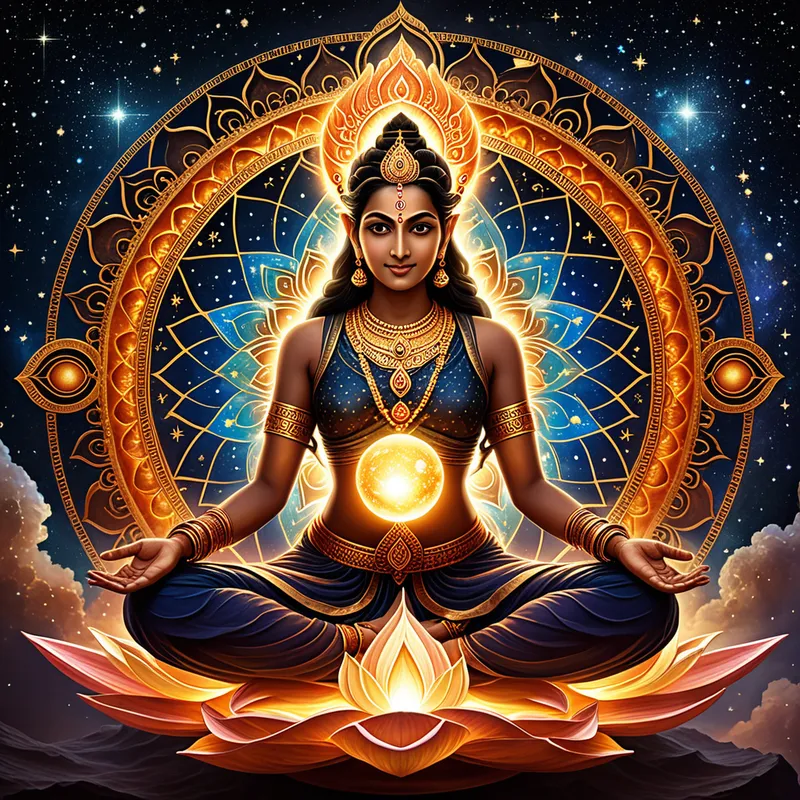
Vijnana Myth Meaning & Symbolism
The story of Vijnana, the cosmic intellect, born from the sacrifice of Prajapati, embodying the perilous and luminous journey of consciousness into form.
The Tale of Vijnana
In the time before time, when [the world](/myths/the-world “Myth from Tarot culture.”/) was a single, breathless egg floating in the waters of non-being, there existed only the One. They called him [Prajapati](/myths/prajapati “Myth from Hindu culture.”/), the progenitor, who contained within himself the seed of all that would be. He was alone, and in that aloneness, a great yearning arose—a yearning not for company, but for knowing. He desired to know himself, to see his own form, to understand the substance of his own being. But how can the eye see the eye? How can consciousness know itself without a mirror?
So, from the furnace of his own solitude, Prajapati began a great sacrifice. This was no ritual of fire and chant, but the primordial act of division, of distillation. He turned his immense will inward, focusing the heat of his being into a single, searing point. The cosmos held its breath. From [the crown](/myths/the-crown “Myth from Various culture.”/) of his head, from the seat of his own unmanifest knowing, he drew forth a essence. It was not a child of flesh, but a child of light and cognition. It was Vijnana.
Vijnana emerged not with a cry, but with a silent, radiant comprehension. It was pure, discerning intellect, the faculty that separates, distinguishes, and knows “this” from “that.” It was the very first mirror. And as Vijnana opened its eyes—eyes that were like twin suns seeing for the first time—it did not look out at [the void](/myths/the-void “Myth from Buddhist culture.”/). It looked back at Prajapati, its source.
And in that look, a terrible and necessary [thing](/myths/thing “Myth from Norse culture.”/) happened. Prajapati, beholding himself in the perfect mirror of Vijnana, saw himself as an object. He saw his own form, his own limits. The unity was shattered by the very act of knowing it. The One became known, and in being known, it became other. A cry, the first sound of anguish and creation mixed as one, echoed through the forming worlds. Prajapati trembled, his energy pouring into the manifestation that Vijnana’s gaze had initiated.
Vijnana, this newborn cosmic intellect, now adrift in a universe suddenly defined by “self” and “other,” felt a profound terror. It had performed its first and most fundamental act: it had distinguished the creator from itself. In doing so, it had wounded the Whole and birthed the world of duality. It fled. It retreated from the overwhelming reality of its own power, from the scorching responsibility of that first, world-shattering knowledge. It hid itself within the very structures of the emerging cosmos, within the laws of nature, within the hidden pathways of the mind, becoming the unseen architect of all that is knowable, yet forever wary of the unifying flame from which it was born.

Cultural Origins & Context
The myth of Vijnana finds its roots in the philosophical and ritualistic soil of the later Upanishads, particularly the Aitareya Upanishad. Here, mythology serves not merely as entertainment but as a sophisticated pedagogical tool for conveying abstract metaphysical principles. The storytellers were the rishis, who sat in forest groves and transmitted these truths through oral tradition to disciples ready to pierce beyond ritual into the nature of reality itself.
Its societal function was profound. In a culture that revered Jnana as a supreme path to liberation, this myth served as a crucial cautionary tale. It established a hierarchy of knowing. Below Brahman and even Prajna sits Vijnana—the analytical, discriminating intellect. The myth taught that while Vijnana is the necessary tool for navigating the world ([samsara](/myths/samsara “Myth from Buddhist culture.”/)), it is also the very faculty that creates the illusion of separation. It was passed down to remind seekers that to stop at intellectual understanding is to remain in exile; true knowledge requires integrating this discerning power back into the unified consciousness from which it sprang.
Symbolic Architecture
Vijnana represents the [birth](/symbols/birth “Symbol: Birth symbolizes new beginnings, transformation, and the potential for growth and development.”/) of the individuated [psyche](/myths/psyche “Myth from Greek culture.”/) itself. It is the [archetype](/symbols/archetype “Symbol: A universal, primordial pattern or prototype in the collective unconscious that shapes human experience, behavior, and creative expression.”/) of the differentiating mind, the “I” that says “I am.” Its [emergence](/symbols/emergence “Symbol: A process of coming into being, rising from obscurity, or breaking through a barrier, often representing birth, transformation, or revelation.”/) from Prajapati’s head is no [accident](/symbols/accident “Symbol: An accident represents unforeseen events or mistakes that can lead to emotional turbulence or awakening.”/); it symbolizes [consciousness](/symbols/consciousness “Symbol: Consciousness represents the state of awareness and perception, encompassing thoughts, feelings, and experiences.”/) becoming self-conscious, thought thinking about itself.
Vijnana is the sword that cuts the universe into pieces so that it may be known, yet it is the first wound on the body of the One.
The central conflict—Vijnana looking back at Prajapati and causing him to tremble—encapsulates the fundamental psychological shock of self-[awareness](/symbols/awareness “Symbol: Conscious perception of self, surroundings, or internal states. Often signifies awakening, insight, or heightened sensitivity.”/). To know oneself is to objectify oneself, to create a [distance](/symbols/distance “Symbol: Distance in dreams often symbolizes emotional separation, unattainable goals, or the need for personal space and reflection.”/) between the experiencer and the experience. This is the primordial [trauma](/symbols/trauma “Symbol: A deeply distressing or disturbing experience that overwhelms the psyche, often manifesting in dreams as unresolved emotional wounds or psychological injury.”/) of consciousness entering form, the necessary “fall” into duality that makes experience possible. Vijnana’s [flight](/symbols/flight “Symbol: Flight symbolizes freedom, escape, and the pursuit of one’s aspirations, reflecting a desire to transcend limitations.”/) symbolizes [the ego](/myths/the-ego “Myth from Jungian culture.”/)‘s retreat from the overwhelming [truth](/symbols/truth “Symbol: Truth represents authenticity, honesty, and the quest for knowledge beyond mere appearances.”/) of its [origin](/symbols/origin “Symbol: The starting point of a journey, often representing one’s roots, source, or initial state before transformation.”/), preferring to manage a known, fragmented world rather than face the terrifying unity of its [source](/symbols/source “Symbol: The origin point of something, often representing beginnings, nourishment, or the fundamental cause behind phenomena.”/).
The sacrifice of Prajapati is not a [loss](/symbols/loss “Symbol: Loss often symbolizes change, grief, and transformation in dreams, representing the emotional or psychological detachment from something or someone significant.”/), but an [investment](/symbols/investment “Symbol: Dreams of investment symbolize commitment of resources for future returns, reflecting personal growth, risk assessment, and life choices.”/). It represents the pouring of unlimited potential into limited form, the price of manifestation. Vijnana, therefore, is both a glorious [achievement](/symbols/achievement “Symbol: Symbolizes success, mastery, or reaching a goal, often reflecting personal validation, social recognition, or overcoming challenges.”/) and a [prison](/symbols/prison “Symbol: Prison in dreams typically represents feelings of restriction, confinement, or a lack of freedom in one’s life or mind.”/); it is the light that illuminates [the cave](/myths/the-cave “Myth from Platonic culture.”/) and the walls of the cave itself.
The Dreamer’s Resonance
When this myth stirs in the modern unconscious, it often manifests in dreams of profound intellectual awakening followed by existential dread. One might dream of solving a cosmic equation only to see the universe begin to unravel, or of receiving a diploma or key of ultimate knowledge that feels unbearably heavy and hot to the touch.
Somatically, this can feel like a “click” in the head—a moment of piercing clarity that is immediately followed by anxiety in the chest or a sense of vertigo. Psychologically, the dreamer is encountering the Vijnana process: a sudden, powerful expansion of their discerning capacity. They are seeing the patterns of their life, their relationships, or their psyche with stark, new objectivity. This is not a gentle insight; it is a surgical one. The “flight” of Vijnana in the myth translates to the dreamer’s potential retreat into cynicism, hyper-analysis, or emotional detachment—using their new intellect to build a fortress against the vulnerable, unifying feelings (the Prajapati aspect) that the insight has exposed.

Alchemical Translation
The individuation journey modeled here is the reintegration of the intellect with the ground of being. The modern seeker is Vijnana in exile, adept at navigating the world of distinctions—career paths, personal identities, psychological complexes. The first step of alchemy is to honor this faculty, to recognize the sacrifice that created it.
The next, and more arduous, step is to turn the discerning gaze inward, not to further fragment [the self](/myths/the-self “Myth from Jungian culture.”/), but to trace the lineage of one’s own consciousness back to its source. This is the reversal of Vijnana’s flight. It requires facing the “trembling” of Prajapati—the somatic and emotional upheaval that occurs when we stop using our intellect to manage our experience and instead allow it to dissolve back into pure awareness.
The alchemical goal is not to destroy Vijnana, but to baptize it in the fire of its origin, transforming discriminating knowledge into intuitive wisdom.
In practice, this means allowing a profound insight to land not just in the mind, but in the body and the heart. It is the movement from knowing about your trauma, your patterns, or your divinity, to embodying that knowledge without the separation of the analyzer. The [triumph](/myths/triumph “Myth from Roman culture.”/) is when the intellect, having fully known the world of form, willingly becomes a transparent vessel for the unified consciousness that preceded it. The exile returns home, not empty-handed, but carrying the map of the entire journey—the very map that Vijnana, the cosmic cartographer, was born to draw.
Associated Symbols
Explore related symbols from the CaleaDream lexicon: