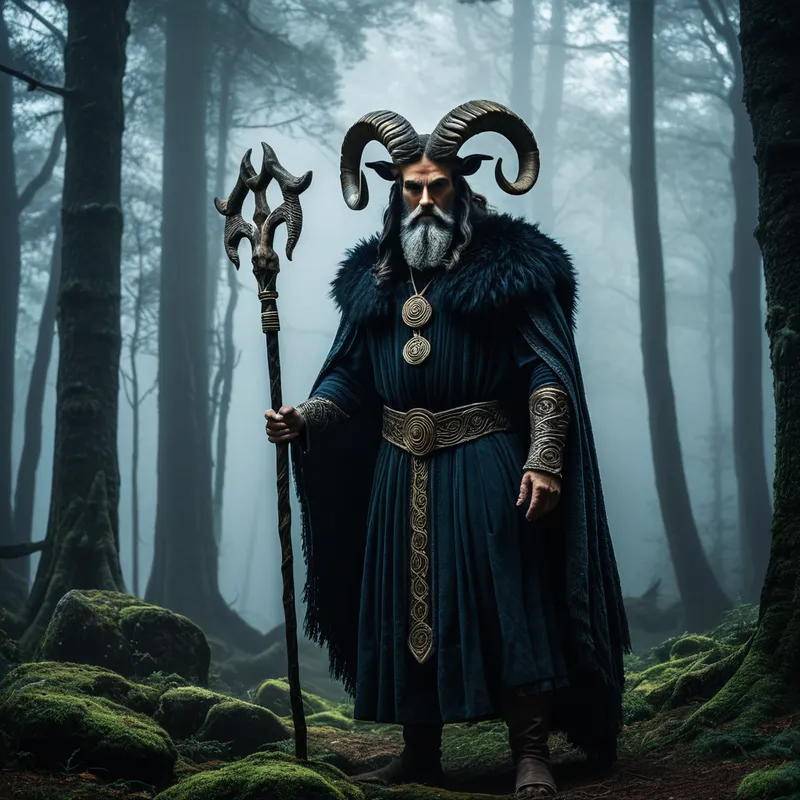
Veles Myth Meaning & Symbolism
The myth of the eternal struggle between Veles, god of the underworld and waters, and Perun, the thunder god, embodying chaos and order.
The Tale of Veles
Listen, and let the smoke of the hearth carry you back. Before the plow cut the earth, when the world was a song sung between the Prav and the Yav, there was a tension, a rhythm as old as the first heartbeat. In the high, clear realm of the mountain lived [Perun](/myths/perun “Myth from Slavic culture.”/). His voice was the crack that splits the sky, his axe the flash that illuminates the world in stark, terrifying truth. He was order, covenant, the unyielding oak.
And below, in the whispering depths, dwelled Veles. His realm was not of stone, but of root and riverbed, of the dark, fertile mud where seeds dream. He was the shape of the bull, the wisdom of the serpent, the patron of poets and herders. His wealth was not gold, but the lowing of cattle, the flow of water, the hidden knowledge in a mushroom ring.
The story tells of a great theft. Not of mere trinkets, but of essence itself. From the sunlit heights, Veles, in the form of a sinuous serpent, stole what was most precious to Perun: his celestial cattle, the storm-clouds, his very children, or the light of the sun. He did not hoard them in a vault, but drove them down, down into the labyrinth of his watery domain, the Nav. The world above grew still and pale. The order of Perun was broken.
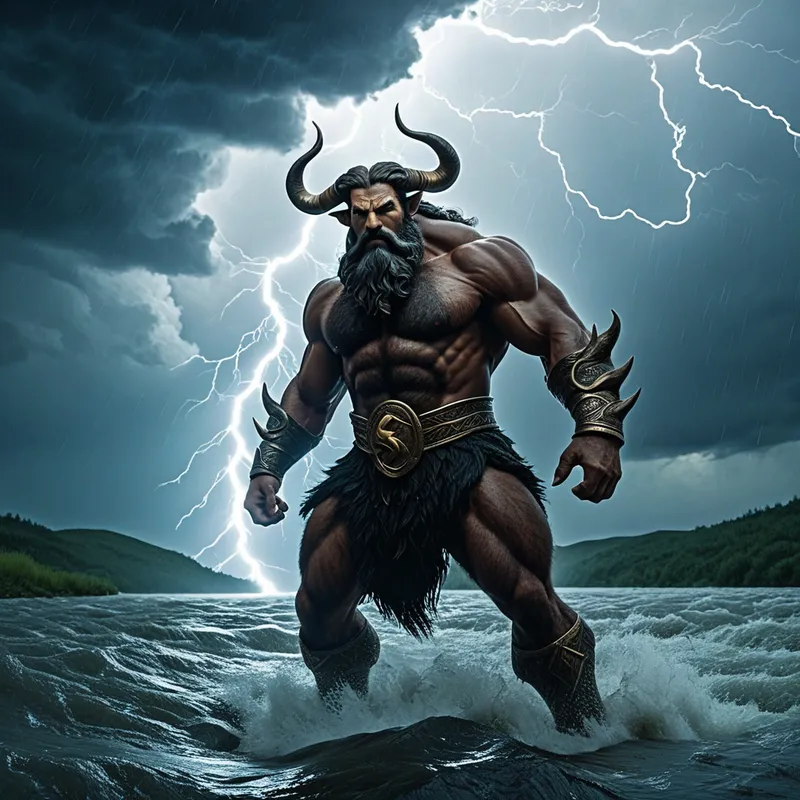
Then came the roaring. The heavens darkened not with night, but with divine rage. Perun descended, a storm given flesh, his chariot the thunderhead. He pursued Veles across the vault of the world. Their battle was the world’s drama. Veles fled, not in cowardice, but in cunning transformation. He became a bull to charge through valleys, a man to hide among the reeds, a fish to slip through the deepest currents. Wherever he touched the earth, springs bubbled forth; wherever he hid, caves opened.
Perun’s lightning struck—a blast of pure, clarifying fury. It found Veles as he crossed a great river, the boundary between worlds. The bolt did not destroy him, but shattered his form. From his body, scattered like seed, sprang all the creatures of the earth and the waters. His essence watered the world. And from this cataclysm, the first rain fell, quenching the parched earth, and the cycle was born anew. Veles retreated, wounded but alive, to the deep places, and Perun reclaimed the sky. But both knew the chase was not over. It was the promise of the world: the theft, the storm, the shattering, and the greening rain that follows.
Cultural Origins & Context
The myth of Veles and Perun is not a single, codified scripture, but a living pattern reconstructed from the fragments of a resilient oral tradition. It echoed in the chants of Slavic priests, the volkhvs, and in the folk tales of peasants who saw the divine struggle in every summer storm and spring flood. The duality was etched into the landscape: temples to Perun on high hills; offerings to Veles near water, in hollows, and under ancient oaks.
This myth served as the fundamental cosmological narrative. It explained the changing seasons—the “death” of Veles’ vitality in winter and his “rebirth” in the spring rains. It governed social structure, with Perun as the god of the ruling warrior-prince and Veles as the patron of the common people, the merchants, the poets, and the magicians. Their eternal, cyclical conflict was not seen as purely antagonistic, but as a necessary, creative tension that maintained the balance of the world. The myth was the answer to why chaos must challenge order, why the underworld feeds the earth, and why creation often requires a sacred theft.
Symbolic Architecture
At its core, this myth maps the psyche’s fundamental polarity. Perun represents the conscious ego: structured, willful, defining boundaries, and imposing order. He is [the principle](/symbols/the-principle “Symbol: A fundamental truth, law, or doctrine that serves as a foundation for a system of belief, behavior, or reasoning, often representing moral or ethical standards.”/) of [differentiation](/symbols/differentiation “Symbol: The process of distinguishing or separating parts of the self, emotions, or identity from a whole, often marking a developmental or psychological milestone.”/)—the [lightning](/symbols/lightning “Symbol: Lightning symbolizes sudden insights or revelations, often accompanied by powerful emotions or disruptive change.”/) bolt that says “this, not that.”
Veles is the necessary shadow, the chaotic, fecund, and untamed unconscious. He is everything the ego excludes to maintain its identity: instinct, fluidity, hidden potential, and the wealth of the unseen.
Veles’s theft is not evil, but an act of profound necessity. The conscious order (Perun) becomes sterile, [static](/symbols/static “Symbol: Static represents interference, disruption, and the breakdown of clear communication or signal, often evoking feelings of frustration and disconnection.”/), and lifeless if it is not periodically challenged and replenished by the contents of the unconscious (Veles). The cattle he steals are the libidinal [energy](/symbols/energy “Symbol: Energy symbolizes vitality, motivation, and the drive that fuels actions and ambitions.”/), the creative and vital forces that the ego claims as its sole [property](/symbols/property “Symbol: Property often represents one’s personal value, possessions, or self-worth.”/). The [pursuit](/symbols/pursuit “Symbol: A chase or being chased in dreams often reflects unresolved anxieties, unfulfilled desires, or internal conflicts demanding attention.”/) and the shattering are the painful but transformative process of the psyche confronting what it has repressed. Veles’s transformations—into [serpent](/symbols/serpent “Symbol: A powerful symbol of transformation, wisdom, and primal energy, often representing hidden knowledge, healing, or temptation.”/), [bull](/symbols/bull “Symbol: The bull often symbolizes strength, power, and determination in many cultures.”/), man, fish—symbolize the protean [nature](/symbols/nature “Symbol: Nature symbolizes growth, connectivity, and the primal forces of existence.”/) of the unconscious, which cannot be pinned down by a single name or form. His final shattering and [dispersal](/symbols/dispersal “Symbol: The act of scattering, spreading, or breaking apart. Often represents release, transition, or loss of cohesion.”/) represent how unconscious contents, when integrated, do not remain monolithic but become the [fertile ground](/symbols/fertile-ground “Symbol: Fertile ground symbolizes potential, growth, and the promise of new beginnings, reflecting a state where life can thrive.”/) for new [life](/symbols/life “Symbol: The symbol of ‘Life’ represents a journey of growth, interconnectedness, and existential meaning, encompassing both the joys and challenges that define human experience.”/) and new [consciousness](/symbols/consciousness “Symbol: Consciousness represents the state of awareness and perception, encompassing thoughts, feelings, and experiences.”/).
The Dreamer’s Resonance
When this myth stirs in modern dreams, it often manifests as a profound sense of underground movement. One might dream of flooding basements, of dark rivers flowing through city streets, or of a powerful, horned animal loose in a structured, familiar place. These are somatic signals of the Veles-force rising. The dream ego (Perun) may feel threatened, chasing a slippery, transformative figure, or trying to contain an overwhelming emotional flood.
This dream pattern signifies a psychological process where long-contained energies—instincts, creativity, grief, or wild intuition—are demanding recognition. The “theft” in the dream could be a loss of control, a sudden emotional outburst, or an impulsive act that disrupts the dreamer’s orderly life. The process is one of somatic unlocking; the body-soul is initiating a necessary rebellion against an overly rigid psychic structure. The dreamer is not going mad but is being called to a more fluid, embodied, and authentic state of being, often at the cost of their previous self-concept.

Alchemical Translation
The alchemical journey modeled by this myth is the transmutation of rigidity into fluid wisdom. The modern individual’s “Perun” is the constructed persona, the successful identity, the well-defended ego. The “Veles” is the neglected soul, the stifled artist, the buried grief, the wild intuition.
The first stage is the Theft: a crisis. Depression, creative block, a relationship ending, or a sudden, inexplicable urge disrupts the orderly life. This is Veles stealing the cattle. The ego feels robbed of its vitality and control.
The second stage is the Pursuit: the painful, often angry, process of shadow-work. One must chase down these disruptive feelings, not to destroy them, but to confront them. This is Perun’s righteous storm—the necessary fury that gives energy to the process of introspection.
The climax is the Shattering at the River: the moment of breakdown or breakthrough at the boundary of the known self. The old ego-structure cannot hold, and it fractures. This is not annihilation, but dissolution.
The final, alchemical stage is the Dispersal and Rain. The shattered pieces of the old self, now mixed with the reclaimed vitality (the cattle), water the soul’s barren fields. What was once a monolithic problem becomes distributed, fertile potential. The individual does not return to the old order but discovers a new, more resilient order that includes the wisdom of the deep self. They learn to hold the tension of the eternal chase within, allowing the storm and the river to converse, creating an inner world that is both structured and alive.
Associated Symbols
Explore related symbols from the CaleaDream lexicon:
- Serpent — The primary form of Veles as the challenger; represents cunning, transformation, chthonic wisdom, and the cyclical shedding of the old.
- Water — The elemental domain of Veles; symbolizes the unconscious, the flow of emotion, hidden depths, and the source of all life.
- Cattle — The prized possession stolen by Veles; symbolizes wealth, vitality, libidinal energy, and the nourishing resources of the soul.
- Thunder — The voice and weapon of Perun; represents shocking revelation, divine judgment, the clarifying force of truth, and the ego’s defensive rage.
- River — The boundary where the confrontation culminates; symbolizes the threshold between conscious and unconscious, the flow of time, and the moment of transformative crisis.
- Forest — The liminal realm where Veles dwells; represents the untamed psyche, mystery, the unknown, and the place of initiation.
- Transformation — The core ability of Veles; signifies the fluid nature of the unconscious and the psyche’s capacity to change form to survive and evolve.
- Chaos — The principle embodied by Veles’s actions; represents not destruction but undifferentiated potential, the fertile void from which new order is born.
- Rebirth — The outcome of the mythic cycle; symbolized by the rain that follows the battle, indicating renewal, new growth, and the integration of shadow contents.
- Shadow — Veles as the archetypal shadow of the Perun-ego; represents everything repressed, feared, and yet essential for wholeness and vitality.
- Dream — The medium of Veles’s realm, the Nav; symbolizes the gateway to the underworld of the psyche, where stolen truths and transformative visions reside.
- Root — The connection of Veles to the underworld; signifies grounding in the deep, ancestral, and instinctual layers of the self, the hidden support system of the psyche.