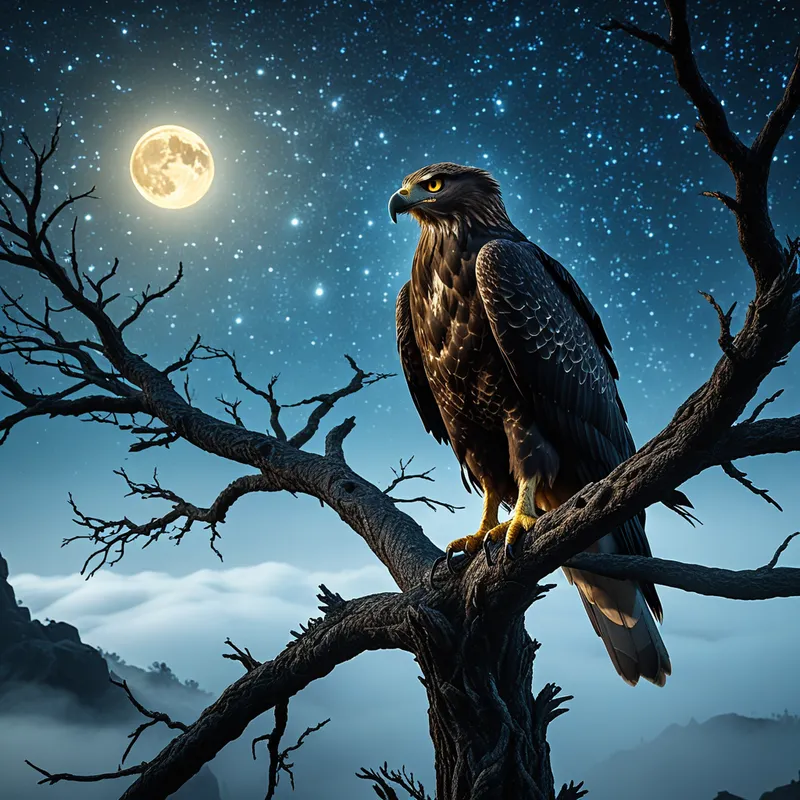
Vedrfölnir Myth Meaning & Symbolism
A hawk perched between the eyes of a cosmic eagle, seeing all that is hidden, atop the world tree that holds the nine realms.
The Tale of Vedrfölnir
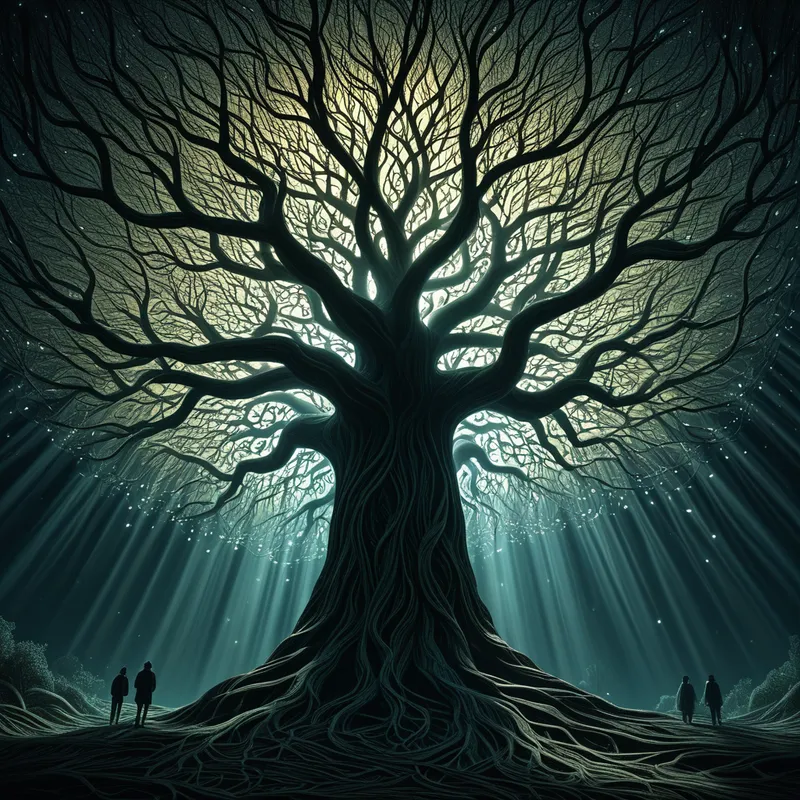
Listen, and let the fire’s crackle become the wind in the highest branches. There is a tree, a pillar of all that is, was, and will be. Its roots drink from wells of memory and fate, its trunk is the axle of the worlds, and its crown is lost in clouds older than the gods. This is Yggdrasil, the Ash, and in its highest boughs, where the air is thin with eternity, sits an eagle. No ordinary bird, but a being of vast and ancient thought, whose wings could blot out the sun.
And between the eyes of this great eagle, perched upon its very brow, is a hawk. They call him Vedrfölnir. He is small against the eagle’s immensity, a sharp-feathered sentinel of stillness. While the eagle gazes upon the broad sweep of the nine realms, Vedrfölnir sees what lies between. He sees the subtle shift of a leaf in Asgard, the secret tear of a giantess in Jotunheim, the silent growth of a root in the darkest deep. His sight is a needle, piercing the veil of mere appearance.
But the tree is not at peace. Coiled around one of its three great roots, gnawing eternally, is the serpent Nidhogg. His scales are the color of buried things, and his venom drips, slow and patient, into the well Urd’s Well. Between them, from the eagle’s high perch to the serpent’s deep coil, runs a squirrel. Ratatoskr is his name, a streak of red malice and gossip. He carries insults downward, hissing the eagle’s scorn into Nidhogg’s ear. He carries venomous threats upward, shrieking the serpent’s hate into the high branches.
And all the while, unmoved by the squirrel’s frenzy, untouched by the serpent’s rage, Vedrfölnir watches. He does not engage. He does not retaliate. His role is not to fight the chaos but to perceive it in its entirety. He is the calm at the storm’s eye, the point of pure awareness upon the head of mighty power. The eagle may shift, the tree may tremble, the worlds may turn toward their destined end, Ragnarok, but the hawk’s gaze remains, a fixed point of witnessing in the turning of the great wheel.
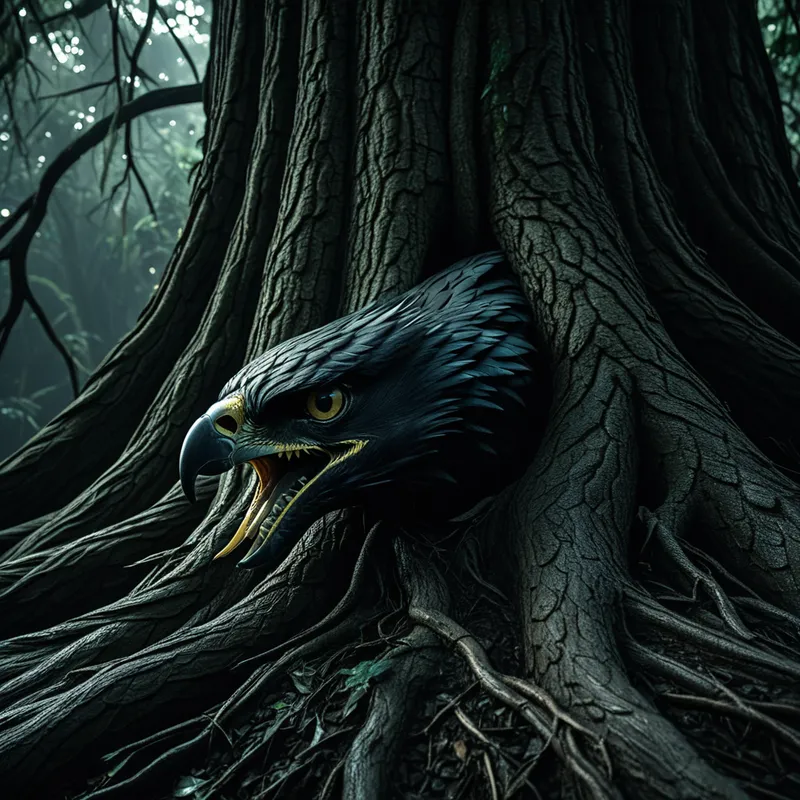
Cultural Origins & Context
The figure of Vedrfölnir is found in the Prose Edda of Snorri Sturluson, a 13th-century preservation of much older oral traditions. Snorri describes the denizens of Yggdrasil in a quasi-encyclopedic manner, yet the image he presents is not one of dry taxonomy, but of a dynamic, interconnected ecosystem of consciousness. This myth was not a standalone tale told in the longhouse for simple entertainment; it was a piece of the cosmic map, a detail in the grand schematic of Norse cosmology.
Its societal function was ontological. It answered, in symbolic terms, profound questions about the nature of reality and perception. In a worldview where the universe was a fragile order besieged by chaotic forces (the gods versus the giants, the eagle versus Nidhogg), Vedrfölnir represented a crucial third principle: detached, panoramic awareness. He modeled a mode of being that was not about brute strength (the eagle) or corrosive hatred (Nidhogg), but about supreme, strategic sight. For a culture of seafarers, warriors, and farmers navigating a harsh and unpredictable world, the value of seeing the whole board—the weather patterns, the hidden currents, the intentions of an enemy—was a matter of survival and sovereignty. Vedrfölnir was the mythic embodiment of that essential, watchful intelligence.
Symbolic Architecture
Vedrfölnir is not merely a bird on a bird. He is a profound symbol of meta-consciousness—the mind’s ability to observe the mind itself. The eagle represents the soaring, dominant aspect of the psyche: the intellect, the will, the conscious ego that surveys the landscape of the self. Vedrfölnir, perched upon this eagle, symbolizes a higher-order awareness that can observe the ego’s movements, its biases, its reactions.
The true seer does not look at the world, but looks from the point that sees the looker.
The squirrel, Ratatoskr, is the critical piece of this symbolic architecture. He represents the internal narrative, the neurotic chatter, the endless loop of grievance and reaction that runs between our lofty aspirations (the eagle) and our deepest, most primal wounds and resentments (Nidhogg gnawing at the roots). This internal messenger amplifies conflict, ensuring the psyche remains in a state of tension. Vedrfölnir’s power lies in his refusal to engage with this messenger. He does not get caught in the story. He simply witnesses the entire circuit—the insult, the threat, the reaction—from a place of serene detachment. He is the symbol of the Self (in the Jungian sense) observing the drama of the ego and the shadow without identification.
The Dreamer’s Resonance
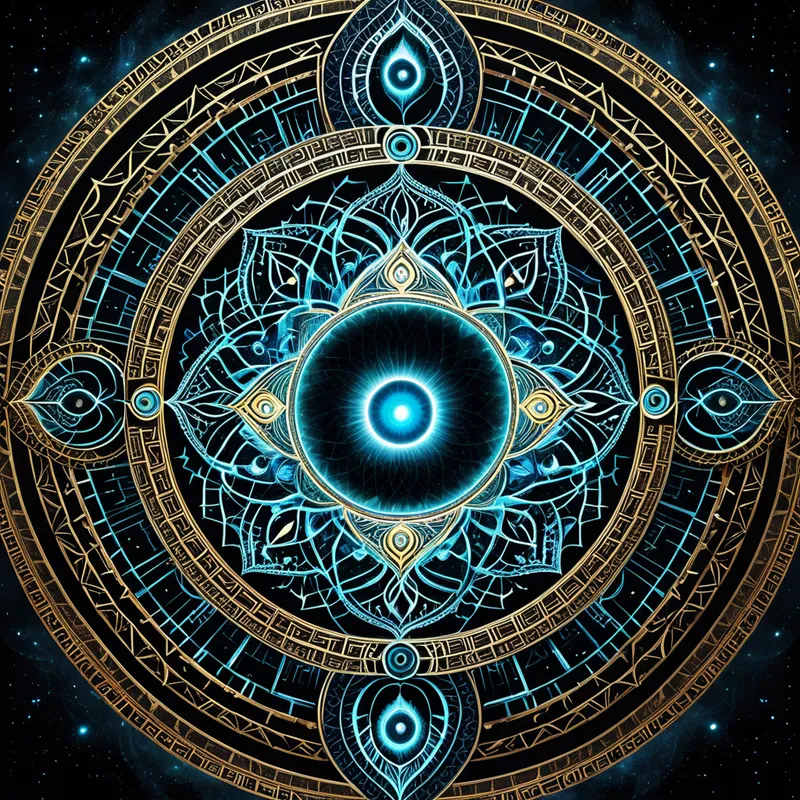
When this mythic pattern stirs in the modern dreamer, it often manifests not as a literal hawk, but as a profound shift in perspective. One might dream of being high above a chaotic city or a tumultuous family scene, looking down with perfect, emotionless clarity. One might dream of a single, unblinking eye in the center of the forehead—a third eye—observing the dreamer’s own dream actions. The somatic sensation is one of sudden stillness and expansion amidst internal turbulence; the cacophony of anxiety, self-criticism, or anger (the squirrel’s chattering) is still present, but it is now held within a vast, silent field of awareness.
Psychologically, this signals the emergence of the observing ego, a crucial developmental step. The dreamer is beginning to differentiate from their thoughts and emotions. They are no longer solely identified with the internal drama between their “eagle” (their ideals and persona) and their “Nidhogg” (their repressed shadow, their gnawing insecurities). The dream of Vedrfölnir marks the moment when the psyche discovers it has a perch outside of its own conflict, a vantage point from which healing and integration become possible.
Alchemical Translation
The alchemical process mirrored here is that of sublimatio—the ascent to a higher, purer state of consciousness—coupled with separatio—the crucial separation of the observer from the observed. The psychic transmutation is not about defeating the shadow (Nidhogg) or inflating the ego (the eagle). It is about achieving the hawk’s perch.
Individuation is not the victory of one part over another, but the establishment of a witness to the entire war.
The modern individual, besieged by the Ratatoskr of digital gossip, internalized criticism, and polarized narratives, is called to cultivate their inner Vedrfölnir. This is the work of meditation, reflection, and active imagination: to consciously withdraw identification from the chattering messenger and ascend to the point of pure seeing. From this vantage, the conflicts that once seemed existential are revealed as parts of a larger, meaningful system. The venom dripping from the roots is seen not as a threat to the self, but as a part of the world tree’s own mysterious process of nourishment and decay. The triumph is not a battle won, but a perspective gained—the hawk’s quiet eye, forever open, seeing the serpent, the squirrel, the eagle, and the vast, beautiful, wounded tree in a single, compassionate glance. This is the alchemical gold: the unified awareness that holds the totality of being.
Associated Symbols
Explore related symbols from the CaleaDream lexicon: