
Vedic Mantras Myth Meaning & Symbolism
The myth of mantras as primordial vibrations heard by sages, forming the fabric of reality and the blueprint for the human soul's journey to wholeness.
The Tale of Vedic Mantras
In the beginning, before the worlds were named, there was only the One—Brahman—resting in the silence of its own infinite potential. This silence was not empty, but pregnant, a boundless ocean of unmanifest possibility. And within that ocean stirred the first impulse, the first desire: “I am One; may I become many.”
From that desire arose a vibration. Not a sound heard by ears, but the primal thrum of existence itself, the spanda. This vibration crystallized into the sacred syllable AUM. As AUM resonated through the void, it differentiated. Its components—A, U, M—unfolded like petals of a cosmic lotus, giving birth to the three fundamental qualities: creation, preservation, and dissolution. The vibration became a hum, the hum became a chant, and the chant became a structured, luminous architecture of sound.
These were the first Mantras. They were not invented, but heard.
In the ages that followed, in the high, thin air of the Himalayas and along the banks of the sacred Saraswati, beings of profound receptivity appeared. They were the Rishis. Their senses were turned not outward, but inward, their consciousness attuned to the subtle strata of reality. In states of deep, wordless meditation (tapas), their inner ears were opened.
They heard the cosmos singing itself into being.
The sound came as a flash of lightning in the mind’s sky—a dṛṣṭi, a “seeing” through sound. It was the roar of Agni consuming the sacrificial offering, the thunderous stride of Indra slaying the chaos-serpent Vritra, the exhilarating sweep of Vayu across the plains. They heard the meters—the Gayatri, the Anushtubh—rising and falling like the breath of the universe itself. Each mantra was a living entity, a sonic form of a deity, a precise frequency that could invoke, placate, or unite with the divine power it encoded.
The conflict was not of armies, but of entropy. The world, born from sound, constantly threatened to fall back into chaos, into silence. The rising action was the eternal ritual. The Rishis, becoming vessels, gave voice to these heard truths. They spoke, chanted, and sang the mantras into the world, their voices becoming the instruments of cosmic maintenance. With each perfectly uttered syllable, they stitched the fabric of Dharma a little tighter, holding chaos at bay, inviting the gods to partake in the sacred exchange of the Yajna.
The resolution was not an end, but a perpetual becoming. The mantras were passed from teacher to disciple, from breath to breath, a river of sound flowing unbroken through time. They became the bedrock of reality, the sonic seeds from which all forms—the gods, the elements, the human mind itself—continually sprout, are sustained, and are ultimately reabsorbed. The myth lives in every utterance, every repetition, a never-ending story where the listener becomes the hearer, and the speaker becomes the source.

Cultural Origins & Context
This mythic narrative is the foundational bedrock of Vedic culture, dating back over three millennia. The term “myth” here is not a falsehood, but the expressed cosmology of a people for whom sound (shabda) was the primary substance of reality. The Vedas themselves—the Rigveda, Samaveda, Yajurveda, and Atharvaveda—are considered apauruṣeya, “not of human origin.” They are the eternal, heard knowledge (śruti), in contrast to later remembered texts (smṛti).
The societal function was total. These were not mere prayers but operative technologies of consciousness and cosmos. The correct pronunciation, intonation (svara), and meter were matters of utmost gravity, preserved with astonishing fidelity through elaborate oral traditions. Brahmins, the priestly class, were the custodians of this sonic science, using it to perform the great public rituals that upheld the cosmic and social order (Dharma). The myth established a sacred epistemology: true knowledge is not constructed by the intellect, but revealed to a consciousness made pure and receptive through discipline (sadhana).
Symbolic Architecture
At its core, the myth presents a universe that is linguistic and vibrational. Reality is a text written in sound. The Rishi represents the purified human consciousness—the inner ear of the soul—that can attune itself to the foundational patterns of existence.
The mantra is the DNA of the cosmos, and the Rishi is the cell that becomes conscious of its own blueprint.
The act of “hearing” (śravaṇa) symbolizes direct, intuitive apprehension, bypassing the analytical mind. The mantra itself is a symbolic microcosm. Its seed syllable (bīja) is the compressed potential. Its body (mantra-sharira) is the structured sequence that unfolds that potential into a specific divine form or power. The deity invoked is not an external figure, but an archetypal force of consciousness—Agni as the transformative power of digestion and insight, Ushas as the awakening of awareness.
Psychologically, the myth maps the process of accessing the deep, ordering structures of the unconscious—the archetypes themselves. The chaotic, unformed potential of the psyche (the silent Brahman) is given form and direction through the emergence of these primordial patterns (the mantras). To “hear” a mantra is to make conscious contact with an archetypal force within.
The Dreamer’s Resonance
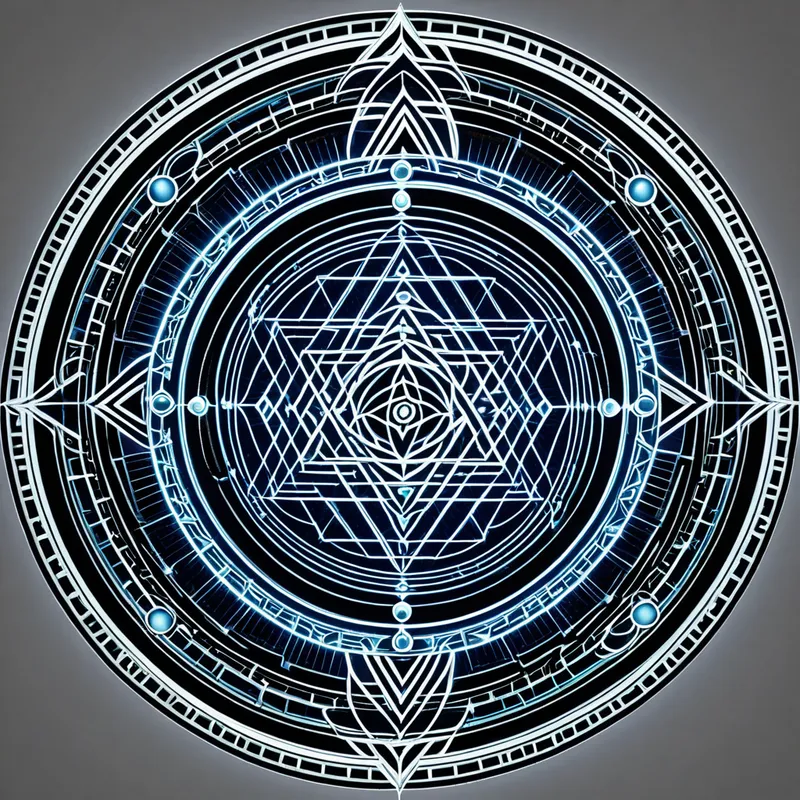
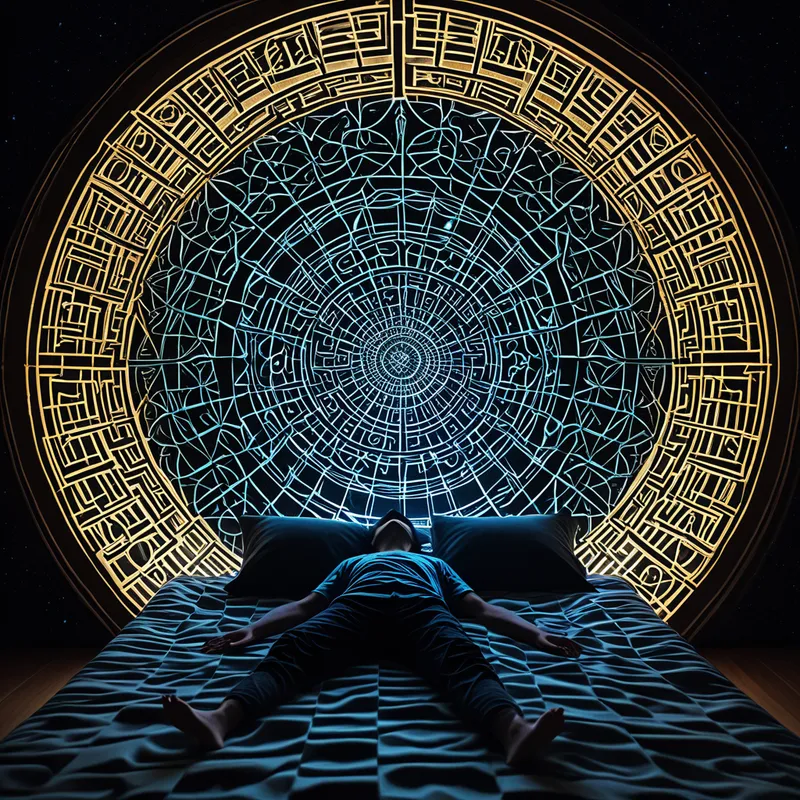
When this mythic pattern stirs in the modern unconscious, it often manifests in dreams of profound sound or resonant structures. One might dream of hearing a bell, a hum, or a chant whose source is unseen, yet which vibrates through the dream body, creating a sense of awe or deep recognition. Alternatively, dreams may feature intricate, glowing geometric patterns (yantras) that are felt to be audible, or of speaking or hearing a word in an unknown language that nonetheless feels utterly significant and powerful.
Somatically, this signals a process of psychic reorganization from a deep, archetypal level. The conscious ego is being “tuned” by a frequency from the Self. It is the psyche’s innate intelligence attempting to transmit a corrective or integrative pattern. The dreamer may be undergoing a period where old, chaotic mental or emotional structures are being dissolved (the pre-creative silence), making way for a new, more authentic ordering principle to emerge (the heard mantra). The experience is often one of being a vessel or a channel for something transpersonal.
Alchemical Translation
The alchemical journey modeled by the Vedic mantra myth is the quintessential process of Individuation—the Self speaking the individual into wholeness.
First, the Nigredo: the aspirant must enter the “silence before the sound.” This is the dark night, the dissolution of egoic certainties, the tapas (austerity) of confronting the undifferentiated unconscious. It is the necessary void.
Then, the Albedo: the moment of reception. In the depth of that silence, a “sound” emerges—not from thought, but as an intuitive knowing, a sudden clarity, a symbolic image or inner word that carries the weight of truth. This is the dṛṣṭi, the flash of the Self. It is the healing idea, the core insight, the personal “mantra” or guiding principle that was always there, waiting to be heard.
The work of the soul is not to create the mantra, but to create the silence in which it can be heard.
Finally, the Rubedo: the incarnation of the sound. The heard truth must be uttered, breathed into life through repeated practice (japa). This is the ritual of daily living. One must align one’s thoughts, speech, and actions with that inner vibration. Through this repetition, the chaotic elements of the personality are gradually re-organized around this central, authentic frequency. The individual becomes a coherent expression of the archetypal pattern they have integrated. They do not become a generic sage, but a unique manifestation of the universal truth they have heard. They become, like the Rishi, a conscious participant in the ongoing creation and sustenance of their own world.
Associated Symbols
Explore related symbols from the CaleaDream lexicon: