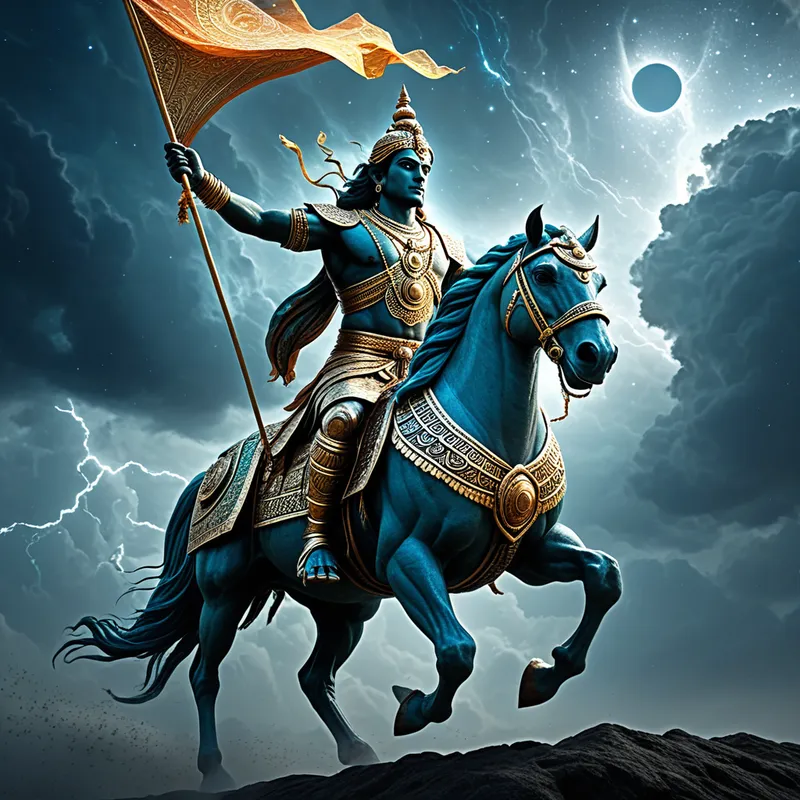
Vayu Myth Meaning & Symbolism
The story of Vayu, the divine wind, whose restless power and sacred breath animate the cosmos and stir the depths of the human soul.
The Tale of Vayu
Listen. Before the world knew stillness, there was the sigh. Before the oceans knew waves, there was the whisper. He was the first motion in the void, the invisible hand that stirs the sleeping cosmos. They called him Vayu, and his essence was the restless spirit of existence itself.
In the celestial realms, where time flows like honey, the great sage Narada wandered. Blessed with knowledge and cursed with a tongue that could unravel destinies, he came upon the three peaks of Meru, piercing the heavens. Its slopes were jeweled, its forests sang with immortal birds, and it stood immovable, the very pillar of creation. Narada, beholding its perfection, felt a question bloom in his heart—a question that sought not an answer, but a test.
He journeyed to the court of Indra, where Vayu, Lord of the Winds, resided. The air in the hall thrummed with Vayu’s presence, a constant, vibrant hum. “O Mighty Vayu,” Narada began, his voice deceptively gentle, “they say your breath gives life to all beings. They say your storms can level forests. But tell me, can your power, so vast and free, even stir the roots of Mount Meru? Or does that mountain stand beyond even your reach?”
A silence fell, thick and heavy. Vayu’s form seemed to sharpen, the gentle breeze in the hall turning keen. The challenge hung in the air, a seed of doubt planted in fertile pride. Without a word, Vayu departed, a gust that shook the pillars of Indra’s hall.
He went to Meru. At first, he was but a zephyr, coaxing the leaves on the celestial trees. Then a breeze, teasing the clouds that wreathed its peaks. Then a gale, howling against the mountainside. Meru did not move. It was, as Narada implied, unmovable. Vayu’s pride curdled into a furious, focused will. He gathered himself, drawing breath from the farthest corners of the universe. He became not a storm, but the Storm—a cyclone of divine intent, a roar that silenced all creation. For one year, he hurled his entire being against the steadfast mountain.
On the peak of Meru sat the great bird-king, Garuda, resting a single feather upon the summit. As Vayu’s fury reached its zenith, Garuda’s feather trembled. A single, downy filament loosened, caught in the maelstrom, and was whisked away into the infinite void.
And in that moment, Vayu ceased. The cosmic wind stilled. He returned to Narada, not in triumph, but in a profound and quiet humility. “You spoke truth, sage,” Vayu said, his voice now the sound of a vast, calm sky. “Meru is immovable. I could not shift it. But I did move a single feather of Garuda, who rests upon it.” Narada smiled, a smile of deep knowing. “Lord of Breath, you have misunderstood. You sought to conquer the unconquerable. But in moving Garuda’s feather, you proved your true nature. You do not move the eternal pillar; you move what rests upon it. You are the animating force of all that lives and travels in this cosmos. You are the breath in the lungs of the world, not its bones.”
From that day, Vayu was honored not merely as a destructive wind, but as Prāṇa, the essential breath of life. His restless power found its true purpose: not to topple the eternal, but to give movement, voice, and life to all that dwells within it.
Cultural Origins & Context
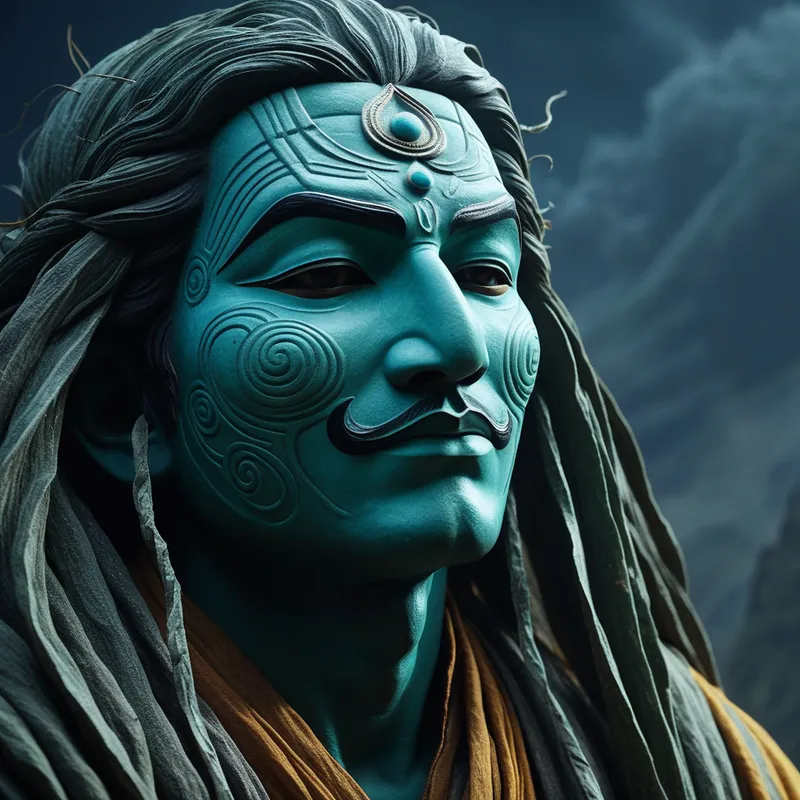
The figure of Vayu is woven into the earliest strands of Hindu thought, appearing in the Vedas as one of the elemental Vasus. He was not initially a deity of elaborate narrative, but a personification of an immediate, sensory, and vital reality: the wind that brings the monsoon rains, the breath in one’s body, the force that carries scent and sound. His myths evolved through the Itihasas and the Puranas, where he gained familial connections—father to the mighty Hanuman and the warrior Bhima.
This story of Vayu and Mount Meru is a classic Puranic narrative, a “teaching tale” told by sages and storytellers. Its function was multifaceted: to explain the nature of a fundamental cosmic principle (wind/breath), to illustrate the hierarchy of divine powers, and to model a philosophical truth. It was a tool for contemplation, teaching that raw power (shakti) must be guided by wisdom (jnana) and self-knowledge to find its rightful and life-giving role in the cosmic order (Dharma). The story curbs the potential arrogance of a primal force, grounding it in a purpose that serves the whole.
Symbolic Architecture
At its core, the myth of Vayu is a profound allegory for the relationship between the dynamic, restless spirit and the static, eternal ground of being. Vayu represents pure potential energy, the animating principle, the psyche’s libido or driving force. Mount Meru symbolizes the immutable Self, the central axis of the personality (the Self), or the foundational structures of reality itself.
The wind does not question the mountain’s existence; it learns what the mountain allows it to become.
Narada, the divine provocateur, embodies the catalytic function of consciousness and inquiry. His question is not malicious, but necessary—it instigates a crisis that leads to differentiation and self-discovery. Vayu’s initial failure and subsequent revelation model a critical psychological process: the inflation of the ego (believing one’s power is absolute) followed by the necessary humiliation that leads to true insight. He discovers he is not the structure, but the energy that moves within and upon the structure. Garuda’s feather is the perfect symbol—it is not the eternal peak, but it is connected to the divine (Garuda is Vishnu’s vehicle). Moving the feather signifies Vayu’s true domain: the realm of life, movement, and transformation, not the realm of immutable absolutes.
The Dreamer’s Resonance
When this myth stirs in the modern unconscious, it may manifest in dreams of relentless winds, of trying and failing to move an immovable object, or of feeling like an invisible force trapped in a confined space. Somatically, this can correlate with experiences of anxiety—a restless, churning energy with no clear outlet—or with breathwork where one confronts the raw, untamed power of their own respiration.
Psychologically, the dreamer is likely grappling with a core frustration: a feeling that their vital energy, their passion, or their will is being blocked by something perceived as monolithic and unmoving. This could be an internal complex (a deep-seated belief, a trauma), an external structure (a job, a relationship pattern, societal expectation), or the sheer weight of existential reality. The dream is presenting the Vayu-archetype in its undifferentiated state—pure, restless force crashing against the Meru of one’s life. The process underway is the difficult but necessary tempering of raw drive into directed purpose, the shift from destructive frustration to animating breath.

Alchemical Translation
The alchemical journey modeled here is the transmutation of undifferentiated power into sacred function. In the process of individuation, we all contain a “Vayu”—a bundle of innate talents, drives, and psychic energy. Initially, this energy is often ego-bound. We may try to use it to conquer our world, to prove our worth by toppling personal “mountains” of difficulty or expectation, often meeting with exhaustion and the humbling realization of our limits.
Individuation begins when we stop trying to move the mountain and start listening for what the mountain needs us to move upon it.
Narada’s question is the call of the Self, provoking this necessary crisis. The year-long storm is the nigredo, the dark night of the soul where one’s efforts seem futile. The realization—moving Garuda’s feather, not the mountain—is the albedo, the illuminating insight. Vayu discovers his true identity as Prāṇa, the vital breath. The alchemical translation for the modern individual is this: your fundamental life force is not meant to dismantle the core structures of your being or the world. Its sacred purpose is to animate. To give breath to your unique voice. To carry the seeds of your creativity. To empower the “vehicles” (like Garuda, a symbol of devotion and soaring insight) that connect you to your higher purpose. The struggle is not to become the unmovable center, but to become the dynamic, life-giving spirit that makes the journey upon that center possible.
Associated Symbols
Explore related symbols from the CaleaDream lexicon: