Varuna's Waters Myth Meaning & Symbolism
The myth of Varuna, the cosmic sovereign who binds the universe with truth and law, and whose primordial waters are the source of all order and chaos.
The Tale of Varuna’s Waters
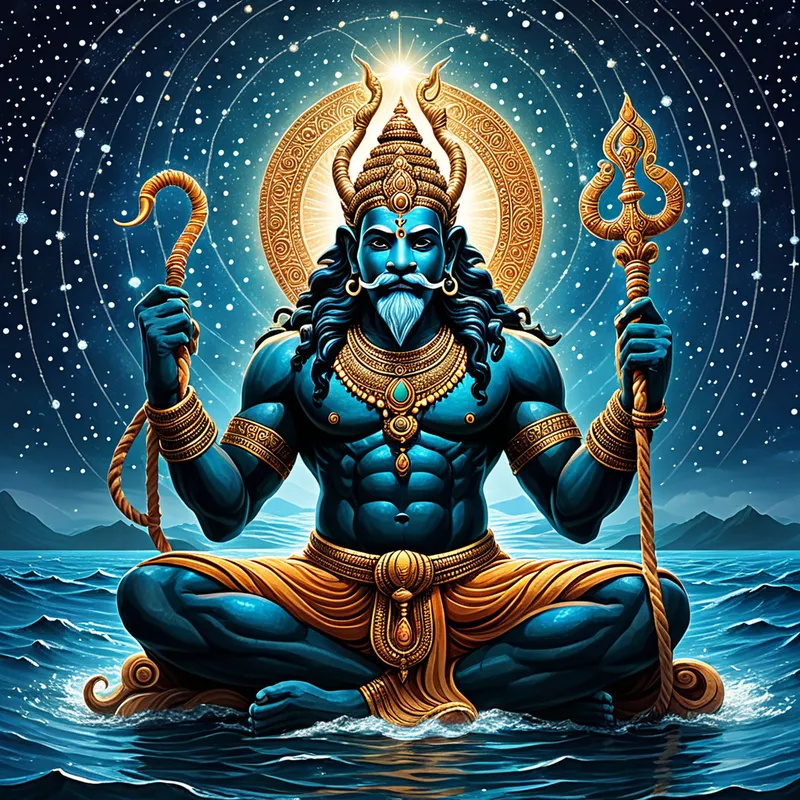
In the beginning, before the names of things were fixed, there was only the Waters. Not the waters of river or sea, but the Waters that are the womb and the tomb, the substance of potential itself. From these dark, limitless, undulating depths, a consciousness arose. He was Varuna. His body was the firmament; his eyes were the sun and moon, seeing all that was, is, and shall be. With him came his twin, Mitra, but where Mitra walked the sunlit paths of men, Varuna remained in the fathomless, star-strewn deep.
He established the world not with a shout, but with a silent, unwavering intention. He poured the Waters into the vessel of Rta, the hidden rhythm that makes the dawn follow the night and the seasons turn in their endless dance. With his hands, he measured the expanse of the sky. With his breath, he set the winds on their courses. And in his grasp, he held the pasha, a noose woven from the threads of cosmic law itself, gentle as moonlight yet unbreakable as destiny.
For a time, the universe hummed with this perfect order. But within the Waters, other potentials stirred. The asuras, forces of chaos and boundless desire, began to churn the depths, seeking to unravel the measured tapestry Varuna had woven. They whispered to the stars to stray from their paths and urged the rivers to flood their banks. The sacred order, Rta, began to tremble.
Varuna did not rage. From his celestial throne, he simply opened his omniscient gaze wider. He saw the hidden falsehood in the heart of a king who broke his oath. He perceived the secret sin of a man who polluted a sacred spring. Each breach of Rta was a knot of darkness in the web of creation. And for each knot, Varuna’s pasha, invisible to mortal eyes, would gently tighten. The offender would be seized not by soldiers, but by a creeping inner dread—enas—a sickness of the soul, a profound spiritual anxiety that constricted the breath and brought the terror of the infinite void into the human heart.
The only cure was to stand before the Waters. The afflicted one, driven by the inner noose, would journey to a riverbank at the hush of dawn. There, they would confess their transgression aloud to the flowing water, to Varuna who heard in every ripple. They would offer hymns, not of flattery, but of terrified awe and longing for the lost state of integrity. “Release us from the upper noose, O Varuna, and from the lower, and from the middle let us loose,” they would plead.
And if the confession was true, if the heart’s alignment with Rta was restored, a miracle would occur. The Waters, agents of Varuna, would become agents of purification. The inner constriction would dissolve. The pasha would fall away, not because Varuna forgave like a mortal, but because the truth itself had re-knit the torn fabric of order. The sinner, now bathed in the Waters of truth, would be reborn into the world, their place in the cosmic whole restored. The Waters that judged were the very same Waters that healed, for in Varuna’s realm, law and liberation were two faces of the same deep, endless sea.

Cultural Origins & Context
The myth of Varuna is not a single story bound in an epic, but a constellation of hymns, rituals, and philosophical fragments preserved in the most ancient layer of Hindu scripture: the Rig Veda. Dating back over three millennia, these verses were composed and meticulously memorized by rishis who perceived the cosmos as a sacred, interconnected organism.
Varuna was the sovereign of this early Vedic worldview. His cult was not one of communal temple worship, but of profound individual and royal responsibility. Kings swore oaths by Varuna, understanding that their rule was a microcosm of his cosmic sovereignty; to rule unjustly was to invite the divine noose. The myth functioned as the psychological and ethical bedrock of society. It taught that the universe was not morally neutral, but structured by an inherent truth (Satya aligned with Rta). Transgression did not merely break a human law; it caused a metaphysical dislocation, a sickness that only truth-telling before the symbolic infinity of the Waters could cure. The myth was passed down not just as lore, but as a lived technology for maintaining psychic and cosmic equilibrium.
Symbolic Architecture
Varuna’s Waters represent the primordial, undifferentiated unconscious—the source of all life and the repository of all that is hidden. They are not merely physical water, but the substance of the soul itself, vast, dark, and pregnant with potential forms.
The unconscious is not a chaotic dump of repressed memories, but a cosmic ocean governed by its own profound and impersonal laws.
Varuna himself symbolizes the ordering principle within that unconscious. He is the archetypal Superego in its most primordial, non-personal form. He is not a punishing father, but the very instinct for wholeness and integrity. His pasha is the psychological law of consequence: the guilt, anxiety, and somatic tension that arise when we live a lie or act against our deepest nature (our personal Rta). The myth beautifully conflates the inner and outer worlds; the “sin” is a deviation from one’s own truth, and the resulting “disease” is a spiritual-psychic dis-ease.
The ritual confession by the water is the critical act of symbolic integration. By voicing the hidden fault to the symbol of the unconscious (the Waters), the conscious ego re-aligns itself with the deeper, ordering Self (Varuna). The Waters that receive the confession are the same that grant purification, illustrating that the unconscious is both the source of our conflict and the wellspring of our healing.
The Dreamer’s Resonance
When the pattern of Varuna’s Waters stirs in the modern dreamer, it often manifests as dreams of profound, impersonal scrutiny or encounters with vast, deep water.
You may dream of being observed by a distant, star-like eye from the sky or the deep sea, feeling a quiet, non-judgmental but inescapable gaze upon your life. You may find yourself on the shore of an endless, moonlit ocean, feeling both dwarfed and called. Alternatively, you may dream of being subtly entangled—not by chains, but by threads of light, spiderwebs, or intricate nets—that restrict you without a visible captor. These are somatic metaphors for the pasha of enas, the binding power of an unacknowledged truth, a broken promise to the self, or a life lived out of alignment.
The psychological process underway is one of ethical confrontation at a soul level. The ego is being summoned by the deeper Self to account for a divergence. The dread in the dream is not punishment, but the pressure of a truth seeking to surface. The dream is an invitation to the riverbank, to perform the ancient ritual: to acknowledge what has been hidden, to speak the unspeakable to the depths of your own being, and to seek re-integration.

Alchemical Translation
The alchemical journey modeled by Varuna’s myth is the transmutation of shadow into sovereignty. It is the path from being bound by unconscious complexes to becoming a conscious ruler of one’s own inner kingdom.
The initial state is Nigredo, the blackening: the experience of the pasha, the anxiety, depression, or somatic illness that signals a life out of sync. This is the “sin” against the Self. The hero’s task is not to slay a dragon, but to submit to the terrifying gaze of Varuna—to turn one’s own consciousness inward and behold the misalignment without flinching.
Individuation begins not with self-aggrandizement, but with the humble, terrifying confession of one’s own falsehood to the vast, listening silence within.
The confession by the Waters is the Albedo, the whitening: the purifying act of brutal self-honesty. This is the dissolution of the ego’s defenses in the waters of truth. It is a psychic death, a surrender of the fabricated persona.
The resolution, where the Waters heal, is the Rubedo, the reddening: the emergence of a new, more authentic consciousness. The released individual is not “forgiven” by an external god, but reconstituted by the act of integration. The inner Varuna—the principle of cosmic order—is no longer a remote, threatening sovereign, but the very foundation of the individual’s being. One becomes, in a sense, a localized expression of Rta. The waters of the unconscious, once a source of terror, are now recognized as the sacred medium of law and liberation, the deep, nourishing ground of a life lived in truth. The noose falls away because you have willingly bound yourself to what is real.
Associated Symbols
Explore related symbols from the CaleaDream lexicon: