Varuna Myth Meaning & Symbolism
The story of Varuna, the primordial sovereign of cosmic law and the boundless waters, whose decline reveals the psyche's journey from outer order to inner truth.
The Tale of Varuna
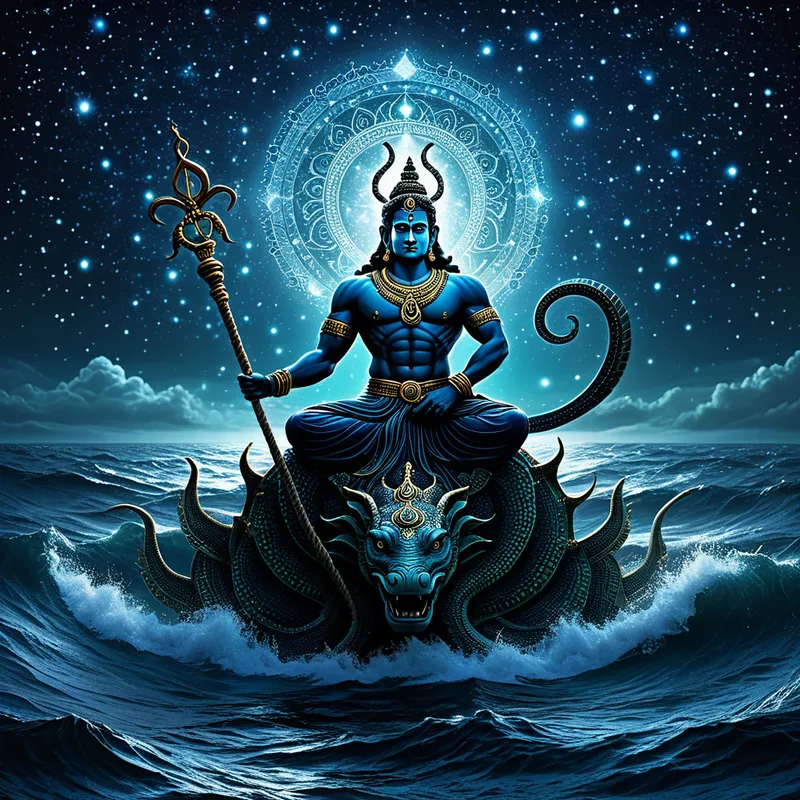
Listen. Before the world knew the names of a thousand gods, there was the Sky and the Sea, and they were one. His name was Varuna. He was the first sovereign, the one who wore the vault of heaven as his crown and the abyssal waters as his robe. His throne was the horizon, that thin, burning line where light drowns in dark. His breath was the wind that filled the sails of the sun, his gaze the unblinking stars that watched all things.
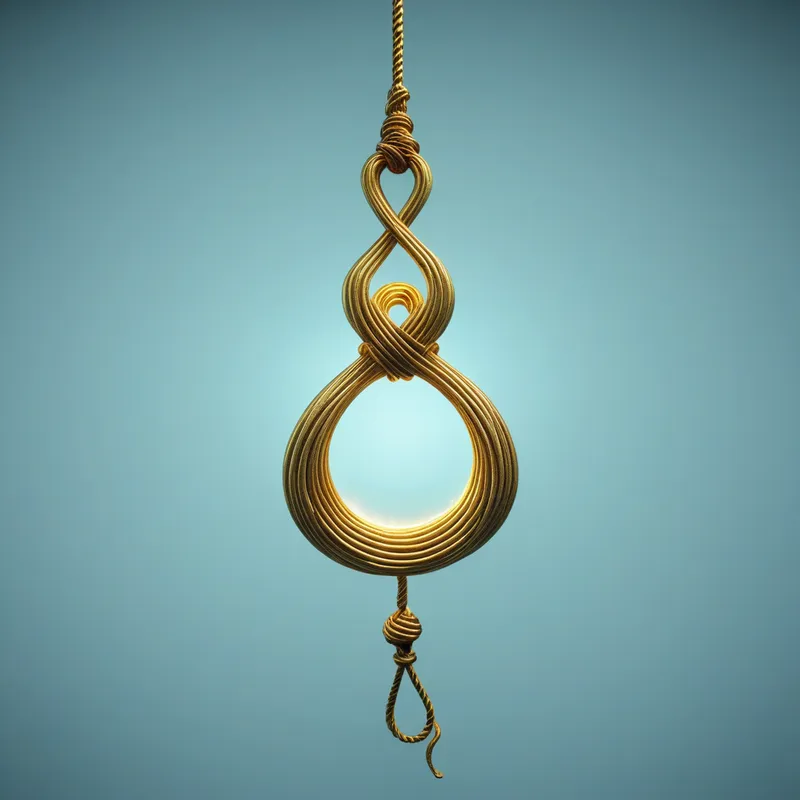
In that dawn-time, Varuna and his brother Mitra stood as twin pillars of the world. Mitra held the inner law, the covenant of the hearth and the tribe. But Varuna held the outer law, the vast, impersonal Rta that bound the cosmos. He ensured the rivers ran to the sea, the sun did not falter in its path, and the seasons turned in their eternal wheel. His weapon was not a thunderbolt, but a noose—a loop of stars and shadows called the Pasha. It was the bond of truth itself, which could gently guide or tightly ensnare those who broke the sacred order.
He saw everything. From his palace in the western depths, where the sun went to sleep, his spies were the sunbeams and the moonrays. His messengers were the whispering winds. No secret thought, no hidden deed in the heart of a human or a god could escape his notice. To lie was to feel the subtle tightening of the celestial noose around one’s spirit, a sickness in the soul that only confession to Varuna could loosen.
But epochs turn. A new fire began to burn in the east, a fierce, blazing energy named Agni. And a younger, more vigorous god, Indra, the wielder of the thunderbolt, rose with a warrior’s roar. Indra fought the dragon of chaos, Vritra</abbr], and claimed the waters for the world of men. The people’s prayers, once drifting westward to the contemplative, all-seeing Varuna, now turned eastward to the triumphant, life-giving Indra.
And so, the first sovereign receded. Not in defeat, but in a profound withdrawal. His explicit kingship over the waking world faded. His throne on the horizon dissolved. He did not die; he descended. He returned to his primordial essence—the boundless, dark, silent waters. He became the king of the unseen, the lord of the depths, both of the ocean and of the soul. His explicit rule became an implicit presence. The starry noose remained, but now it was woven into the fabric of fate itself, and his all-seeing eye became the eye of the conscience, watching from within the deep, dark well of the unconscious.

Cultural Origins & Context
The myth of Varuna is not a single story with a plot, but a theological and poetic evolution captured in the oldest layers of Hindu thought: the Rig Veda. Here, he is among the most supreme of the Adityas. His myth was not told by bards around a fire for mere entertainment, but chanted by rishis during solemn rituals to uphold cosmic order (Rta).
His societal function was foundational. He was the divine archetype of the sovereign who rules not by force, but by moral law and omniscience. He modeled the ideal of kingship based on truth (Satya) and order. As this model shifted with changing social structures—from priestly contemplation to warrior-kingship—Varuna’s narrative arc reflects that historical transition. He was gradually absorbed, his attributes distributed: his sovereignty to Indra and later Vishnu, his judicial aspects to Yama, and his connection to waters to Samudra and others. He became a memory of a more abstract, less personal, and profoundly deep form of divinity.
Symbolic Architecture
Varuna represents the archetype of the primordial Rta—the impersonal, all-encompassing pattern that precedes and undergirds the personal gods. He is the psychic equivalent of the Self in its most majestic, transpersonal form, the inner ruler who establishes order from chaos.
He is the consciousness that knows itself as part of a vast, interconnected web, where every action creates a ripple in the fabric of being.
His domain is the cosmic waters, the symbol par excellence of the unconscious—the source of all life and the repository of all that is hidden. His all-seeing eye is the eye of the Self, the objective psyche that witnesses our every evasion and self-deception. The Pasha, his noose, is the inescapable law of cause and effect, of psychological consequence. It is not punishment, but the natural tightening that occurs when we live out of alignment with our own deepest truth.
His “decline” is perhaps the most potent symbol. It does not signify irrelevance, but internalization. The order he once imposed from the outside (as a sky god) now governs from the inside (as a god of the depths). This mirrors the psychological movement from being ruled by external dogma, parental authority, or societal “shoulds,” to being guided by an internalized moral and ethical compass—the voice of conscience that arises from engagement with the deep Self.
The Dreamer’s Resonance
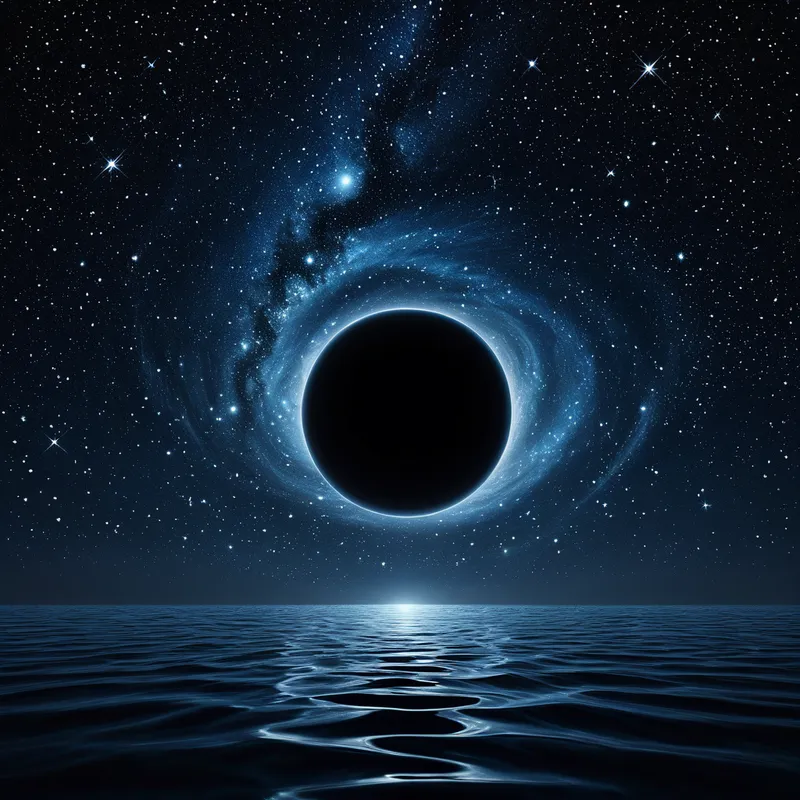
When the pattern of Varuna stirs in the modern psyche, it often manifests in dreams of vast, awe-inspiring, and sometimes terrifying waters: endless oceans, deep lakes, or star-filled night skies that feel conscious and watching. One may dream of being bound by invisible threads or feeling a profound, guiltless accountability to an unseen presence.
Somatically, this can feel like a pressure in the chest or a tightening in the gut—not the sharp anxiety of fear, but the heavy, solemn weight of truth. Psychologically, it signals a confrontation with the personal shadow—not the petty faults, but the deeper breaches of one’s own inner law. It is the psyche’s preparation for a ritual of self-honesty. The dream is the court of Varuna, and the dreamer is both the accused and the witness. The process underway is the soul’s demand for integrity, for bringing hidden things—shames, unacknowledged talents, repressed truths—to the surface of awareness to be “confessed” and integrated.
Alchemical Translation
The alchemical journey modeled by Varuna is the transmutation of the ego from a subject under law to a vessel of law. It is the shift from a life governed by external validation and fear of social consequence (the outer sovereign) to a life anchored in inner truth and authentic expression (the inner sovereign).
The first stage is Awareness of the Noose—feeling the constriction of living a lie, a false persona, or a life out of sync with one’s values. This suffering is the Pasha doing its work, not to punish, but to orient.
The second is the Descent into the Waters—the voluntary engagement with the unconscious. This is Varuna’s retreat to the depths. It requires turning away from the bright, noisy world of Indra-like achievement and diving into meditation, therapy, art, or solitude to listen to the deeper currents.
The alchemical fire is not the blaze of conquest, but the cold, dark pressure of the deep, which forces the soul’s hidden contents to crystallize into conscious truth.
The final transmutation is Becoming the Vessel. The ego does not become the king; it becomes the throne for the king. It becomes the conscious vehicle through which the impersonal order (Rta) of the Self can flow into the personal world. One does not command the waters; one learns to navigate them with integrity. The all-seeing eye is no longer experienced as a judgmental gaze from above, but as a unifying awareness from within. The ruler archetype is integrated: one rules one’s own inner kingdom with the wisdom, justice, and profound connection to the cosmic whole that Varuna first embodied. The myth ends not with his death, but with his silent, omnipresent reign in the depths of everything—which is where true sovereignty begins.
Associated Symbols
Explore related symbols from the CaleaDream lexicon: