Vamana Myth Meaning & Symbolism
A dwarf deity asks a demon king for three paces of land, then expands to cosmic size to reclaim the universe, restoring balance through a sacred promise.
The Tale of Vamana
Hear now of a time when the worlds trembled, not under the fist of a tyrant, but beneath the gentle footfall of a dwarf.
The cosmos had lost its rhythm. The great asura king, Bali, through fierce austerity and virtue, had achieved the impossible. He had brought the three worlds—Swarga, Bhūmi, and the nether regions—under one sovereign rule. His court glittered with a righteousness that outshone the sun itself. Yet, in this perfect order, a profound imbalance festered. The Devas, displaced from their heavenly abode, wandered like ghosts, their light dimming. The axis of Dharma was bent, for even a virtuous usurpation is still a usurpation.
In the timeless depths of the cosmic ocean, upon the coils of the great serpent [Shesha](/myths/shesha “Myth from Hindu culture.”/), the preserver stirred. [Vishnu](/myths/vishnu “Myth from Hindu culture.”/) perceived the discord. But how to unseat a king who was not evil, but merely too grand? Not through thunderbolt or trident, but through a sacred, unbreakable law: [the law](/myths/the-law “Myth from Biblical culture.”/) of the gift.
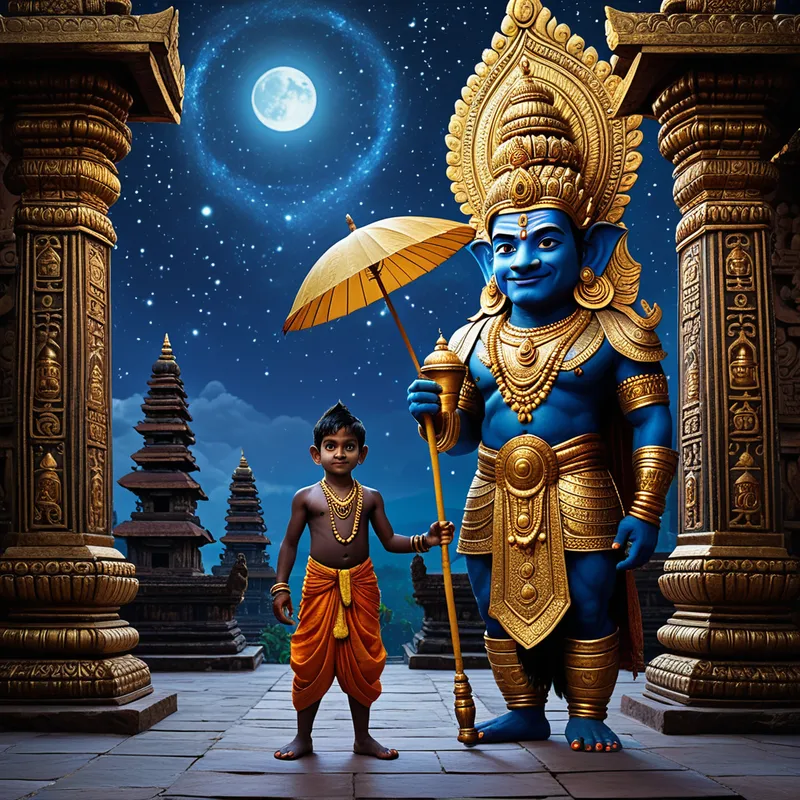
Thus, Vishnu took form in [the womb](/myths/the-womb “Myth from Various culture.”/) of Aditi. He was born not as a warrior, but as a Brahmachari, a dwarf Brahmin boy. He was Vamana. His body was small, dark, and unassuming, clad in deerskin, holding a wooden [water](/myths/water “Myth from Chinese culture.”/) pot and a simple umbrella of leaves. His eyes, however, held the patience of eternity.
He walked into the midst of King Bali’s great sacrifice, a ceremony so potent it threatened to grant the asura king dominion over all that remained. The air was thick with the smoke of clarified butter and the chant of a thousand priests. Bali, in his golden generosity, saw the humble Brahmin and welcomed him. “Ask of me anything,” he proclaimed, his voice echoing his boundless virtue. His preceptor, the wise Shukracharya, sensed the deception and warned, but a king’s word, once given, is iron.
Vamana smiled, a small, quiet curve of the lips. “Great king,” he said, his voice soft yet clear, “I ask only for that which can be covered by three paces of my feet.”
A ripple of laughter, then relief, went through the court. Such a modest request from such a mighty giver! Bali, with a magnanimous heart, agreed. He lifted the golden vessel of water to seal the gift.
As the first drop of sanctifying water fell upon Vamana’s palm, the universe inhaled.
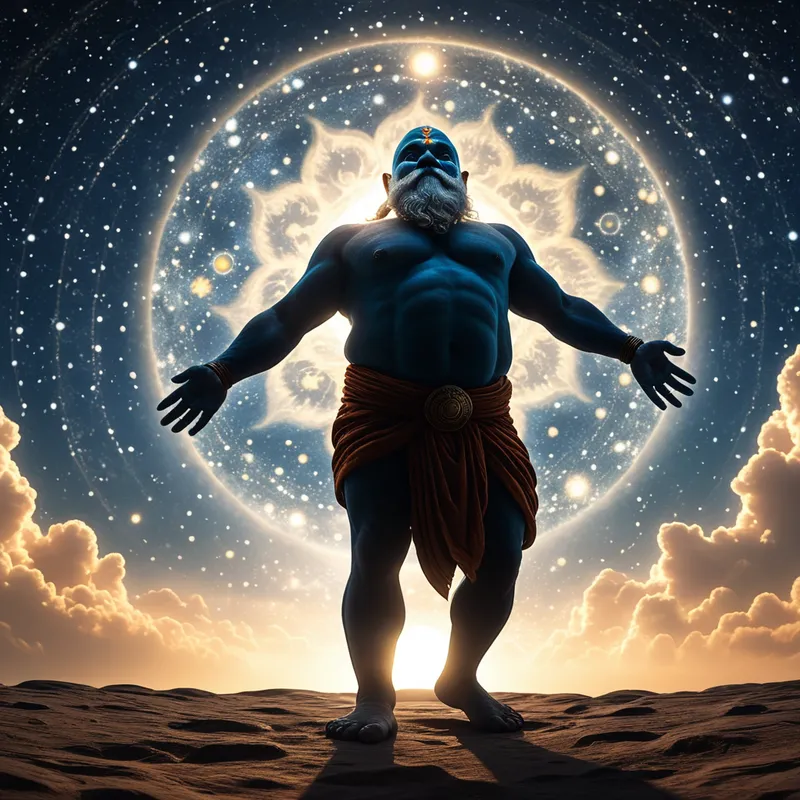
The dwarf began to grow. He expanded, upward and outward, filling the sacrificial hall, then [the sky](/myths/the-sky “Myth from Persian culture.”/), then the spaces between the stars. The simple Brahmachari transformed into a form of terrifying, sublime vastness: Trivikrama, “He of the Three Strides.” His first step covered the entire earthly realm. His second step encompassed the heavens, the stars, and all of Swarga. The cosmos lay measured beneath his two strides. He turned his galactic gaze upon Bali, who stood in awe, not fear, for his virtue remained unbroken. “Oh king of great promise, where shall I place my third step? You have given me all of creation, and I have taken it. But my measure is not yet full.”
Bali, in that ultimate moment of reckoning, bowed his head. He offered that which he had left: himself. He offered his own head as the resting place for the third pace. And the cosmic giant, the preserver of all, gently placed his foot upon the head of the demon king, not to crush, but to subdue. Bali was sent to the netherworld, [Patala](/myths/patala “Myth from Hindu culture.”/), to rule there as an immortal sovereign, his virtue intact, the cosmos restored to its rightful order. The Devas reclaimed their heaven, and Dharma stood upright once more, balanced on three sacred footprints.
Cultural Origins & Context
The myth of Vamana is woven into the earliest cosmological layers of Hindu thought, primarily found in the Brahmanas and later elaborated with profound devotional and philosophical depth in the Puranas, such as the Bhagavata Purana. It functions as a critical narrative hinge. It marks the transition from the cosmic cycles of the Satya, Treta, and Dvapara [Yugas](/myths/yugas “Myth from Hindu culture.”/) into the current, complex age of the [Kali Yuga](/myths/kali-yuga “Myth from Hindu culture.”/).
The story was not merely told; it was performed. It was recited by Sūtas and Sannyasis during sacrifices and festivals. Its societal function was multifaceted: it was a theological assertion of Vishnu’s supremacy as the inner controller of even the most righteous worldly power; a political allegory about the limits of kingly authority and the sacredness of the Brahminical gift; and a moral lesson on the dangers of inflation, even by virtuous means. It reinforced the idea that true cosmic order (Rta/Dharma) is not merely human morality scaled up, but a delicate balance maintained by a principle that transcends both gods and demons.
Symbolic Architecture
At its [heart](/symbols/heart “Symbol: The heart symbolizes love, emotion, and the core of one’s existence, representing deep connections with others and self.”/), Vamana is the myth of the container and the contained. The [dwarf](/symbols/dwarf “Symbol: A dwarf often represents hidden potential, undervalued wisdom, or primal instincts. It can symbolize something small but powerful or foundational aspects of the self.”/) is the ultimate [symbol](/symbols/symbol “Symbol: A symbol can represent an idea, concept, or belief, serving as a powerful tool for communication and understanding.”/) of humility, limitation, and the specific, measured request. He represents the [vessel](/symbols/vessel “Symbol: A container or structure that holds, transports, or protects something essential, representing the self, emotions, or life journey.”/)—seemingly small, defined, and humble. The cosmic giant Trivikrama is the content—the infinite, the unbounded, the totality that cannot be contained by any worldly form.
The ego is the dwarf that believes it owns the land; the Self is the giant for whom the entire cosmos is but three steps.
Bali symbolizes the virtuous, capable, and expansive ego. He is not a [villain](/symbols/villain “Symbol: A character representing opposition, moral corruption, or suppressed aspects of self, often embodying fears, conflicts, or societal threats.”/), but a successful ruler whose very success has become a [problem](/symbols/problem “Symbol: Dreams featuring a ‘problem’ often symbolize internal conflicts or challenging situations that require resolution and self-reflection.”/). He has internalized [the world](/myths/the-world “Myth from Tarot culture.”/), believing his righteous rule is the cosmic order. His gift of “three paces” is [the ego](/myths/the-ego “Myth from Jungian culture.”/)‘s [agreement](/symbols/agreement “Symbol: A harmonious arrangement in artistic collaboration, symbolizing unity, shared vision, and creative consensus.”/) to a contract it does not understand, a naive belief that it can accommodate the transcendent within its own terms. The myth dramatizes the shocking, inevitable [moment](/symbols/moment “Symbol: The symbol of a ‘moment’ embodies the significance of transient experiences that encapsulate emotional depth or pivotal transformations in life.”/) when the transcendent [reality](/symbols/reality “Symbol: Reality signifies the state of existence and perception, often reflecting one’s understanding of truth and life experiences.”/) ([the Self](/myths/the-self “Myth from Jungian culture.”/)) reveals its true scale, and [the ego](/myths/the-ego “Myth from Jungian culture.”/)’s entire domain is re-contextualized, swallowed by a greater [truth](/symbols/truth “Symbol: Truth represents authenticity, honesty, and the quest for knowledge beyond mere appearances.”/).
The three steps themselves are a profound [mandala](/symbols/mandala “Symbol: A sacred geometric circle representing wholeness, the cosmos, and the journey toward spiritual integration.”/). They often correspond to the three worlds ([earth](/symbols/earth “Symbol: The symbol of Earth often represents grounding, stability, and the physical realm, embodying a connection to nature and the innate support it provides.”/), [atmosphere](/symbols/atmosphere “Symbol: Atmosphere can signify the emotional and sensory environment surrounding an experience or situation.”/), [heaven](/symbols/heaven “Symbol: A symbolic journey toward ultimate fulfillment, spiritual transcendence, or connection with the divine, often representing life’s highest aspirations.”/)), the three states of [consciousness](/symbols/consciousness “Symbol: Consciousness represents the state of awareness and perception, encompassing thoughts, feelings, and experiences.”/) (waking, dreaming, deep sleep), and the three measures of [the sacred fire](/myths/the-sacred-fire “Myth from Native American culture.”/) in Vedic [ritual](/symbols/ritual “Symbol: Rituals signify structured, meaningful actions carried out regularly, reflecting cultural beliefs and emotional needs.”/). They map the process of the infinite manifesting within and then surpassing the finite structures of reality.
The Dreamer’s Resonance
When this myth stirs in the modern [psyche](/myths/psyche “Myth from Greek culture.”/), it rarely appears as a literal dwarf or giant. Instead, one may dream of signing a contract for a small, manageable project that suddenly expands into an all-consuming, life-altering endeavor. Or of a tiny, overlooked detail in a room—a crack in the wall, a humble pot—that begins to glow and unravel the entire structure of the dream-world.
Somatically, this can feel like a sudden, awe-filled expansion in the chest, a vertigo of perspective, or the grounding solidity of a final, accepting bow. Psychologically, it signals a process where a conscious attitude or achievement (the “Bali complex”—perhaps a hard-won career success, a carefully constructed identity, or a moral high ground) is being confronted by a deeper, transpersonal truth. The dreamer is at the point of offering their “head”—their seat of identity and control—to a force that will not destroy them, but will irrevocably re-locate their center of gravity from the personal ego to a broader, more cosmic alignment.

Alchemical Translation
The alchemy of Vamana is the transmutation of inflation into humility, and humility into cosmic sovereignty. It models the individuation process where the ego must consent to its own dethronement for the Self to emerge.
[The first stage](/myths/the-first-stage “Myth from Alchemical culture.”/) is the appearance of the dwarf: the humble, often embarrassing, symptom, limitation, or “small request” from the unconscious. This is the neurosis, the recurring failure, the simple dream image that seems too trivial to matter. The ego, in its “Bali” mode of virtuous control, agrees to entertain it (“I’ll give that a little space”). This is the [nigredo](/myths/nigredo “Myth from Alchemical culture.”/), the blackening, where the ego’s golden certainty is confronted by a dark, small, unknown element.
The second stage is the expansion: the humble content swells, breaking all containers. In analysis, this is when a simple association unlocks a torrent of memory, affect, or archetypal imagery. The ego’s world is flooded. This is the albedo, the whitening, a blinding revelation of scale.
The third step is not a step at all, but a station. It is the ego’s conscious offering of its own authority as the ground for the transcendent. This is the rubedo, the reddening, where sacrifice becomes sovereignty.
For the modern individual, this translates to a profound inner shift. One must learn to honor the “dwarf”—the small, specific, humble truth, feeling, or need one would rather ignore. One must then have the courage to let that small truth define its own scale, even if it rewrites the map of one’s entire life. Finally, one must offer one’s former identity—the “king” of one’s personal narrative—as a foundation for a new, vaster consciousness. The result is not annihilation, but a graceful subordination. Like Bali, we are not destroyed; we are given a new domain—[the underworld](/myths/the-underworld “Myth from Greek culture.”/) of the psyche, the rich realm of the unconscious—to rule in harmony with the celestial order above. We become stewards of our own depths, having been measured and found whole by the three steps of the Self.
Associated Symbols
Explore related symbols from the CaleaDream lexicon: