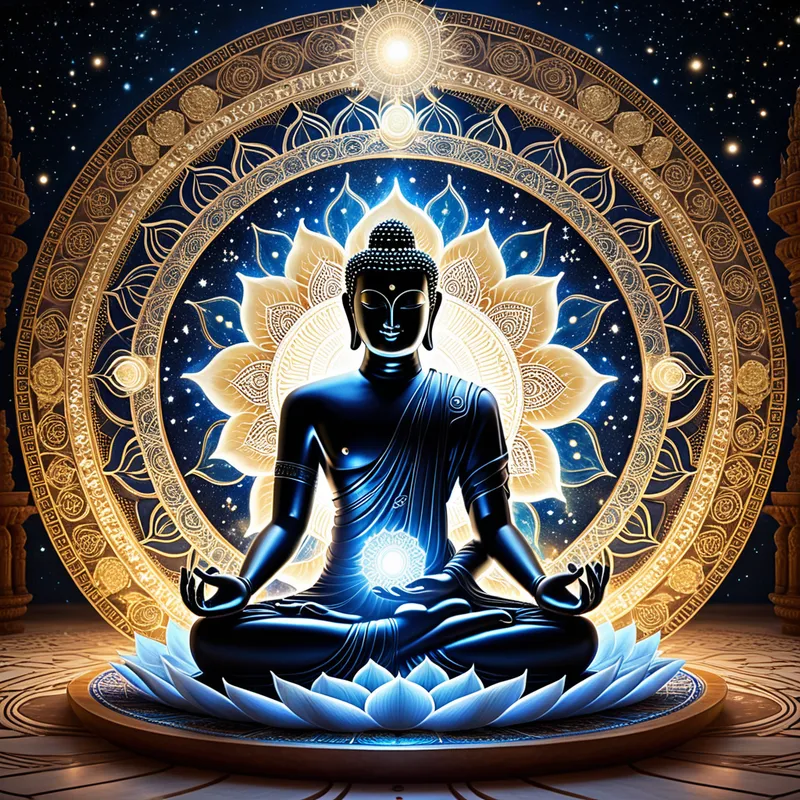
Vairocana Myth Meaning & Symbolism
The myth of the cosmic Buddha Vairocana, the embodiment of ultimate reality and the illuminating sun at the center of all existence and consciousness.
The Tale of Vairocana
In the beginning, before the first thought stirred in the heart of the void, there was a silence so profound it was a sound. From within that pregnant stillness, a vibration arose—not a noise, but a pure, intentionless resonance. It was the syllable A, the uncreated source of all phonemes, humming in the dark.
And from that hum, light was born. Not the light that casts shadows, but the light that is existence itself. It coalesced, not into a form, but into a presence: Vairocana, the Illuminator. He did not appear in a place, for he became the place—the adamantine, immutable center of the Dharma-dhātu, the realm of reality. His body was not flesh, but the essence of space, white as a conch shell, clear as a mountain crystal, radiant as a hundred thousand suns rising at once.
Around this luminous nucleus, the cosmos crystallized. His wisdom manifested as four perfect directions, and from his heart-mind sprang forth four other Dhyani Buddhas: Akshobhya, Ratnasambhava, Amitabha, and Amoghasiddhi. They were not separate from him, but were his own qualities—mirror-like wisdom, equanimity, discriminating awareness, and all-accomplishing action—projected into the mandala of being. Together, they formed the Pañcatathāgata, a silent, radiant council at the heart of all things.
The conflict was not one of battle, but of obscuration. The world of sentient beings, in its ignorance, spun in endless cycles of Samsara, mistaking the play of shadows on the cave wall for the sun itself. The drama was the great forgetting. Beings turned away from the central sun, captivated by their own reflections, by desire, aversion, and delusion. They built palaces of thought upon the shifting sands of illusion, never sensing the adamantine ground beneath.
The rising action was the turning of the wheel. From Vairocana’s boundless compassion, a teaching emerged that required no words. It was the teaching of thusness, of Tathatā. He manifested in countless realms, to countless beings, not as a preacher, but as the very environment of awakening. In the Avataṃsaka Sūtra, he is the universe itself—every atom containing infinite worlds, every world containing the entire cosmos, all interpenetrating without obstruction, a net of Indra made of light, each jewel reflecting all others. To perceive Vairocana was to perceive the radical, non-dual intimacy of all existence.
The resolution is eternal and ever-present. It is the moment a practitioner, through profound contemplation or the grace of a master, glimpses the architecture of reality. They see that their own mind, in its purest, most luminous state, is not separate from the mind of Vairocana. The seeker and the sought merge. The outer sun and the inner light become one. The cosmos is not a prison, but his majestic, teaching body. The resolution is not an end, but a homecoming to the source that was never left, an awakening to the sunlight that has been shining all along, at the very core of consciousness.
Cultural Origins & Context
The figure of Vairocana emerged from the fertile philosophical ground of Mahayana Buddhism, around the early centuries of the Common Era, finding his most elaborate expressions in texts like the Avataṃsaka Sūtra and the Mahāvairocana Tantra. He represents a profound theological evolution: the move from the historical Buddha, Śākyamuni, to the concept of a cosmic, timeless Buddha-nature that pervades all reality. This was not a replacement, but an expansion—Śākyamuni became a nirmanakaya, a manifestation in time, of the eternal dharmakaya, the truth-body, which is Vairocana.
This myth was primarily transmitted and elaborated within the esoteric traditions of Vajrayana, particularly in East Asia (as Dainichi Nyorai) and Tibet. It was not a folktale for the masses but a sophisticated map of reality for initiates. Masters, or Lamas, would transmit the teachings of Vairocana orally and through complex mandalas, like the magnificent Garbhadhātu and Vajradhātu mandalas. Its societal function was soteriological and unifying. It provided a cosmological framework that placed the practitioner at the center of a universe that was inherently sacred and structured by wisdom, offering a path to realize one’s own Buddha-nature by aligning with the very architecture of enlightenment.
Symbolic Architecture
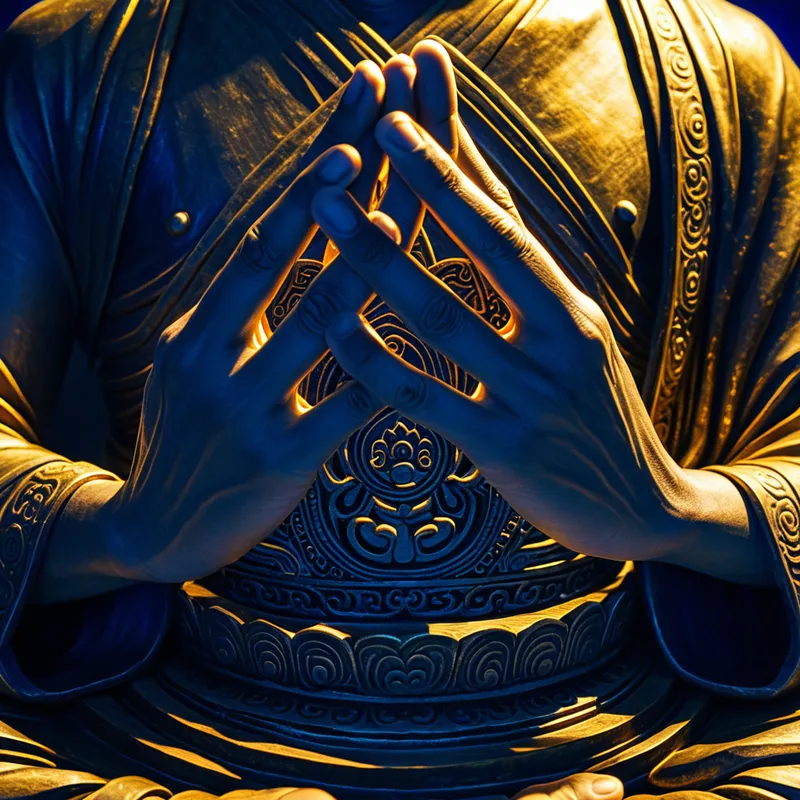
Vairocana is the ultimate symbol of the ground of being. He is not a god who creates the world ex nihilo, but the luminous principle from which all phenomena and their true nature co-arise. His white color symbolizes the pure, undifferentiated potentiality that contains all colors, all qualities. His common mudra, the Dharmachakra-pravartana, represents the perpetual turning of the wheel of Dharma, the endless teaching of reality-as-it-is.
He is the sun that does not move, around which the planets of our perceptions orbit. To find him is not to travel outward, but to collapse inward to the still point.
Psychologically, Vairocana represents the Self in the Jungian sense—the central, ordering principle of the psyche that transcends the ego. He is the core consciousness that observes without judgment, the integrative function that can hold paradox and multiplicity without fragmentation. The four directional Buddhas emanating from him symbolize the integration of the four psychological functions (thinking, feeling, sensation, intuition) into a unified, enlightened awareness. The entire mandala is a map of the complete, individuated psyche, with Vairocana as its indestructible, luminous center.
The Dreamer’s Resonance
When this myth stirs in the modern unconscious, it often manifests not as a clear image of a Buddha, but as profound experiences of centrality and luminous structure. A dreamer might find themselves in a vast, dark space, feeling lost or formless. Then, a geometry of light—a spinning wheel, a fractal pattern, a brilliant white sphere—appears at their core or in the center of the void. This light is not threatening; it is deeply organizing and calm.
Somatically, this can correlate with a release of tension from the solar plexus or the crown of the head, a feeling of “coming home” to the body, or a sudden, quiet clarity that cuts through mental chaos. Psychologically, this dream pattern signifies a process of centering. The ego, overwhelmed by life’s complexities (the fragmented mandala), is beginning to reconnect with the deeper, ordering principle of the Self. It is the psyche’s innate movement toward integration, signaling that beneath the turmoil of personal conflicts and identities, there is a bedrock of pure, conscious awareness that remains untouched and radiant.
Alchemical Translation
The alchemical journey modeled by Vairocana is the transmutation of a scattered, identity-based consciousness into a unified, reality-based awareness. The prima materia, the lead of the soul, is our ordinary, distracted mind, believing itself to be separate and located in a body. The opus begins with the nigredo: the dark night, the confusion, the sense of being lost in samsara’s endless cycles.
The albedo, the whitening, is the crucial turn. It is the meditation practice, the therapy, the sincere introspection that allows us to stop projecting meaning outward and begin to seek the source of light within. We start to identify less with our thoughts and emotions (the peripheral Buddhas) and more with the space in which they arise. This is the cultivation of kadag, primordial purity.
The ultimate alchemy is the realization that the vessel, the ingredient, and the gold were never separate. The seeker is the path, and the path is the goal, illuminated by a single, unchanging light.
The rubedo, the reddening or culmination, is the non-dual realization. The boundary between the inner sun (Vairocana as Self) and the outer cosmos (Vairocana as Dharma-dhātu) dissolves. One’s entire lived experience—joy, sorrow, success, failure—is seen not as a problem to be solved, but as the radiant, teaching display of the central wisdom itself. The individual is individuated: no longer a fragment fighting the universe, but a conscious, integrated expression of the universe’s own luminous, intelligent core. The struggle for enlightenment transmutes into the graceful abiding in the enlightenment that was always already present, shining silently at the heart of every moment.
Associated Symbols
Explore related symbols from the CaleaDream lexicon: