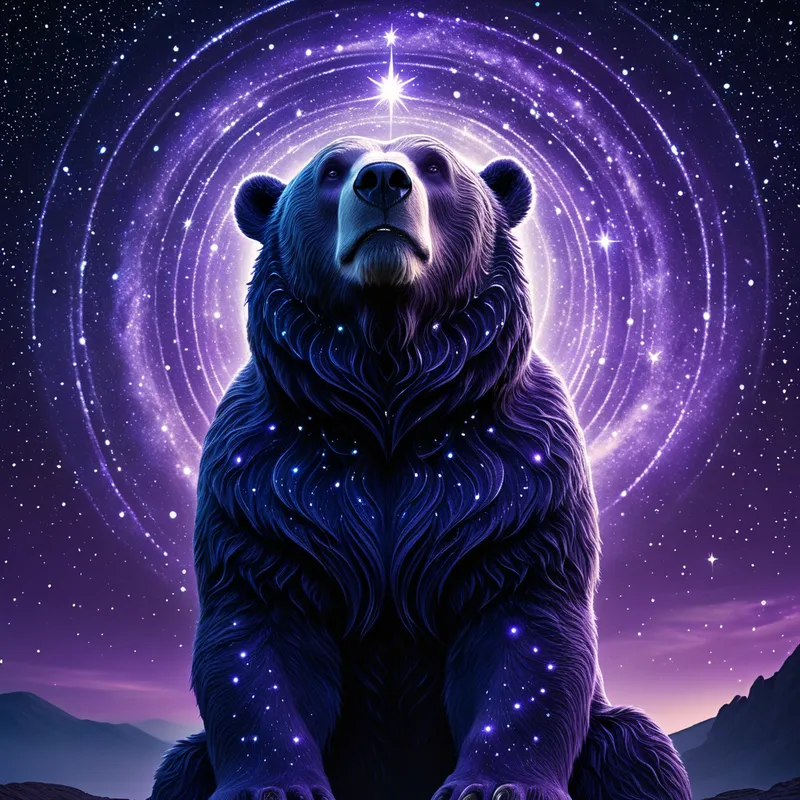
Ursa Major Myth Meaning & Symbolism
The nymph Callisto, transformed into a bear and cast into the heavens, becomes the Great Bear, a celestial testament to betrayal, survival, and eternal circling.
The Tale of Ursa Major
Listen, and let the scent of pine and mountain [thyme](/myths/thyme “Myth from Greek culture.”/) fill your senses. In the wild, untamed heart of Arcadia, where the air is sharp and the shadows are deep, there lived a nymph named Callisto. She was a daughter of the forest, sworn to the silver-bowed goddess Artemis, and her vow was one of chastity—a life lived in the pure, fierce communion of the hunt, untouched by mortal or divine desire.
But the king of the gods, Zeus, whose gaze falls like lightning, saw her. He saw the strength in her stride, the wild grace in her form, and a fire was kindled in him that would burn a world. Knowing Callisto would flee the approach of a god, the Cloud-Gatherer wove a deception. He took the shape of Artemis herself—the same short tunic, the same silver circlet, the same voice that called the nymph to her side. Trusting her goddess, Callisto came near. In that moment of shattered trust, the god had his way.
Time passed, and the secret grew within her. On a hot, still day, as the company of [nymphs](/myths/nymphs “Myth from Greek culture.”/) shed their garments to bathe in a clear, cold spring, Callisto’s condition could no longer be hidden. Artemis, the unforgiving virgin, saw the rounded belly that betrayed the broken oath. No explanation was heard. No tale of divine trickery could soften the goddess’s wrath. With a cry of pure, cold fury, Artemis banished her from the sacred band. Callisto, alone and heavy with child, was cast out from the only home she had ever known.
Her son, Arcas, was born in exile, and for years they lived a hidden life. But the wrath of heaven has long arms. Hera, the queen of Olympus, discovered her husband’s infidelity and [the child](/myths/the-child “Myth from Alchemy culture.”/) that was its fruit. Her jealousy, colder and more calculated than Artemis’s rage, sought a punishment of exquisite cruelty. She descended upon the lonely glade where Callisto wandered. With a gesture, she worked a terrible magic. Callisto felt a roughness crawl over her skin. Her graceful limbs thickened and grew heavy, her nails lengthened into cruel claws, and a dense pelt of fur swallowed her human form. Her mind, trapped within the beast, knew terror and confusion. She who had been a huntress was now a bear, driven by instinct, feared by all.
Fifteen years later, a young hunter, skilled and bold, tracked a great she-bear through the Arcadian woods. It was Arcas, her own son, now a man. The bear, sensing something familiar yet unknown, did not flee but approached. Arcas, seeing only a beast advancing, raised his spear. In that instant, as the weapon was poised to strike mother down with son’s hand, Zeus finally intervened. He could not undo the past, but he could arrest this final horror. With a sweep of his will, he snatched both from [the earth](/myths/the-earth “Myth from Hindu culture.”/). He grasped the great bear by her tail—and legend says he swung her so mightily into [the sky](/myths/the-sky “Myth from Persian culture.”/) that her tail stretched long—and placed her among the fixed stars. Her son, transformed into the constellation Arctophylax, was set beside her, forever near, forever separate.
But Hera’s vengeance was not complete. She went to the ancient marine deities, [Tethys](/myths/tethys “Myth from Greek culture.”/) and [Oceanus](/myths/oceanus “Myth from Greek culture.”/), and extracted a bitter promise. So it is that the Great Bear, Ursa Major, never dips below [the horizon](/myths/the-horizon “Myth from Various culture.”/) to bathe in the restorative sea. Condemned to an eternal, circling exile, she wheels around the pole star, forever in sight, forever unreachable, a prisoner of the glittering dark.

Cultural Origins & Context
This myth, in its most familiar form, comes to us from the poet Ovid in his [Metamorphoses](/myths/metamorphoses “Myth from Greek culture.”/), a compendium of transformation tales that served as a vital source for Greco-Roman mythology. However, its roots are older and tangled in the deep soil of pre-Hellenic belief. The figure of a great celestial bear appears across Northern Hemisphere cultures, suggesting an ancient, possibly Neolithic, layer of stellar lore. The Greeks syncretized this powerful asterism with their own pantheonic dramas.
The story functioned on multiple levels. For the everyday Greek, it was an aition—a mythic explanation for a natural phenomenon. It answered the child’s question: “Why does that big bear never set?” with a tale of divine jealousy and cosmic punishment. For the society that told it, it reinforced sacred boundaries: the inviolable oath to a deity, the terrible price of transgressing (even unwillingly) the social order guarded by Hera, and the capricious, often devastating, intervention of Zeus’s power. It was a cautionary tale about the vulnerability of mortals and nymphs caught in the crossfire of immortal passions, told by bards and woven into the fabric of a culture that saw its gods in every mountain and its stories written in the stars.
Symbolic Architecture
At its core, the myth of Ursa Major is a profound map of the [psyche](/myths/psyche “Myth from Greek culture.”/)’s experience of catastrophic, involuntary change and eternal otherness.
The most brutal transformations are not those we choose, but those that are thrust upon us, rewriting our very nature in a language of exile.
Callisto begins as an ego aligned with the Artemis [archetype](/symbols/archetype “Symbol: A universal, primordial pattern or prototype in the collective unconscious that shapes human experience, behavior, and creative expression.”/): autonomous, whole, integrated with [nature](/symbols/nature “Symbol: Nature symbolizes growth, connectivity, and the primal forces of existence.”/). The encounter with Zeus represents the [eruption](/symbols/eruption “Symbol: A sudden, violent release of pent-up energy or emotion from beneath the surface, often representing transformation or crisis.”/) of the unconscious—in the form of the Zeus [archetype](/symbols/archetype “Symbol: A universal, primordial pattern or prototype in the collective unconscious that shapes human experience, behavior, and creative expression.”/)—which shatters this conscious wholeness. The experience is one of profound violation and psychological [pregnancy](/symbols/pregnancy “Symbol: Represents creation, potential, and transformation—a journey of nurturing something new within oneself.”/), bearing a new content (Arcas) that the old [identity](/symbols/identity “Symbol: Identity represents the sense of self, encompassing personal beliefs, cultural background, and social roles.”/) cannot accommodate.
Hera’s transformation is the crystallization of this [trauma](/symbols/trauma “Symbol: A deeply distressing or disturbing experience that overwhelms the psyche, often manifesting in dreams as unresolved emotional wounds or psychological injury.”/) into a new, rigid identity: the [Orphan](/symbols/orphan “Symbol: Represents spiritual abandonment, primal vulnerability, and the quest for belonging beyond biological ties. Often signifies a soul’s journey toward self-reliance.”/) archetype. Callisto is made a [stranger](/symbols/stranger “Symbol: A stranger in dreams can represent unfamiliar aspects of the self or new experiences.”/) to herself, her humanity locked inside a [beast](/symbols/beast “Symbol: The beast often represents primal instincts, fears, and the shadow self in dreams. It symbolizes the untamed aspects of one’s personality that may need acknowledgment or integration.”/)’s form. This is the [symbol](/symbols/symbol “Symbol: A symbol can represent an idea, concept, or belief, serving as a powerful tool for communication and understanding.”/) of the [shadow](/symbols/shadow “Symbol: The ‘shadow’ embodies the unconscious, repressed aspects of the self and often represents fears or hidden emotions.”/) made total; she becomes what she once hunted. The final, poignant encounter with Arcas is the ultimate [shadow](/symbols/shadow “Symbol: The ‘shadow’ embodies the unconscious, repressed aspects of the self and often represents fears or hidden emotions.”/) confrontation: the [product](/symbols/product “Symbol: This symbol represents tangible outcomes of one’s efforts and creativity, often reflecting personal value and identity.”/) of one’s [trauma](/symbols/trauma “Symbol: A deeply distressing or disturbing experience that overwhelms the psyche, often manifesting in dreams as unresolved emotional wounds or psychological injury.”/) (the son) now threatens to destroy the unrecognizable self (the [mother](/symbols/mother “Symbol: The symbol of ‘Mother’ represents nurturing, protection, and the foundational aspect of one’s emotional being, often associated with comfort and unconditional love.”/)). Celestial catasterism—becoming a star—is not a salvation, but a [sublimation](/symbols/sublimation “Symbol: Transforming base impulses into creative or socially acceptable outlets, often seen in artistic expression.”/). It is the [trauma](/symbols/trauma “Symbol: A deeply distressing or disturbing experience that overwhelms the psyche, often manifesting in dreams as unresolved emotional wounds or psychological injury.”/) made eternal, visible to all, yet placed at an unbridgeable [distance](/symbols/distance “Symbol: Distance in dreams often symbolizes emotional separation, unattainable goals, or the need for personal space and reflection.”/). The eternal circumpolar [journey](/symbols/journey “Symbol: A journey in dreams typically signifies adventure, growth, or a significant life transition.”/) is the [symbol](/symbols/symbol “Symbol: A symbol can represent an idea, concept, or belief, serving as a powerful tool for communication and understanding.”/) of a core complex, a wound that never sets, forever circling the central [pole](/symbols/pole “Symbol: A pole in dreams often symbolizes stability, support, or a point of reference in life.”/) of the psyche.
The Dreamer’s Resonance
When the pattern of Ursa Major stirs in the modern dreamer, it signals a profound somatic and psychological process of alienation and integration. To dream of being a bear in a human world, or of seeing a loved one as a beast, speaks directly to the Callisto experience.
Somatically, this may manifest as a feeling of being “trapped in the wrong skin,” a deep disassociation from one’s own body or social identity following a violation or a life-altering event (which need not be literal assault, but any seismic betrayal or loss). Psychologically, the dreamer is navigating the Hera-phase: a jealous, punishing inner critic or societal force has labeled them, changed them, cast them out from a previous “sacred band” (a family, a community, a former sense of self). The dream may feature endless circling—a maze, a repeating path—mirroring the bear’s celestial orbit. This is the psyche working through a state of exile, where the old self is gone, but the new form feels alien and monstrous. The dream work is the slow, painful recognition that the beast and [the star](/myths/the-star “Myth from Tarot culture.”/) are the same entity; the exiled shadow contains a latent, majestic permanence.
Alchemical Translation
The alchemical journey modeled by Ursa Major is not one of triumphant redemption, but of the opus of enduring and finding meaning in eternal exile—the alchemy of the fixed state.
The prima materia of the soul is often the unwilled catastrophe; the philosopher’s stone is the capacity to bear its light.
The process begins with [nigredo](/myths/nigredo “Myth from Alchemical culture.”/), the blackening: the shattering of the nymph’s identity (Artemis’s wrath) and the descent into the beast-state (Hera’s curse). This is the ultimate dissolution. The albedo, or whitening, is not a cleansing but a freezing—the fixation into the starry pattern. The trauma is not washed away; it is crystallized into a permanent, luminous structure in the psyche’s night sky. The eternal circling is the circulatio, the endless distillation. Here, the goal of individuation shifts. It is not about “curing” the exile or setting the constellation. It is about recognizing that one’s core wound has become one’s defining constellation, a source of navigation.
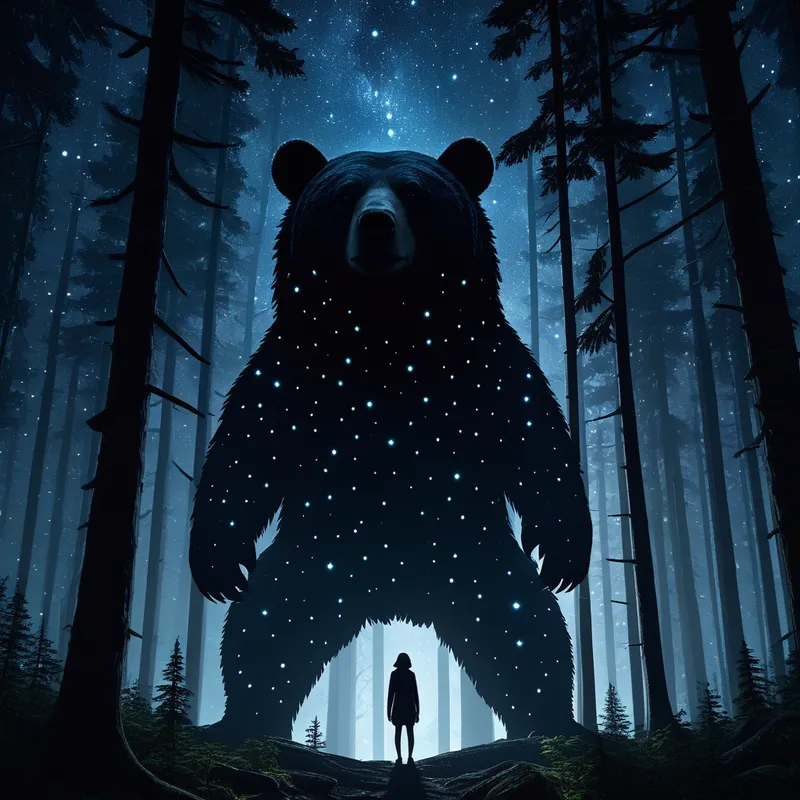
For the modern individual, the alchemical translation is this: the experiences that seem to destroy us, that make us feel fundamentally other and trapped in an endless cycle, are undergoing a slow, cosmic sublimation. We are not being healed from them; we are being transformed into them. The Great Bear does not ask to be released from the sky. She is the sky’s architecture. The individuated self learns to inhabit its own circumpolar journey, to see the monstrous transformation not as a curse to be broken, but as the very pattern by which it, and others lost in the dark, can find their way. The pole star around which she wheels becomes the transcendent function—the still, central point of meaning around which even eternal exile finds its orbit and its purpose.
Associated Symbols
Explore related symbols from the CaleaDream lexicon: