Unus Mundus Myth Meaning & Symbolism
The primordial myth of the One World, a unified reality shattered into duality, whose memory calls the soul back to its original, undivided state.
The Tale of Unus Mundus
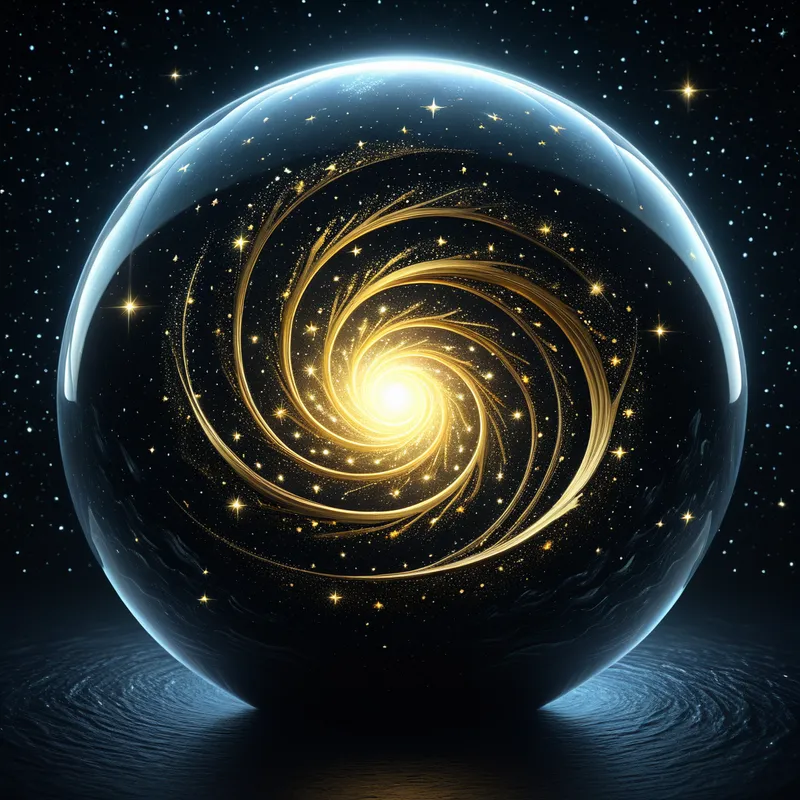
In the time before time, there was no above nor below, no within nor without. There was only the Unus Mundus. It was not a place you could walk, but the reality in which walking was conceived. It was a perfect, silent sphere—a cosmic egg of potential where every star was also a stone, every thought was also a mountain, and the lion and the lamb were not two, but one creature with two faces.
Within this sphere lived the Anima Mundi, [the World Soul](/myths/the-world-soul “Myth from Various culture.”/). It did not breathe, for breath implies separation—an in and an out. It simply was, a serene consciousness dreaming all possibilities in harmonious simultaneity. There was no story, for a story requires a sequence, and here, all beginnings, middles, and ends lay curled together like sleeping dragons.
But within the heart of this perfection, a longing stirred. A question formed, not in words, but as a vibration: “What if I were to know myself?” This was the First Desire, and it echoed through the Unus Mundus like a single, clear note struck on a bell of glass.
The note resonated. And with its resonance came a differentiation. The single, white light of the sphere trembled and began to separate into spectra. Gold from silver. Fire from [water](/myths/water “Myth from Chinese culture.”/). Day from night. The one creature with two faces sighed, and its sigh was [the wind](/myths/the-wind “Myth from Various culture.”/) of creation, pulling the faces apart. The lion awoke on a sun-drenched plain. The lamb awoke in a dewy meadow. They felt a pang, a ghost-limb memory of the other, now seen as separate, as other.
The sphere did not explode; it unfolded. Its surface became the dome of [the sky](/myths/the-sky “Myth from Persian culture.”/). Its center became the core of [the earth](/myths/the-earth “Myth from Hindu culture.”/). The Anima Mundi, in its desire to know itself, had to look into a mirror. But a mirror requires a surface, a boundary. Thus, [the world](/myths/the-world “Myth from Tarot culture.”/) of duality was born—a world of ten thousand things, of opposites and contrasts, of lovers and enemies, of joy and sorrow. This was the Great Division, not a punishment, but a necessary descent into the drama of experience. The memory of the perfect sphere became a faint, haunting melody at the edge of all hearing, a nostalgia for a home no consciously divided [thing](/myths/thing “Myth from Norse culture.”/) could fully remember.

Cultural Origins & Context
This is not a myth told around campfires, but one whispered in the dim light of [the laboratory](/myths/the-laboratory “Myth from Alchemical culture.”/) and encoded in cryptic texts. The concept of the Unus Mundus is the foundational, often unspoken, bedrock of the Western alchemical tradition, spanning from Hellenistic Egypt through the Islamic [Golden Age](/myths/golden-age “Myth from Universal culture.”/) to the Renaissance workshops of Europe. It was never a single, standardized narrative but the implicit cosmology behind the work.
Alchemists were not merely primitive chemists; they were philosophers of nature and the soul. They passed down this understanding not as a story for the public, but as an operational truth for initiates. It was discussed in the coded language of [the sacred marriage](/myths/the-sacred-marriage “Myth from Various culture.”/), the search for the [Lapis Philosophorum](/myths/lapis-philosophorum “Myth from Alchemical culture.”/), and the goal of the Opus Magnum. Its societal function was subversive and introspective: it proposed that the chaos and suffering of the material world (the mundus fractus) were not the ultimate reality, but a fragmented reflection of a divine, unified order. [The alchemist](/myths/the-alchemist “Myth from Various culture.”/)’s task was to remember that order and, through their art, help redeem the fragments.
Symbolic Architecture
The myth of the Unus Mundus is the ultimate map of the [psyche](/myths/psyche “Myth from Greek culture.”/)’s [origin](/symbols/origin “Symbol: The starting point of a journey, often representing one’s roots, source, or initial state before transformation.”/) and [destination](/symbols/destination “Symbol: Signifies goals, aspirations, and the journey one is on in life.”/). It symbolizes the primordial state of the unconscious before the [birth](/symbols/birth “Symbol: Birth symbolizes new beginnings, transformation, and the potential for growth and development.”/) of [the ego](/myths/the-ego “Myth from Jungian culture.”/)—a state of undifferentiated wholeness where contradictions do not conflict.
The birth of consciousness is the original trauma, and the entire spiritual journey is the attempt to heal that sacred wound without denying the beauty of the scar.
The Unus Mundus represents [the Self](/myths/the-self “Myth from Jungian culture.”/) in its totality, the anthropos, the original [human](/symbols/human “Symbol: The symbol of a human represents individuality, complexity of emotions, and social relationships.”/) that contains all opposites. The Great [Division](/symbols/division “Symbol: Represents internal conflict, separation of self, or unresolved emotional splits. Often indicates a need for integration or decision-making.”/) symbolizes the inevitable [emergence](/symbols/emergence “Symbol: A process of coming into being, rising from obscurity, or breaking through a barrier, often representing birth, transformation, or revelation.”/) of the ego, which, by defining an “I,” simultaneously creates a “not-I.” This is the genesis of all psychological duality: conscious/unconscious, [persona](/symbols/persona “Symbol: The social mask or outward identity one presents to the world, often concealing the true self.”/)/[shadow](/symbols/shadow “Symbol: The ‘shadow’ embodies the unconscious, repressed aspects of the self and often represents fears or hidden emotions.”/), thinking/feeling. The [haunting melody](/symbols/haunting-melody “Symbol: A mesmerizing tune that evokes deep emotions and memories, often connected to nostalgia or loss.”/) of [memory](/symbols/memory “Symbol: Memory symbolizes the past, lessons learned, and the narratives we construct about our identities.”/) is the call of [the Self](/myths/the-self “Myth from Jungian culture.”/), a lifelong pull toward individuation—not a return to infantile unconsciousness, but a conscious re-[integration](/symbols/integration “Symbol: The process of unifying disparate parts of the self or experience into a cohesive whole, often representing psychological wholeness or resolution of internal conflict.”/) of what was split asunder.
The [alchemical symbols](/symbols/alchemical-symbols “Symbol: Alchemical symbols represent the transformative processes of purification and enlightenment, indicating a quest for inner change.”/) derived from this myth—the conjunctio, the [Rebis](/myths/rebis “Myth from Alchemical culture.”/), the [Ouroboros](/symbols/ouroboros “Symbol: An ancient symbol depicting a serpent or dragon eating its own tail, representing cyclicality, eternity, self-sufficiency, and the unity of opposites.”/) snake eating its [tail](/symbols/tail “Symbol: A tail in dreams can symbolize instincts, connection to one’s roots, or the hidden aspects of personality.”/)—are all attempts to depict this reconciled state. They are icons of the psyche’s deepest desire: to know itself completely, to hold the [tension](/symbols/tension “Symbol: A state of mental or emotional strain, often manifesting physically as tightness, pressure, or unease, signaling unresolved conflict or anticipation.”/) of opposites until a third, transcendent thing is born.
The Dreamer’s Resonance
When this myth stirs in the modern dreamer, it rarely appears as a cosmic egg. It manifests as profound experiences of paradoxical union or haunting separations yearning for resolution.
You may dream of two people you know in waking life—perhaps rivals or ex-lovers—merging into a single, radiant person. You may find a room in your house you never knew existed, a round, silent chamber that feels like home. You may dream of holding two opposing emotions, like rage and compassion, and feeling them cancel each other out into a profound peace. Conversely, [the shadow](/myths/the-shadow “Myth from Jungian culture.”/) of the myth appears in dreams of catastrophic splitting: your reflection stepping out of [the mirror](/myths/the-mirror “Myth from Various culture.”/) with a life of its own, or the world literally cracking in two beneath your feet.
Somatically, this process can feel like a deep, central tension in the body—a pull between the head and the heart, or a sense of being stretched between two poles. Psychologically, it is the process of confronting a major inner conflict, where two irreconcilable parts of the self demand acknowledgment. The myth is active when you are in [the crucible](/myths/the-crucible “Myth from Alchemical culture.”/) of a decision that feels existential, where the choice isn’t between good and bad, but between two core, seemingly opposite identities.

Alchemical Translation
For the modern individual, the Unus Mundus myth models the entire trajectory of individuation. The alchemical laboratory is your own life. The [prima materia](/myths/prima-materia “Myth from Alchemical culture.”/)—the base, chaotic matter you start with—is your own fragmented psyche, riddled with complexes and contradictions.
[The first stage](/myths/the-first-stage “Myth from Alchemical culture.”/), [nigredo](/myths/nigredo “Myth from Alchemical culture.”/) (the blackening), is the painful acknowledgment of the Great Division within yourself. It is seeing your own shadow, admitting your inner conflicts, and feeling the despair of separation from your own wholeness. The subsequent stages—albedo (whitening), citrinitas (yellowing)—are the long work of purification and illumination, where you consciously work with these opposites.
The goal is not to destroy the ego, but to expand its capacity to contain the universe that birthed it.
The final stage, [rubedo](/myths/rubedo “Myth from Alchemical culture.”/) (reddening), is the symbolic attainment of the Lapis. This is not a state of perfect, conflict-free bliss. It is the conscious embodiment of the conjunctio. It is the ability to hold the tension of life’s opposites—success and failure, love and loss, life and death—without being torn apart, recognizing them as necessary poles of a single, vibrant reality. You become a living vessel where the memory of the sphere is no longer a nostalgia, but a present experience. You do not return to the Unus Mundus; you realize, through the long journey of division, that you have never truly left it. The One World is the ground of your being, and your life is its most recent, most precious, and most conscious dream.
Associated Symbols
Explore related symbols from the CaleaDream lexicon: