Unicorn Myth Meaning & Symbolism
A pure, wild creature is captured only by a virgin's innocence, then slain, its horn a symbol of grace wrested from a fallen world.
The Tale of the Unicorn
Listen, and I will tell you of a creature that walks the border between worlds. It is not of [the earth](/myths/the-earth “Myth from Hindu culture.”/), though its hooves tread the soft moss of the deepest, oldest woods. It is not of heaven, though its nature is a mirror to grace. It is the Unicorn, and its story is one of impossible capture and sacred surrender.
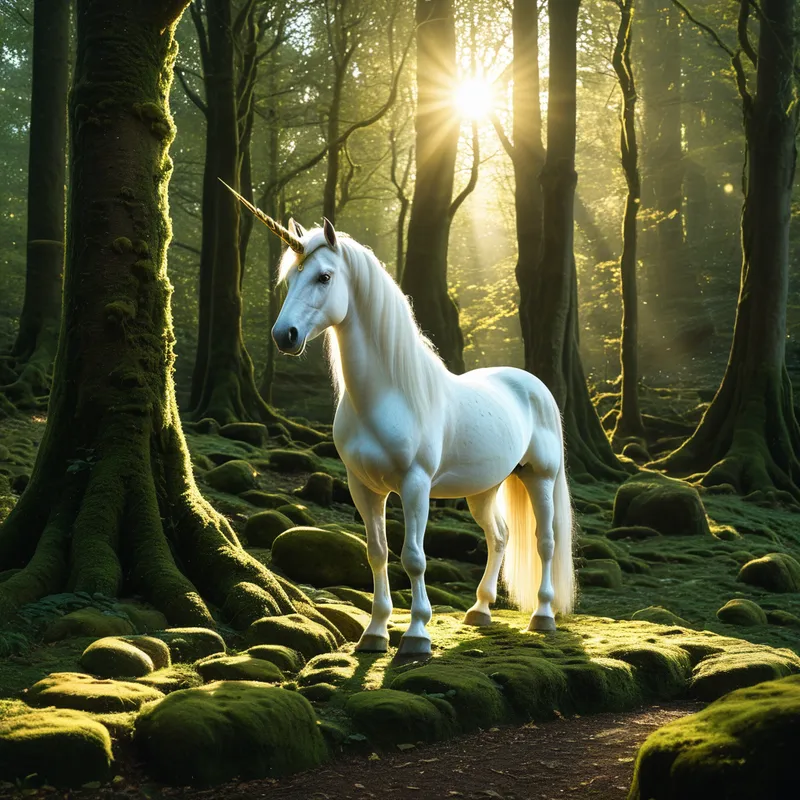
In the time when forests were vast kingdoms of shadow and whispered secrets, [the unicorn](/myths/the-unicorn “Myth from Medieval Bestiaries culture.”/) lived. No hunter, however cunning, could trap it. No net, however strong, could hold it. Its speed was [the wind](/myths/the-wind “Myth from Various culture.”/) given form; its horn, a lance of pure light, could purify poisoned waters and strike down the wicked. It was the soul of the wild, untamed and untamable, a flash of white against the eternal green.
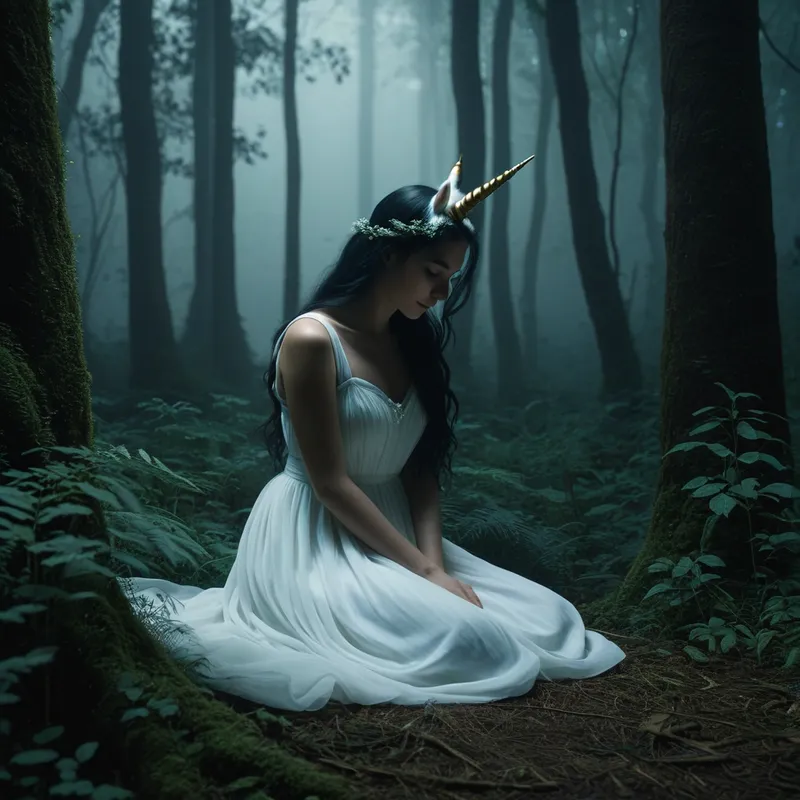
But the wise men, in their dusty books, spoke of a way. Not through force, but through its own flawless nature. They said the creature, in all its fierce purity, was drawn to purity itself. And so, into the heart of the wood they would send a maiden. Not a queen in silks, but a young woman of untouched heart and quiet spirit. She was instructed to go alone, to sit at the base of a great oak or by a clear spring, and to wait. To be still. To offer nothing but her own innocent presence.
And there, in the cathedral hush of the forest, a miracle would unfold. The air would grow still, the birds would cease their song. From between the ancient trees, the unicorn would come. It would approach not with the caution of a beast, but with the solemn recognition of a kindred spirit. It would lower its magnificent head, and with a sigh that seemed to carry the weight of its eternal solitude, it would lay it gently in the maiden’s lap. In that moment of perfect trust, the wild was tamed not by a chain, but by a reflection of its own essence.
Then, and only then, could the hunters hidden in the thicket emerge. As the unicorn rested, vulnerable in its communion, they would take its life. The story tells it was a necessary sacrifice. Its blood held power; its horn, the alicorn, became the greatest of treasures—an antidote to all poisons, a symbol of inviolable strength wrested from a moment of perfect vulnerability. The maiden often weeps, her innocence the bait in a divine trap, her lap the altar for a sacred slaughter.
Cultural Origins & Context
This potent narrative is not a single myth from a lost epic, but a tapestry woven from many threads: the natural histories of Pliny the Elder, the allegorical Physiologus, and the rich symbolic language of medieval Christianity. It was passed down through bestiaries—illuminated manuscripts that described animals both real and imagined, each with a moral lesson. Monks painstakingly copied these tales, and traveling storytellers spread them.
The unicorn myth served a crucial societal and religious function. In a world perceived as fallen and corrupt, the unicorn became a perfect allegory for Christ: the pure, singular son of God who could only be “captured” and brought to his sacrifice through [the vessel](/myths/the-vessel “Myth from Alchemical culture.”/) of a pure virgin (Mary), and whose death brought healing (the horn as salvation) to a poisoned world. For the nobility, owning an alicorn (often a narwhal tusk) was a sign of immense power and divine favor, a literal piece of the mythic that promised protection from poison and evil. The story thus bridged the gap between spiritual instruction and secular power, between the longing for the divine and the fears of a perilous physical world.
Symbolic Architecture
The myth’s power lies in its stark, almost painful, [juxtaposition](/symbols/juxtaposition “Symbol: The deliberate placement of contrasting elements side-by-side to create tension, meaning, or new perspectives in art, music, or dreams.”/) of symbols. The [unicorn](/symbols/unicorn “Symbol: A mythical creature symbolizing purity, magic, and the unattainable. It represents spiritual awakening and rare, untamed beauty.”/) itself is a [paradox](/symbols/paradox “Symbol: A contradictory yet true concept that challenges logic and perception, often representing unresolved tensions or profound truths.”/). It is [strength](/symbols/strength “Symbol: ‘Strength’ symbolizes resilience, courage, and the ability to overcome challenges.”/) incarnate, yet it is felled by its own highest quality. It represents the untamed [spirit](/symbols/spirit “Symbol: Spirit symbolizes the essence of life, vitality, and the spiritual journey of the individual.”/), the core of individuality that exists before and beyond socialization—the Self in its primordial form.
The unicorn is the psyche in its wild state: whole, potent, and free, but also isolated and inaccessible to the conscious mind.
The [virgin](/symbols/virgin “Symbol: The virgin represents purity, innocence, and new beginnings, often echoing themes of untainted potential.”/) maiden is not merely a passive lure. She symbolizes the receptive, uncontaminated [consciousness](/symbols/consciousness “Symbol: Consciousness represents the state of awareness and perception, encompassing thoughts, feelings, and experiences.”/)—a state of inner [stillness](/symbols/stillness “Symbol: A profound absence of motion or sound, often representing inner peace, creative potential, or existential pause in artistic contexts.”/), humility, and ego-[less](/symbols/less “Symbol: The concept of ‘less’ often signifies a need for simplicity, reduction, or minimalism in one’s life or thoughts.”/) waiting. She is the necessary [vessel](/symbols/vessel “Symbol: A container or structure that holds, transports, or protects something essential, representing the self, emotions, or life journey.”/) through which the magnificent but remote Self can be approached. Her [innocence](/symbols/innocence “Symbol: A state of purity, naivety, and freedom from guilt or corruption, often associated with childhood and moral simplicity.”/) is not naivete, but a quality of [perception](/symbols/perception “Symbol: The process of becoming aware of something through the senses. In dreams, it often represents how one interprets reality or internal states.”/) unclouded by desire or agenda.
The hunt and the kill are the most challenging elements. They represent the inevitable “capture” and “sacrifice” of this pure, inner spirit by the demands of [the world](/myths/the-world “Myth from Tarot culture.”/) (the hunters) and the conscious ego. The raw, wild essence must be integrated, which feels like a [death](/symbols/death “Symbol: Symbolizes transformation, endings, and new beginnings; often associated with fear of the unknown.”/). The prized [horn](/symbols/horn “Symbol: A horn symbolizes primal power, warning signals, and spiritual connection, often representing strength, alertness, or divine communication in dreams.”/), the gift left after the sacrifice, symbolizes the transformative power gained from this [integration](/symbols/integration “Symbol: The process of unifying disparate parts of the self or experience into a cohesive whole, often representing psychological wholeness or resolution of internal conflict.”/): the [ability](/symbols/ability “Symbol: In dreams, ‘ability’ often denotes a recognition of skills or potential that one possesses, whether acknowledged or suppressed.”/) to purify, to discern [truth](/symbols/truth “Symbol: Truth represents authenticity, honesty, and the quest for knowledge beyond mere appearances.”/) from falsehood ([antidote](/symbols/antidote “Symbol: A substance or remedy that counteracts poison, illness, or harmful influences, symbolizing healing, protection, and restoration.”/) to poison), and the enduring strength of the spirit now made usable in the [human](/symbols/human “Symbol: The symbol of a human represents individuality, complexity of emotions, and social relationships.”/) [realm](/symbols/realm “Symbol: The symbol of ‘Realm’ often signifies the boundaries of one’s consciousness, experiences, or emotional states, suggesting aspects of reality that are either explored or ignored.”/).
The Dreamer’s Resonance
To dream of a unicorn in the modern night is to encounter a call from this deep, archetypal layer. It rarely appears in mundane settings. It is seen at the edge of a misty wood, in a forgotten corner of the [psyche](/myths/psyche “Myth from Greek culture.”/)‘s landscape. Such a dream often accompanies a phase where one feels a profound longing for authenticity, a sense that one’s true nature has been lost or compromised by the “hunt” of daily life—career, relationships, social masks.
The somatic feeling can be one of aching beauty mixed with sorrow. You may feel the awe of seeing the creature, followed by the grief of watching it flee or, more powerfully, the complex emotions of being the maiden—the quiet power of attracting it, coupled with the guilt or sadness of its subsequent capture. This dream pattern signals a process of numinous encounter: [the Self](/myths/the-self “Myth from Jungian culture.”/) is announcing its presence. The psyche is preparing for a necessary, perhaps difficult, integration. The dream asks: Where in your life have you sacrificed your wild purity for security? What part of your spirit waits, like the maiden, in stillness, to make contact with something magnificent within you?

Alchemical Translation
The unicorn myth is a precise map of the alchemical and Jungian process of individuation. The initial state is the unconscious wholeness of the unicorn roaming free—a potential not yet realized. The maiden’s deliberate stillness represents the first conscious step: the creation of a receptive, ego-free space within (meditation, introspection, therapy).
The laying of the head in the lap is the coniunctio, [the sacred marriage](/myths/the-sacred-marriage “Myth from Various culture.”/). It is the moment when the unconscious Self connects with the conscious ego, not in battle, but in recognition. This is often a fleeting, blissful experience of profound meaning and connection.
The sacrifice is not an end, but the alchemical mortificatio: the old form must die for the new, more conscious form to live. The wild spirit is not destroyed; its essence is distilled into the horn.
The hunters, often seen as villains, are here the necessary agents of the conscious world. They represent the difficult, often painful, process of bringing this numinous experience back into ordinary life—giving it form in work, creativity, or relationship. The final treasure, the alicorn, is the [lapis philosophorum](/myths/lapis-philosophorum “Myth from Alchemical culture.”/), [the philosopher’s stone](/myths/the-philosophers-stone “Myth from Alchemical culture.”/). It is the enduring gift of the process: a centered self that possesses the power to “neutralize poison.” Psychologically, this is the hard-won ability to face the toxins of negativity, trauma, and illusion without being destroyed by them. The integrated individual carries the horn’s grace: the purity of the unicorn’s essence, now grounded and active in the human world, transforming base experience into meaning.
Associated Symbols
Explore related symbols from the CaleaDream lexicon: