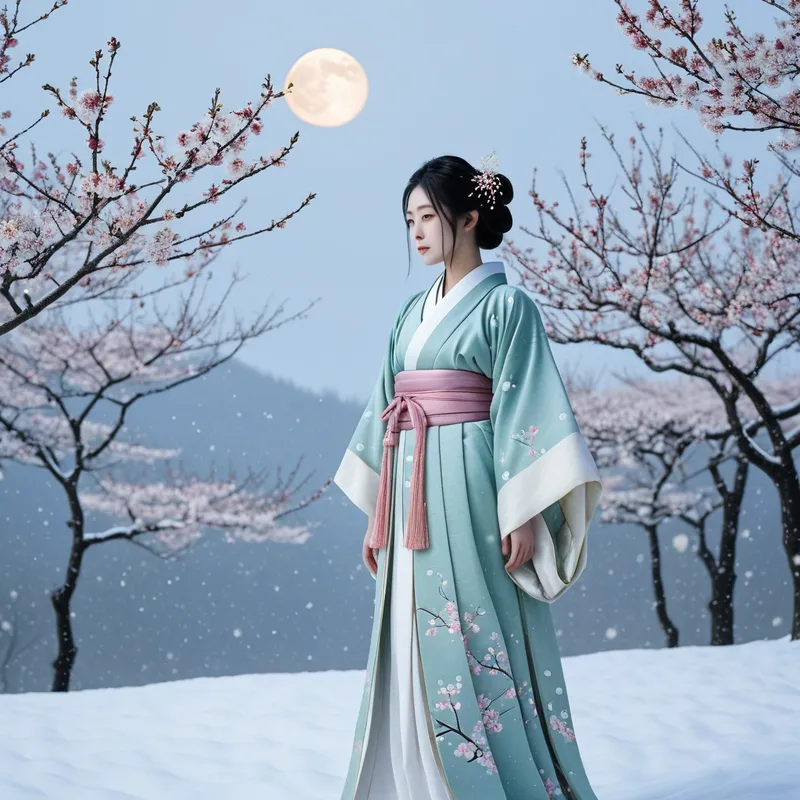
Ume Myth Meaning & Symbolism
A myth of a celestial spirit who descends as a plum blossom, enduring winter's bitterness to become the first herald of spring and the promise of renewal.
The Tale of Ume
Listen, and hear the tale whispered on the first cold wind of the year, a story not of grand battles, but of quiet, impossible courage.
In the celestial realm of Takamagahara, there lived a spirit of exquisite beauty and gentle melancholy named Ume. She was not a goddess of thunder or harvest, but of potential, of the promise held in a single, unopened bud. While her sisters, the spirits of cherry and peach, dreamed of the revelries of full spring, Ume felt a different calling—a pull toward the silence of [the world](/myths/the-world “Myth from Tarot culture.”/) below, a world locked in the iron grip of winter.
The kami of the seasons warned her. “[The earth](/myths/the-earth “Myth from Hindu culture.”/) is the domain of [Susanoo](/myths/susanoo “Myth from Japanese culture.”/)’s wild brother, the Winter King. His breath is death to blossoms. His touch is stillness. You are made for fragrance and soft sun, not for his bitter reign.”
But Ume’s heart was resolute. She saw not a dead world, but a sleeping one. She heard not silence, but a held breath. And so, as the year turned to its deepest, darkest point, she gathered her essence—the scent of hope, the color of dawn’s first blush—and descended. She did not arrive in a burst of light, but as a whisper against the bark of a gnarled, sleeping tree in a forgotten garden. There, she became a bud, small and hard as a pebble, clinging to a branch that seemed as lifeless as stone.
The Winter King soon discovered her. He roared with laughter that cracked the ice on ponds. “A flower? Here? Now?” He summoned his generals: the North Wind, which tore at her with frozen claws, and the Heavy Snow, which sought to bury her in a white tomb. The cold was a pain so profound it was beyond feeling, a stillness that threatened to become eternal. The world was monochrome—shades of grey, black, and blinding white. The nights were long, and the sun, when it appeared, was a pale, distant coin offering no warmth.
Ume held fast. She did not fight, for that was not her nature. She endured. She turned the very bitterness of the frost into a sweetness locked deep within her core. She drew strength not from the absent sun, but from the memory of light, from the certainty of the turn of the world. She made her stand not with a shout, but with a deepening silence, a gathering of essence.
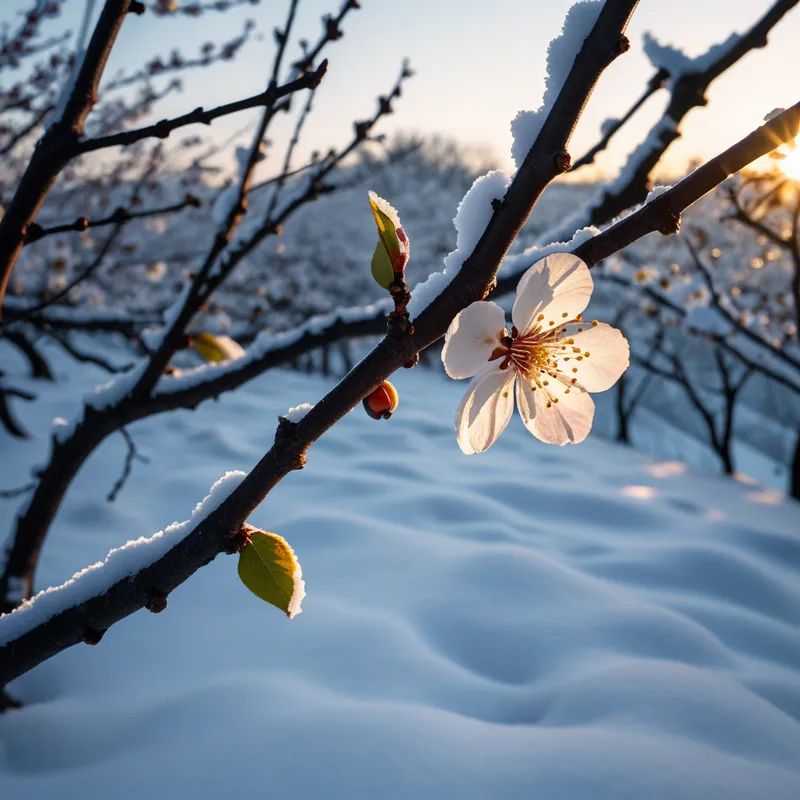
Then, one morning, when the cold was at its most arrogant, a change came. Not a thaw, but a subtle softening in the iron quality of the air. A single, defiant ray of sunlight, thin and sharp as a needle, pierced the grey. And on that barren branch, the hard, dark bud stirred. It did not explode, but unfurled. One petal, then five, revealing a blossom of the purest white, blushed at its heart with the faintest pink. It was a shock of delicate life in a world of brute force. Its fragrance was not the heavy perfume of summer, but a clean, sharp, almost medicinal scent—the very aroma of resilience.
Ume had bloomed. She was the first. Before the green of the grass, before the song of the birds, her solitary flower declared that the reign of winter was not eternal. She was the covenant between the sleeping earth and the returning sun. She did not conquer the cold; she transformed its meaning, making the snow a backdrop for her beauty, the frost a jeweler setting her delicate form. And seeing her [triumph](/myths/triumph “Myth from Roman culture.”/), the spirit of the land itself began to stir, knowing that spring, at last, had sent its most courageous [herald](/myths/herald “Myth from Greek culture.”/).
Cultural Origins & Context
The story of Ume is woven deeply into the fabric of Japanese culture, less as a formal, canonical myth with named deities like those in the Kojiki or Nihon Shoki, and more as a living folkloric and poetic archetype. It finds its voice in the classical tradition of waka and later [haiku](/myths/haiku “Myth from Japanese culture.”/), where the plum blossom (ume) is a premier seasonal keyword (kigo) for early spring.
This “myth” was passed down not by priests alone, but by poets, gardeners, and painters. It was told in the imperial anthologies like the Kokin Wakashū, where the plum blossom is praised for its fragrance and its brave blooming. It served a societal function that was both practical and deeply spiritual. In an agrarian society, the first plum blossom was a vital, observable sign—a promise that the harsh winter would end and the life-sustaining work of planting could soon begin. Psychologically, it modeled an ideal of graceful endurance (gaman) and hopeful perseverance, virtues highly esteemed in Japanese aesthetics and ethics. The tale reinforced a worldview where beauty and strength are not opposites, but are born from the same act of steadfastness in the face of adversity.
Symbolic Architecture
The myth of Ume is a masterclass in symbolic [paradox](/symbols/paradox “Symbol: A contradictory yet true concept that challenges logic and perception, often representing unresolved tensions or profound truths.”/). The [plum blossom](/symbols/plum-blossom “Symbol: A symbol of resilience, purity, and early renewal, blooming in harsh winter conditions to herald spring’s arrival.”/) is not merely a flower; it is an [emblem](/symbols/emblem “Symbol: A symbolic design representing identity, authority, or ideals, often used in heraldry, logos, or artistic expression.”/) of the [soul](/symbols/soul “Symbol: The soul represents the essence of a person, encompassing their spirit, identity, and connection to the universe.”/)’s [journey](/symbols/journey “Symbol: A journey in dreams typically signifies adventure, growth, or a significant life transition.”/) through its own winters.
The most profound hope is not born in the warmth of certainty, but in the cold heart of doubt. It is the blossom that chooses the branch of winter, knowing its beauty will be defined by the very frost it defies.
Ume, the [Spirit](/symbols/spirit “Symbol: Spirit symbolizes the essence of life, vitality, and the spiritual journey of the individual.”/), represents the potential self—the latent wholeness within us that knows it must descend into difficulty to become real. Her [choice](/symbols/choice “Symbol: The concept of choice often embodies decision-making, freedom, and the multitude of paths available in life.”/) to leave Takamagahara is the soul’s necessary descent from idealized potential into the gritty [reality](/symbols/reality “Symbol: Reality signifies the state of existence and perception, often reflecting one’s understanding of truth and life experiences.”/) of lived experience.
The [Winter](/symbols/winter “Symbol: Winter symbolizes a time of reflection, introspection, and dormancy, often representing challenges or a period of transformation.”/) [King](/symbols/king “Symbol: A symbol of ultimate authority, leadership, and societal order, often representing the dreamer’s inner power or external control figures.”/) symbolizes not just external hardship, but the internal [landscape](/symbols/landscape “Symbol: Landscapes in dreams are powerful symbols representing the dreamer’s emotional state, personal journey, and the broader context of life situations.”/) of depression, stagnation, [grief](/symbols/grief “Symbol: A profound emotional response to loss, often manifesting as deep sorrow, yearning, and a sense of emptiness.”/), or the “dark [night](/symbols/night “Symbol: Night often symbolizes the unconscious, mystery, and the unknown, representing the realm of dreams and intuition.”/) of the soul.” He is the psychic cold that numbs feeling and convinces us of permanence in transient states.
The Blooming is the critical [symbol](/symbols/symbol “Symbol: A symbol can represent an idea, concept, or belief, serving as a powerful tool for communication and understanding.”/). It is not a victory of force, but of [presence](/symbols/presence “Symbol: Presence in dreams often signifies awareness or acknowledgment of something significant in one’s life.”/). It represents the [moment](/symbols/moment “Symbol: The symbol of a ‘moment’ embodies the significance of transient experiences that encapsulate emotional depth or pivotal transformations in life.”/) when endurance transforms into [expression](/symbols/expression “Symbol: Expression represents the act of conveying thoughts, emotions, and individuality, emphasizing personal communication and creativity.”/). The fragrance—sharp, clean, medicinal—is key. This is not the sweet, easy [beauty](/symbols/beauty “Symbol: This symbol embodies aesthetics, harmony, and the appreciation of life’s finer qualities.”/) of fulfillment, but the bracing, healing beauty of integrity earned through trial. The [blossom](/symbols/blossom “Symbol: A symbol of new beginnings, growth, and the unfolding of potential, often marking a transition or the start of a journey.”/) does not melt the snow; it makes the snow its context, thereby alchemizing the entire environment. The cold becomes the [condition](/symbols/condition “Symbol: Condition reflects the state of being, often focusing on physical, emotional, or situational aspects of life.”/) that makes its [appearance](/symbols/appearance “Symbol: Appearance in dreams relates to self-image, perception, and how you present yourself to the world.”/) miraculous.
The Dreamer’s Resonance
When the pattern of Ume blooms in the modern dreamscape, it signals a profound somatic and psychological process: the emergence of hope or a new sense of self from a period of felt barrenness or emotional winter.
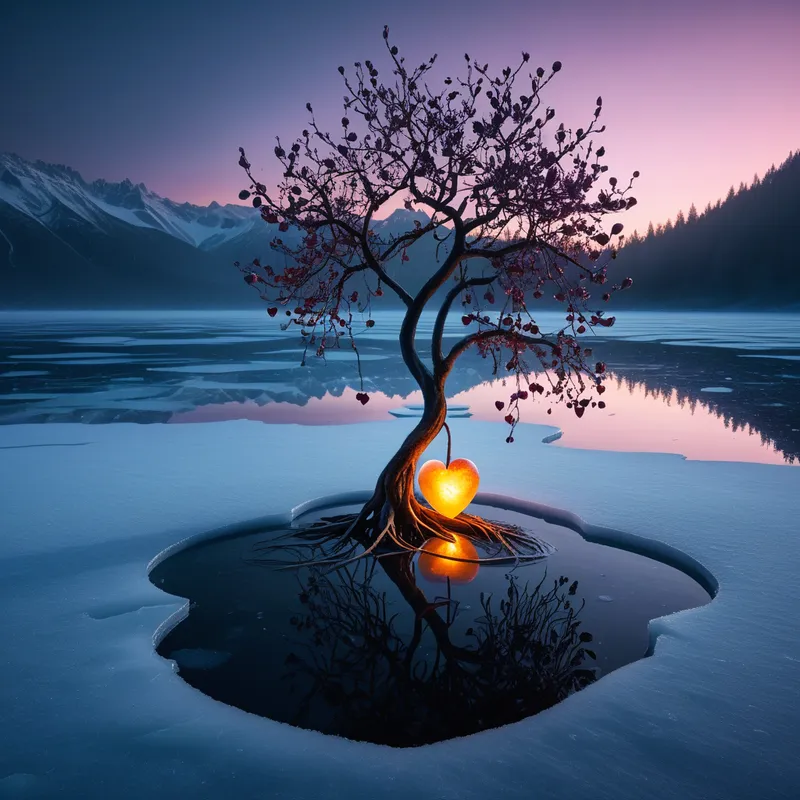
A dreamer might find themselves in a frozen, monochrome landscape—a symbol of emotional numbness, creative block, or a life situation that feels static and lifeless. The central image is often a single, vivid point of life: a lone flower on a dead tree, a small green shoot in concrete, a tiny, persistent light in vast darkness. There is a somatic quality of tightness giving way to release, often felt as a deep, quiet warmth spreading from the core, even as the dream environment remains cold.
Psychologically, this dream marks the turning point in a cycle of endurance. [The ego](/myths/the-ego “Myth from Jungian culture.”/) has been in a state of holding on, of sheer survival. The Ume dream is the first unconscious confirmation that this holding has not been in vain; that deep within the psychic frost, a process of consolidation and sweetening has been underway. It is the dream of the “first sign,” assuring the dreamer that the internal season is changing, even if the external circumstances have not yet shifted. It speaks to the resilience of the life force itself, beginning its gentle, unstoppable push toward expression.
Alchemical Translation
The journey of Ume is a perfect map for the alchemical process of psychic transmutation, or individuation—the Jungian path toward wholeness.
[The first stage](/myths/the-first-stage “Myth from Alchemical culture.”/), descent ([nigredo](/myths/nigredo “Myth from Alchemical culture.”/)), is her conscious choice to enter the winter world. This is the necessary, often painful, engagement with [the shadow](/myths/the-shadow “Myth from Jungian culture.”/), with limitation, and with the reality of one’s own “cold” aspects. We must leave the heavenly illusion of pure potential and commit to the earthly process.
The long endurance through winter is the albedo, the whitening. This is not a passive waiting, but an active purification. The frost and wind are the trials that burn away the superficial, forcing a distillation of essence. In psychological terms, it is the period where we are stripped of false identities and easy comforts, left with only the core of our being. As Ume turns the frost’s bitterness into inner sweetness, we alchemize our suffering into insight, our grief into depth.
The individuated self is not the one who avoided the winter, but the one who learned to bloom within it, making the pattern of its scars the very architecture of its beauty.
Finally, the blooming is the [rubedo](/myths/rubedo “Myth from Alchemical culture.”/), the reddening, the culmination. It is the conscious integration of the experience into a new form of being. The blossom is the symbol of [the Self](/myths/the-self “Myth from Jungian culture.”/)—not the ego, but the larger, more connected totality of the personality. It is modest, often solitary, but radiant with meaning. Its beauty is inseparable from its struggle; its fragrance is the direct emission of its transmuted pain. For the modern individual, this translates as the moment when enduring a depression, a loss, or a period of stagnation gives birth to a new, more authentic way of living—a creativity, a compassion, or a quiet confidence that is rooted in proven resilience, not in naive optimism. One becomes the herald of one’s own spring.
Associated Symbols
Explore related symbols from the CaleaDream lexicon: