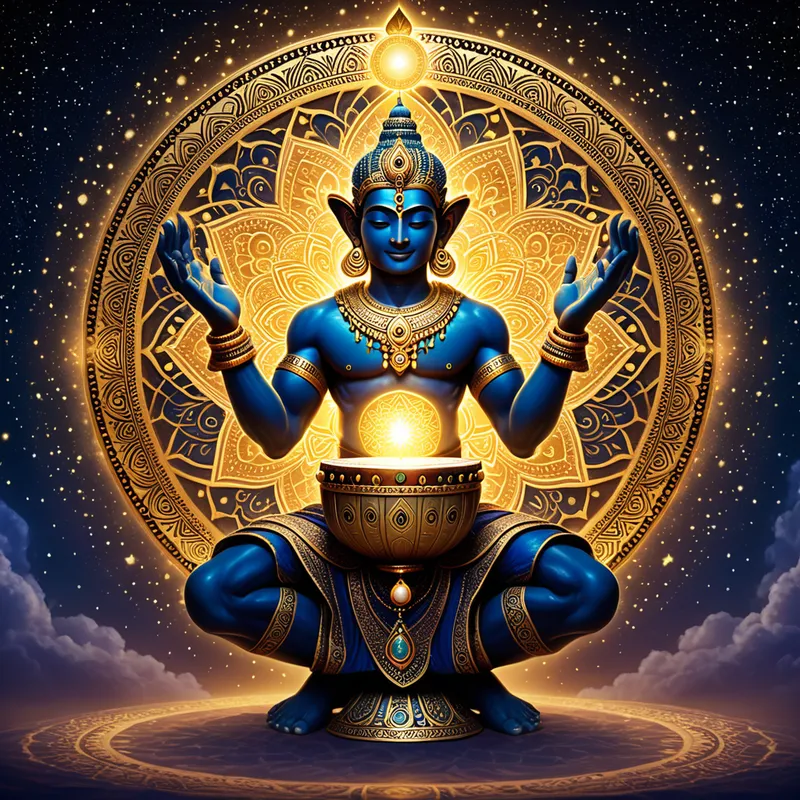
Tympanum of the Heart Myth Meaning & Symbolism
A myth of the divine drum within the chest, whose sacred rhythm bridges the mortal and immortal, born from cosmic sacrifice and resonant silence.
The Tale of Tympanum of the Heart
Listen. Before the world knew its own name, there was a silence so profound it was a presence. It was the silence of Brahman, the unmanifest, dreaming of a song. From that dreaming silence, the first vibration arose—Aum. And from that vibration, the gods were spun into being.
Among them was a deity whose essence was not of stone or storm, but of resonance. He was the master of Nada, the divine musician whose instrument was the cosmos itself. Yet, he felt a sorrow. The music he played for the gods in their celestial halls was glorious, but it did not reach the hearts of mortals, who stumbled in the darkness of Maya, deaf to the divine symphony.
He went to the shores of the Kshirasagara, the ocean of milk, where Vishnu rests upon the serpent Shesha. “Lord,” the musician said, his voice a low hum. “My music is trapped in the heavens. How can I make the mortal heart hear the rhythm of the Real?”
Vishnu, whose eyes hold the patience of eternity, smiled. “To be heard, the instrument must be where the listener is. Not outside, but within. The greatest drum cannot be held in the hand. It must be fashioned from the very substance of listening itself.”
Understanding dawned, a terrible and beautiful understanding. The musician returned to his celestial forge. But he did not gather hide or wood. Instead, he gathered the two most potent materials in all existence: the ecstatic joy of creation, and the profound agony of separation. From the joy, he spun a luminous, tensile membrane, thin as a soul’s hope. From the agony, he carved a frame of dark, resonant wood, hard as a lifetime’s lessons.
He worked for an acon, and when he was done, he held not a drum, but the potential of one. It was a perfect, double-headed damaru, small enough to fit in a closed fist, yet containing universes in its silence.
Then came the sacrifice. The musician placed the silent drum against his own chest, where his heart beat the rhythm of his divine life. He did not ask another to play it. He raised his own hand, fashioned into a mallet of pure intent. With a look of infinite compassion—for the coming pain, for the coming beauty—he struck.
The sound was not a sound. It was the first sound, the sound that is also light, the vibration that is also form. It shattered his own form, dissolving his celestial body into a cascade of shimmering notes. But from that dissolution, the drum lived. It absorbed the strike, the sacrifice, the very essence of the musician, and began to beat with a life of its own.
The gods wept. The demons paused. And in every mortal creature yet to be born, in the hidden chamber behind the ribs, a tiny, silent replica of that drum was placed. It was the Tympanum of the Heart. It does not beat with blood, but with the echo of that primordial, self-sacrificing strike, waiting for the individual to learn how to listen.

Cultural Origins & Context
This myth, while not belonging to one single, canonical text like the Itihasas, is woven from the deep philosophical and aesthetic threads of Advaita Vedanta and the Rasa theory. It is a “teaching story” that emerged from the oral traditions of mystic poets and sadhus, particularly those devoted to the paths of Bhakti and Jnana.
Its primary societal function was not to chronicle history, but to map the interior landscape. Storytellers would recite it not as a literal event, but as a metaphysical truth about the human condition. It served as an answer to the perennial question: “If the divine is everywhere, why do I not perceive it?” The myth locates the answer not in external ritual alone, but in the cultivation of an inner faculty—a sacred, attentive listening. It democratized the divine encounter, suggesting the ultimate instrument of connection was not in a temple, but implanted within the very core of the individual.
Symbolic Architecture
The myth is a profound blueprint of consciousness. The divine musician represents the aspect of the Self that knows its origin is symphonic, connected to the cosmic vibration (Aum). His sorrow is the divine compassion (Karuna) that seeks to bridge the perceived gap between the Absolute and the relative.
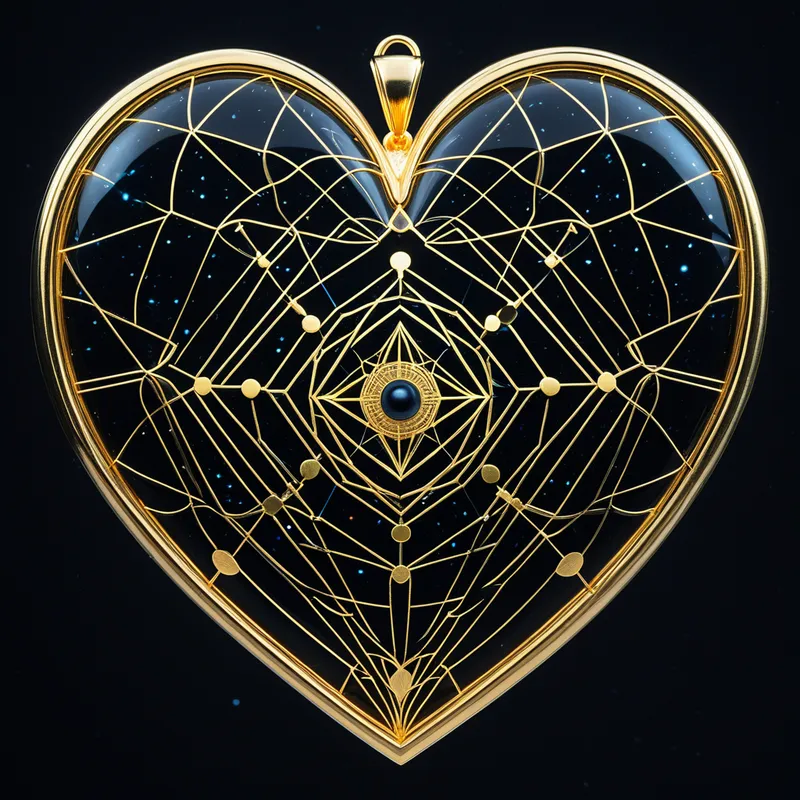
The Tympanum itself is the ultimate symbol of the Atman—the true Self. It is not the physical, emotional heart (hridaya), but the spiritual heart-cave (hridaya guha), the seat of consciousness.
The two materials—ecstatic joy and the agony of separation—symbolize the dualistic world of dvandvas that stretch the membrane of our awareness. Our experiences of bliss and suffering are not distractions, but the very tensions that prepare the instrument to resonate. The musician’s self-sacrifice is the alchemical key: the ego, the limited identity, must be “struck” and dissolved for the true, resonant Self to be activated. The sound that is “not a sound” is anahata nada, the unstruck sound heard in deep meditation, the proof of the drum’s eternal vibration.
The Dreamer’s Resonance
When this myth surfaces in modern dreams, it often manifests not as a literal story, but as a somatic or symbolic pattern. A dreamer may experience:
- A pulsating object in the chest: A glowing crystal, a trapped bird fluttering, or a hidden, intricate machine beating in time with a distant rhythm.
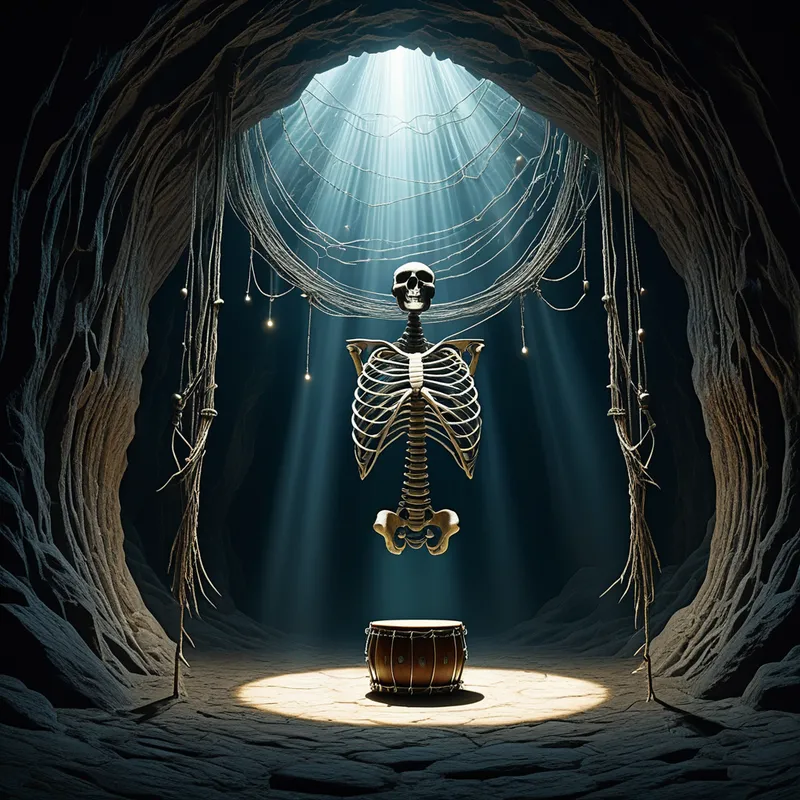
- The act of listening intently: To a whisper in a vast hall, the hum of power lines, or the rhythmic dripping of water in a cave—a search for a signal in the noise.
- A sacrifice of a cherished identity: The shattering of a self-image (the professional, the caregiver, the achiever) that, while painful, leads to a feeling of eerie, silent spaciousness.
Psychologically, this indicates a process where the conscious ego is being confronted by the Self. The “strike” is the impact of a life event, a profound insight, or a deep therapy session that disrupts the old narrative. The dreamer is in the liminal space between the strike and the full resonance—experiencing the dissolution of the known, and the terrifying, thrilling potential of the new vibration trying to emerge from within.
Alchemical Translation
The myth models the entire journey of individuation—the process of becoming who one fundamentally is. The modern individual begins identified with the “celestial musician” trapped in the heavens: our ideals, spiritual aspirations, and intellectual understandings are glorious but disconnected from our embodied, earthly reality. We make music, but it doesn’t touch our core wounds or our daily life.
The alchemical work is to descend to the “ocean of milk”—the chaotic, nurturing, unconscious psyche—and receive the instruction to build the instrument within.
This is the labor of life: every joy and every suffering becomes material for the frame and membrane of our unique Tympanum. We spend years, often in resistance, stretching and tightening this inner instrument through our experiences. Then comes the critical, terrifying phase: the conscious sacrifice. This is the willing surrender of the ego’s central control, the allowing of a foundational identity to be “struck” by truth. It feels like death, failure, or annihilation.
But this strike is the initiation. It is not the ego that plays the drum of the Self; the ego must become the mallet that, in its own yielding, activates the deeper rhythm. The resulting “sound” is the authentic life: actions, creativity, and relationships that vibrate with the unique frequency of one’s own Atman, now in harmony with the primordial Aum. One does not hear the divine from outside; one becomes a point of resonance for it, from the inside out. The myth concludes not with an ending, but with an eternal beginning: the Tympanum is placed, waiting. The rest of the individuation journey is the lifelong practice of learning to listen to its beat, and to courageously align one’s life with its profound and silent song.
Associated Symbols
Explore related symbols from the CaleaDream lexicon: