Tunnel Phenomenon Myth Meaning & Symbolism
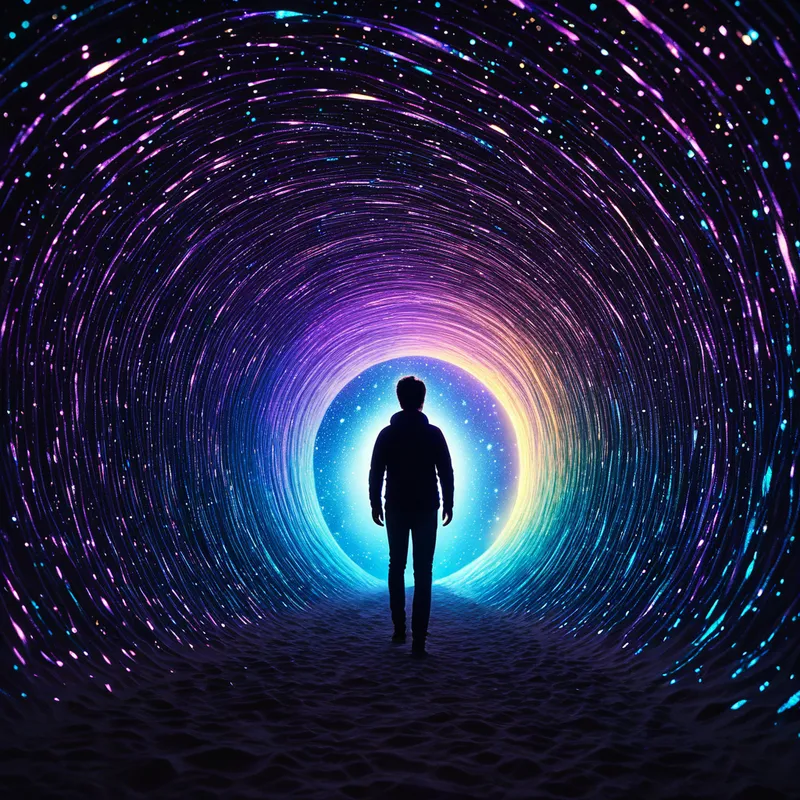
A soul, severed from the body, is drawn through a tunnel of light toward an ineffable presence, facing the ultimate review of a life lived.
The Tale of Tunnel Phenomenon
Listen. The drumbeat of the heart falls silent. The breath, that faithful tide, retreats for the final time. In that stillness, a severing occurs—not with a sound, but with a sensation of profound release, like a mooring line cut in a silent sea.
The one who was, is no longer there. They are here, hovering in a twilight space, looking down upon the shell they once called home. A strange cord, luminous and silver, tenuously connects the two. Then, the pull begins. It is not violent, but inexorable, a current in a river they only now perceive. It draws them upward.
And then, they see it. Not with eyes, but with the essence of their being. A tunnel. It is not of stone or earth, but of living darkness, velvet and deep, yet at its end—oh, at its end!—a light. It is not the light of sun or lamp. It is a light that knows, that loves, that is home. It spills into the tunnel’s mouth, painting its swirling walls with impossible colors: golds of forgiveness, blues of peace, whites of pure being.
They are moving, rushing, flying without effort. The tunnel walls stream past, a vortex of stars and memories. Sounds emerge—a hum that is also a song, a chorus of whispers that feel like recognition. The light grows, filling their entire perception. It is not blinding, but illuminating, stripping away fear, pain, and identity like old garments. Within that light, forms sometimes coalesce: beloved faces, radiant beings of pure energy, a presence so vast and intimate it defies description. A voice, or perhaps a knowing, asks a question not in words: What have you learned? What love did you give?
A life—their life—unfurls not as a story, but as a living tapestry. Every moment is felt simultaneously, the joy and the shame, the kindness and the wound, all held in the compassionate gaze of the light. It is judgment only in the sense of perfect clarity, an ultimate truth-telling. The journey reaches its zenith at the threshold of the light, a border of pure bliss. Here, a choice is felt, though no voice speaks it: to cross into the light and become one with it, or to turn back.
And then, the reversal. A jolt, like a fish hooked and reeled. The light recedes, the tunnel rushes backward, the world of form and weight rushes up with a gasp and a pounding heart. They have returned. But they are not the same.
Cultural Origins & Context
The myth of the Tunnel Phenomenon does not belong to a single ancient tribe but to a new, global culture of experience that emerged in the late 20th century: the culture of Near-Death Experience (NDE). Its bards are not poets by firesides, but doctors, nurses, psychologists, and the experiencers themselves—ordinary people from all walks of life who returned from the brink with an extraordinary, shared story.
This myth was passed down not through generations, but through best-selling books like Raymond Moody’s Life After Life, through support groups like the International Association for Near-Death Studies (IANDS), and in hushed, urgent conversations in hospital rooms and therapists’ offices. Its societal function is profound: in a secular, medically-dominated age, it provides a modern, experiential narrative for the soul’s journey, challenging materialist views of consciousness and offering a template for understanding death not as an annihilation, but as a transition. It serves as a radical comfort and a call to re-evaluate life’s purpose.
Symbolic Architecture
Psychologically, the tunnel is the ultimate birth canal in reverse. It is the archetypal passageway, the liminal corridor between states of being. The movement from the darkness of the known world (life) into the light of the unknown (death/transcendence) mirrors every great transition: from ignorance to knowledge, from suffering to peace, from ego-consciousness to Self-awareness.
The tunnel is the psyche’s own pathway, carved by the momentum of a life leaving one vessel and seeking another.
The light at the end is the symbolic representation of the Self, the divine core, the source of consciousness itself. It is not a “place” but a state of wholeness. The life review is the ego’s final audience before the Self, a total integration of the shadow and the persona where every repressed and celebrated part of the personality is acknowledged and reconciled in a moment of non-dual awareness. The “choice” to return symbolizes the unfinished psychic work that still tethers consciousness to the individual project of life.
The Dreamer’s Resonance
When this myth surfaces in modern dreams—as rushing through tunnels, approaching great lights, or feeling a disembodied pull—it rarely signifies a literal premonition of death. Instead, it marks a profound psychic death and rebirth in progress.
The dreamer is likely undergoing a seismic shift in identity. An old way of being—a career, a relationship, a foundational belief—has “died.” The somatic sensation of rushing or flying reflects the disorientation and speed of this unconscious process. The tunnel walls, often morphing into faces or memories, represent the contents of the personal unconscious being stirred up and reviewed by the emerging new consciousness. The light represents the nascent, integrative awareness trying to be born. To dream of reaching the light but turning back suggests the ego’s resistance to a necessary but frightening transformation. The dream is the psyche’s way of rehearsing the dissolution of the current personality structure to make way for a more authentic one.
Alchemical Translation
The alchemical process mirrored in the Tunnel Phenomenon is the Rubedo, the reddening, but approached through its prerequisite: the Nigredo. The clinical “death” is the Nigredo—the utter dissolution of all that is known, the reduction of the personality to its prima materia.
The journey through the tunnel is the Albedo, the washing in the celestial light. Here, in the life review, the “lead” of base, unexamined life is purified in the fire of total truth. The confrontation with the light is the conjunction, the meeting of the mortal ego with the immortal Self.
The return is the true Rubedo—not staying in the transcendent light, but bringing its gold back into the body, into the world of lead.
For the modern individual, this models the path of individuation. We are called to periodically let old selves “die”—to enter the tunnel of uncertainty (a crisis, a deep therapy, a creative void). We must allow our life’s patterns to be “reviewed” with ruthless compassion. If we can endure the pull toward the light of a simpler, spiritualized escape, and instead choose to return—to integrate that luminous awareness back into our messy, earthly existence—we perform the alchemy. We don’t become angels; we become fully human, vessels of the transcendent light now grounded in the immanent world. The myth teaches that the ultimate goal is not to escape the tunnel, but to learn that we carry its luminous endpoint within us, transforming our every step here into part of the sacred journey.
Associated Symbols
Explore related symbols from the CaleaDream lexicon: